
Why do uterine fibroids often experience a temporary worsening of symptoms ... | WHC Clinical FAQ

Wondering how menopause is diagnosed?

Can you experience menopausal symptoms if you have a hysterectomy but keep ... | WHC Clinical FAQ
Gynaecology
Bleeding safety
HRT nuance
Women’s Health Clinic FAQ
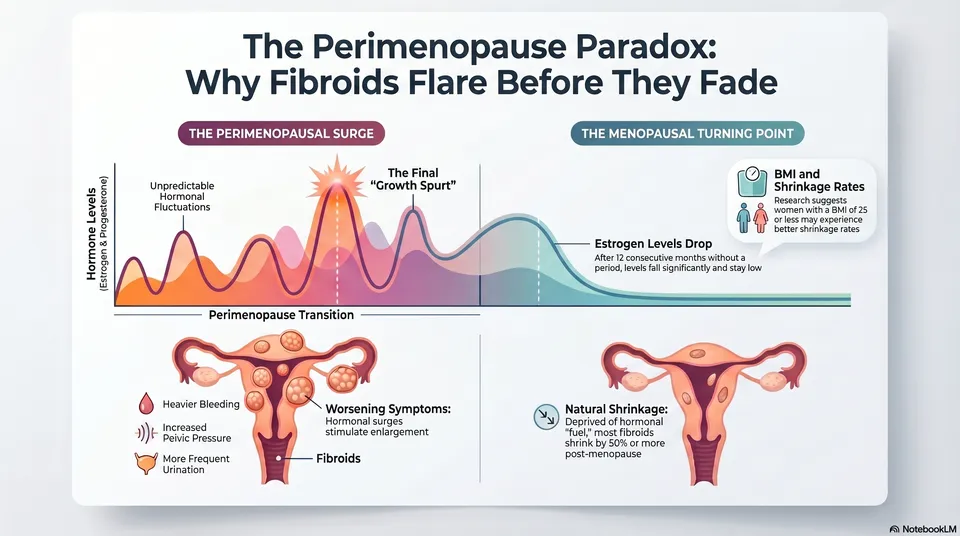
Why do uterine fibroids often experience a temporary worsening of symptoms before they shrink post-menopause?
Existing gynaecological conditions do not always disappear neatly at menopause, especially during the fluctuating perimenopause years.
Direct answer
Fibroid symptoms can worsen during perimenopause because hormone fluctuations may still drive bleeding and bulk symptoms before ovarian hormone levels fall more consistently after menopause. Heavy, prolonged or new bleeding should be assessed, especially after menopause or when anaemia is possible. Pain, heavy bleeding or postmenopausal bleeding should be reviewed rather than assumed to be a normal transition.
A useful answer explains symptom change, bleeding safety and treatment decisions without promising that menopause will cure the condition.
Educational only. Suitability and next steps should be confirmed after consultation. Results vary. Not a cure.

Complex gynaecology
At a glance
These are the main points to understand before deciding whether tracking, testing, treatment review or specialist input may be needed.
At a glance
Practical clinical summary
Main area
Gynaecology
Pattern
Pain or bleeding change
Watch for
Heavy or new bleeding
Next step
Gynaecology review
Important safety note
Heavy, persistent, postcoital or postmenopausal bleeding should be assessed, especially with fibroids, adenomyosis, endometriosis or HRT use.
History
Medicines
Assessment
Safety
Detailed answer
Detailed answer
The deeper answer starts by separating a plausible menopause contribution from the other clinical causes that still need consideration.
Perimenopause hormone swings
The reader has been told fibroids shrink after menopause but is experiencing worse symptoms now.
Overlap
Review
Red flags
Perimenopause hormone swings
Start with the exact symptom pattern and what has changed from the person's usual baseline.
Heavy bleeding and anaemia
Consider menopause as one possible contributor alongside existing diagnoses, medicines, sleep, pain, stress and general health.
Bulk symptoms
The most useful plan explains what can be monitored, what needs assessment and what should not be changed without advice.
Postmenopause expectations
Specialist input may be needed when symptoms are severe, progressive, treatment-resistant or diagnostically unclear.
How the research shapes the answer
The research supports treating gynaecology as a menopause-aware question, not a menopause-only explanation.
The benchmark shaped the search intent and structure, but final wording avoids mechanism certainty, medicine promises, product promotion and dismissal of unusual symptoms.
Patient safety
Why this matters
Complex symptoms can leave patients feeling disbelieved. A strong answer should validate the pattern while still protecting clinical safety.
Menopause may contribute
Hormonal change can be one factor, but it should not be treated as the only explanation.
The underlying condition matters
Existing diagnoses, medicines, sleep, pain, stress and general health can all change the pattern.
Evidence varies by topic
Some mechanisms are well described, while others are plausible but less certain.
Specialist input may be needed
Complex, worsening or unusual symptoms may need GP review or specialist assessment.
Validation with boundaries
The symptom can be real and still need careful assessment rather than a single simple explanation.
That balance is especially important when symptoms involve seizures, breathing, bleeding, severe pain, panic, allergy or medication control.
Considerations
What to consider
A consultation should review the symptom pattern, relevant history, medicines, red flags, previous diagnoses and whether monitoring, testing or referral is needed.
Consultation priorities
Bring a timeline, triggers, medicines, existing diagnoses, treatment changes, test results and examples of how symptoms affect daily life.
Triggers
Medicines
Referral
Track the pattern
Record timing, triggers, severity, medicines, cycle or HRT context and what has changed from baseline.
Look for non-menopause causes
Infection, anaemia, thyroid disease, medication effects, inflammation, injury and other diagnoses can overlap.
Ask what would change management
Useful review focuses on whether testing, treatment, referral or monitoring would alter the plan.
Avoid self-adjusting treatment
Prescription medicines, hormone treatment, restrictive diets and devices should be discussed before major changes.
What not to assume
Do not assume that menopause explains every new symptom, or that unusual symptoms are imaginary because they are not commonly discussed.
Patterns over time matter; a clear timeline is often more useful than one isolated episode or one isolated test result.
Common concerns and myths
Common misconceptions
These corrections reduce false certainty and keep the answer clinically grounded.
Myth: Fibroids always shrink before symptoms worsen
Reality: the right interpretation depends on symptoms, history, severity, medicines, red flags and examination where needed.
Myth: Heavy bleeding is harmless in perimenopause
Reality: menopause can contribute to the picture, but it should not replace assessment of other causes.
Myth: Postmenopausal fibroid symptoms can be ignored
Reality: menopause can contribute to the picture, but it should not replace assessment of other causes.
One symptom can have several causes
Menopause may change vulnerability, but clinical context decides what should happen next.
Self-management has limits
Tracking and lifestyle steps may help, but they should not delay urgent care, medicine review or specialist assessment when needed.
Safety checklist
Safety checklist
Use these checks to decide whether routine tracking is enough or whether advice should be escalated.
Has the pattern changed clearly?
A new, worsening or unusual pattern is more important than a symptom that is stable and familiar.
Could medicines or another diagnosis be involved?
Prescription medicines, chronic conditions, sleep, infection, inflammation and stress can all change symptoms.
Is function affected?
Work, driving, sleep, breathing, mobility, sex, safety, mood or daily activities are useful markers of severity.
Is specialist input needed?
Epilepsy, respiratory, gynaecology, oral medicine, mental-health, physiotherapy or medication review may be relevant.
More reassuring signs
The situation is more reassuring when symptoms are mild, stable, explainable, improving and there are no red flags.
Tracked
No red flags
Reasons to seek advice
Heavy, persistent, postcoital or postmenopausal bleeding should be assessed, especially with fibroids, adenomyosis, endometriosis or HRT use.
Progressive
Unsafe
When to escalate
When to seek medical help
These symptoms or situations should not be managed with general menopause advice alone.
Use NHS 111 online
Sudden or severe change
New severe pain, collapse, chest symptoms, stroke-like symptoms or sudden neurological change needs urgent help.
Persistent or progressive symptoms
Symptoms that are worsening, one-sided, unexplained or limiting daily function should be assessed.
Bleeding or infection signs
Postmenopausal bleeding, heavy bleeding, fever, discharge, non-healing wounds or feeling very unwell needs review.
Mental-health or allergy crisis
Suicidal thoughts, feeling unsafe, severe panic, swelling, breathing difficulty or collapse needs urgent support.
Use NHS 111 for urgent advice or call 999 in a life-threatening emergency. This page is educational and does not replace individual medical assessment.
Additional clinical context
How to use this answer
Use this page to prepare a structured conversation about symptom timing, triggers, severity, medicines and whether menopause is one factor among others.What to bring to a conversation
Helpful details include a symptom diary, current medicines, existing diagnoses, relevant test results, red-flag symptoms, treatment changes and what decision you need help making.Regulatory resources
Authoritative resources
These resources support UK-facing information on endometriosis, adenomyosis, fibroids, menopause and complex HRT decisions.
Next step
Book a clinical consultation
A consultation can review pain, bleeding, imaging history, previous treatment, HRT questions and whether specialist gynaecology input is needed.
▶ View Research Sources (12 Sources)
These 12 source names are selected from 12 display-ready sources, with a raw audit trail of 62 imported records. Additional reviewed material included UK clinical guidance, professional society guidance, peer-reviewed clinical papers; duplicate, low-relevance and non-clinical records were removed before display.
Educational only. This information is for education only and is not a substitute for professional medical advice, diagnosis or treatment. Results vary. Not a cure.
