



How should I document a family history of blood clots, breast cancer, or ca... | WHC Clinical FAQ

How should I document a family history of blood clots, breast cancer, or cardiovascular disease f...
Family history
Risk review
HRT discussion
Women’s Health Clinic FAQ
How should I document a family history of blood clots, breast cancer, or cardiovascular disease for my appointment?
Family history is most useful in a menopause appointment when it is specific enough to help the clinician understand risk rather than a vague worry.
Direct answer
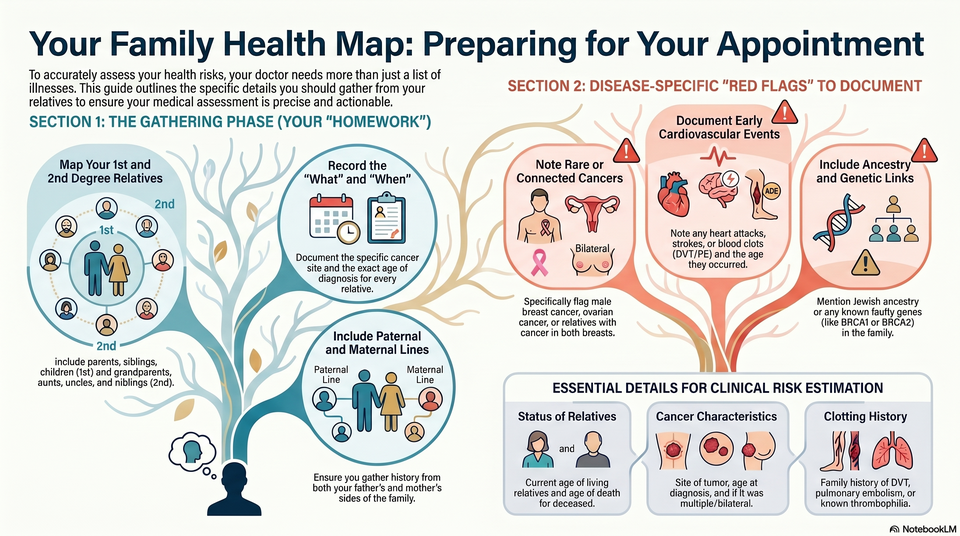
Family history is most useful when it is specific: which relative was affected, whether they were first-degree, the diagnosis, age at diagnosis, clot type, cancer type or cardiovascular event. This helps clinicians discuss HRT route, alternatives and whether specialist advice is needed. Specific details help the clinician individualise risk rather than making assumptions from vague family history.
A strong answer explains what details to bring and how those details may shape HRT route, alternatives or referral discussion.
Educational only. Suitability and next steps should be confirmed after consultation. Results vary. Not a cure.

Family history
At a glance
These are the main points to understand before deciding whether tracking, testing, referral or urgent review is needed.
At a glance
Practical clinical summary
Main area
Risk history
Pattern
Specific details
Watch for
Vague history
Next step
Document clearly
Important safety note
A family history of clots, breast cancer or cardiovascular disease does not automatically rule out every menopause option, but it should be discussed carefully.
History
Testing
Review
Safety
Detailed answer
Detailed answer
The deeper answer starts by separating guideline-led diagnosis from situations where tests, contraception, bleeding patterns or referral change the clinical pathway.
First-degree relatives
The reader wants to prepare risk information before an HRT or menopause appointment.
Pattern
Exceptions
Red flags
First-degree relatives
Start with the specific clinical question, because blood tests, cycle tracking, contraception, bleeding and referral each change the reasoning.
Age at diagnosis
Age, cycle pattern, symptom impact, medicines and contraception usually explain more than one isolated result.
Clot history
The useful plan should say what information changes management and what would not add clarity.
Breast cancer details
Safety-netting matters when there is bleeding, pain, breast change, persistent bloating, severe mood symptoms or diagnostic uncertainty.
How the research shapes the answer
The research supports specific family-history documentation to help individualise HRT, referral and risk-benefit discussions.
The benchmark shaped the search intent and structure, but final wording avoids false certainty, legal overclaiming, product promotion and dismissive language.
Patient safety
Why this matters
Patients often want a clear answer because uncertainty can feel dismissive. The safest page should explain the reasoning and show what to do next.
Specifics change risk review
The affected relative, diagnosis and age at diagnosis help clinicians interpret risk more accurately.
Route can matter
Family or personal clot risk may influence discussion of oral versus transdermal options where HRT is suitable.
History is not always exclusion
Some family histories change counselling rather than ruling out every option.
Personal history matters too
Your own clot, cancer, migraine, heart, liver or bleeding history is also important.
Clear reasoning, not dismissal
A guideline-led answer should still feel respectful and practical.
It should help the reader prepare for the right conversation instead of chasing certainty from the wrong test.
Considerations
What to consider
A consultation should review first-degree relatives, age at diagnosis, clot type, cancer type, cardiovascular events and personal risk factors.
Consultation priorities
Bring age, last period if relevant, cycle or bleeding pattern, contraception, medicines, symptoms, family history, previous advice and what decision you need next.
Symptoms
Medication
Safety
List first-degree relatives
Parent, sibling or child history is especially useful, with age and diagnosis if known.
Separate clot types
Deep vein thrombosis, pulmonary embolism and stroke are not interchangeable.
Clarify cancer details
Breast cancer type, age at diagnosis and genetic testing history may matter.
Bring medication history
Past HRT, contraception, anticoagulants and current medicines help risk discussion.
What not to assume
Do not assume every symptom needs a hormone test, or that lack of testing means symptoms are being dismissed.
Family history is most useful when prepared before the appointment, so risk discussion can focus on decisions rather than reconstruction.
Common concerns and myths
Common misconceptions
Menopause diagnosis advice can become overconfident about tests or too dismissive of symptoms. These corrections keep it balanced.
Myth: Any family history rules out HRT
Reality: a specific, well-prepared history is more useful than a broad assumption or one isolated result.
Myth: Only breast cancer history matters
Reality: a specific, well-prepared history is more useful than a broad assumption or one isolated result.
Myth: Vague family stories are enough
Reality: a specific, well-prepared history is more useful than a broad assumption or one isolated result.
Symptoms are valid
A symptom-led diagnosis is not a guess when it follows age, pattern and guideline-based reasoning.
Tests have limits
The right test is the one that changes the clinical plan, not the one that simply feels more certain.
Safety checklist
Safety checklist
Use these checks to decide whether routine review is enough or whether advice should be more urgent.
Is the pattern typical?
Age, cycle change, symptoms and contraception all affect whether the pattern is expected.
Would a test change the plan?
Testing is most useful when it changes diagnosis, treatment or referral decisions.
Are red flags present?
Bleeding after menopause, breast changes, pelvic pain or persistent bloating should be assessed.
Is follow-up agreed?
If symptoms continue, the plan should include review rather than leaving uncertainty open-ended.
More reassuring signs
The situation is more reassuring when symptoms fit a typical pattern, are not severe, and there are no bleeding, pain, breast or systemic red flags.
No red flags
Reviewed
Reasons to seek advice
A family history of clots, breast cancer or cardiovascular disease does not automatically rule out every menopause option, but it should be discussed carefully.
Pain
Breast change
When to escalate
When to seek medical help
These symptoms should not be managed with general menopause reassurance alone.
Use NHS 111 online
Clot symptoms
Chest pain, severe breathlessness, coughing blood or one-sided leg swelling needs urgent help.
Breast changes
A new lump, nipple discharge, skin dimpling or shape change should be assessed.
Stroke-like symptoms
Face drooping, arm weakness or speech change needs emergency care.
Unusual bleeding
Postmenopausal bleeding or bleeding after sex should be reviewed.
Use NHS 111 for urgent advice or call 999 in a life-threatening emergency. This page is educational and does not replace individual medical assessment.
Additional clinical context
How to use this answer
Use this page to understand what information helps diagnosis, when tests are useful and which symptoms should be assessed promptly.What to bring to an appointment
Helpful details include age, last period, cycle dates, bleeding pattern, contraception, medicines, family history, symptom impact, previous test results and the question you want answered.Regulatory resources
Authoritative resources
These resources support UK-facing information on individualised risk review, blood clots, breast cancer and cardiovascular family history.
Next step
Book a clinical consultation
A consultation can review family history, personal risk factors, symptoms, treatment preferences and whether specialist advice is needed.
▶ View Research Sources (12 Sources)
These 12 source names are selected from 12 display-ready sources, with a raw audit trail of 42 imported records. Additional reviewed material included UK clinical guidance, professional society guidance, peer-reviewed clinical papers; duplicate, low-relevance and non-clinical records were removed before display.
Educational only. This information is for education only and is not a substitute for professional medical advice, diagnosis or treatment. Results vary. Not a cure.

