

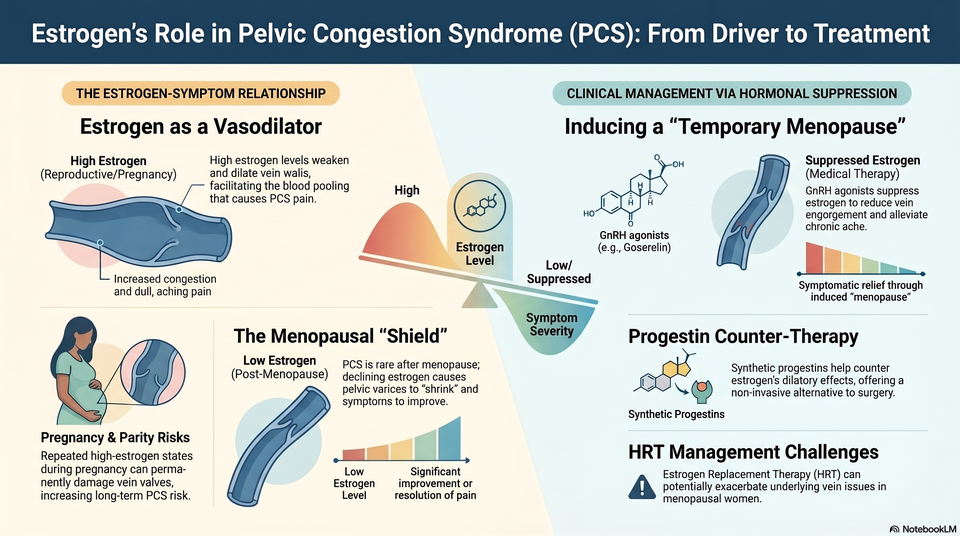


How does the decline of estrogen impact the clinical management and symptom severity of Pelvic Co...

Can the drop in oestrogen worsen symptoms of Pelvic Organ Prolapse (POP) that were previously man...

Can the drop in oestrogen worsen symptoms of Pelvic Organ Prolapse (POP) th... | WHC Clinical FAQ
Pelvic pain
Venous tone
Evidence limits
Women’s Health Clinic FAQ
How does the decline of oestrogen impact the clinical management and symptom severity of Pelvic Congestion Syndrome (PCS)?
Pelvic congestion syndrome and menopause do not follow a simple rule, because venous pain, pelvic anatomy, imaging and hormone questions can all overlap.
Direct answer
Oestrogen may influence venous tone, but pelvic congestion syndrome symptoms do not follow a simple menopause rule. Pelvic pain, venous history, imaging, previous procedures and HRT questions should be reviewed with gynaecology or interventional radiology input where needed. The safest next step is to separate venous pelvic pain from menopause symptoms and review HRT questions individually.
The answer should explain the plausible vascular biology without claiming that menopause or HRT predictably improves or worsens PCS.
Educational only. Suitability and next steps should be confirmed after consultation. Results vary. Not a cure.

Pelvic venous care
At a glance
These are the main points to understand before deciding whether symptoms are expected, need planned review or need urgent advice.
At a glance
Practical clinical summary
Main area
Pelvic venous symptoms
Pattern
Chronic pelvic pain
Watch for
New pain pattern
Next step
Gynaecology or IR review
Important safety note
New severe pelvic pain, unexplained bleeding, fever, fainting, pregnancy possibility or rapidly worsening symptoms should not be managed as routine PCS.
Symptoms
Evidence
Review
Safety
Detailed answer
Detailed answer
The deeper answer starts by separating menopause-related change from the underlying condition, procedure, anatomy, exposure or neurodivergent context.
Venous tone
The reader wants to know whether declining oestrogen worsens or improves PCS and whether HRT is safe.
Limits
Monitoring
Red flags
Venous tone
Start with the exact history because previous surgery, diagnosis, anatomy, workplace exposure or neurodivergent profile can change the interpretation.
Pain pattern
Clarify what is new, what is familiar, what is severe and what follows a known pattern.
Imaging and diagnosis
Where the evidence is limited, the page should say so clearly rather than turning a plausible mechanism into certainty.
HRT uncertainty
Follow-up should be matched to symptoms, risk factors, specialist history and whether treatment or monitoring needs review.
How the research shapes the answer
The research supports treating pelvic venous symptoms as a context-led clinical question rather than a simple menopause explanation.
The benchmark shaped search intent and structure, but final wording avoids dose advice, product promotion, mechanism certainty and treatment promises.
Patient safety
Why this matters
These topics matter because menopause symptoms can overlap with rare, specialist or under-recognised conditions where generic advice may be misleading.
Context changes meaning
The same menopause symptom can mean something different when there is previous surgery, vascular disease, neurodivergence, workplace exposure or pelvic infection history.
Evidence has boundaries
Some links are biologically plausible, but the research rarely supports simple cause-and-effect claims for complex conditions.
Monitoring protects safety
Bleeding pattern, pain, scans, symptom diaries, medicines, heart symptoms, anaemia or functional change may alter the next step.
Specialist input may matter
Gynaecology, cardiology, haematology, vascular, pelvic-health, mental-health or occupational-health review may be needed depending on the history.
Useful, not overconfident
A strong answer helps the reader prepare for review without pretending online information can settle a complex medical question.
It should validate the concern, explain the most relevant mechanism and keep safety thresholds visible.
Considerations
What to consider
A consultation should connect the menopause symptoms with the relevant diagnosis, procedure, anatomy, exposure, medicine, scan history or functional change.
Consultation priorities
Bring the most specific details: dates, diagnoses, operation or scan reports, medicines, symptom diary, bleeding pattern, functional changes and the decision you need help with.
Pattern
Monitoring
Specialist input
Bring the relevant history
Include operation reports, scans, diagnoses, medicines, device details, bleeding records, symptom diaries and specialist letters where available.
Separate overlapping symptoms
Clarify what feels hormonal, what matches the known condition and what is new, severe or different.
Avoid self-changing treatment
Do not stop, start or adjust HRT, local oestrogen, anticoagulants, cardiac medicines, ADHD medicines, devices or specialist plans without advice.
Plan follow-up
Complex histories often need review after treatment changes, symptom tracking or new investigation rather than a one-off answer.
What not to assume
Do not assume menopause explains every change or that HRT, local oestrogen, exercise, tracking or reassurance replaces condition-specific review.
Timing matters because new symptoms after a procedure, treatment change, exposure, flare or period change may need a different level of review.
Common concerns and myths
Common misconceptions
These corrections keep the answer practical, respectful and clinically cautious.
Myth: Menopause always cures pelvic congestion
Reality: the answer depends on the exact history, symptom pattern, risk factors, anatomy, medicines and monitoring plan.
Myth: HRT is automatically contraindicated in PCS
Reality: the answer depends on the exact history, symptom pattern, risk factors, anatomy, medicines and monitoring plan.
Myth: Pelvic pain with PCS never needs reassessment
Reality: menopause may be part of the picture, but it should not replace assessment of the underlying condition or history.
Mechanism is not certainty
Hormone change can be relevant without being the only cause or a complete treatment target.
Safety remains specific
Bleeding, chest pain, clot symptoms, severe pelvic pain, fainting, aneurysm symptoms or crisis symptoms need the right pathway.
Safety checklist
Safety checklist
Use these checks to decide what can wait for routine discussion and what needs faster advice.
Is the history complex?
Previous pelvic surgery, vascular disease, thrombophilia, HHT, POTS, AAA, PID, neurodivergence or occupational exposure can change the answer.
Is anything new or severe?
New bleeding, severe pain, chest symptoms, fainting, unusual discharge, major sleep loss or sudden functional collapse should not be normalised.
Are medicines or devices involved?
HRT, local oestrogen, anticoagulants, cardiac medicines, ADHD medicines, pelvic devices and previous repairs need clinician-led decisions.
What evidence is available?
Scans, operation notes, blood tests, symptom diaries, exposure records and specialist letters can make the review more accurate.
More reassuring signs
The situation is more reassuring when symptoms are mild, familiar, improving, already assessed and not linked with bleeding, chest symptoms, severe pain or crisis signs.
Mild
Reviewed
Reasons to seek advice
New severe pelvic pain, unexplained bleeding, fever, fainting, pregnancy possibility or rapidly worsening symptoms should not be managed as routine PCS.
New
Severe
When to escalate
When to seek medical help
These symptoms should not be managed with general menopause advice alone.
Use NHS 111 online
Emergency symptoms
Chest pain, severe breathlessness, collapse, stroke-like symptoms, severe bleeding or sudden severe abdominal, back or pelvic pain needs urgent help.
New or worsening bleeding
Postmenopausal bleeding, heavy bleeding, black stools, coughing blood or bleeding with pain should be assessed.
Specialist-condition change
New neurological symptoms, fainting, worsening POTS symptoms, uncontrolled bleeding, clot symptoms or aneurysm symptoms need appropriate clinical advice.
Mental-health crisis
Feeling unsafe, suicidal thoughts, severe burnout or major functional collapse should prompt urgent mental-health or clinical support.
Use NHS 111 for urgent advice or call 999 in a life-threatening emergency. This page is educational and does not replace individual medical assessment.
Additional clinical context
How to use this answer
Use this page to organise the key facts before a clinical review. The aim is to make the question clearer, not to decide treatment without assessment.What to bring to a consultation
Helpful details include diagnosis letters, operation or scan reports, medication lists, device details, symptom timing, bleeding pattern, exposure context, functional impact and any previous specialist advice.Regulatory resources
Authoritative resources
These resources support UK-facing information on pelvic pain, pelvic venous disease, menopause care and interventional review.
Next step
Book a clinical consultation
A consultation can review pain pattern, imaging, previous embolisation, medicines, HRT questions and whether gynaecology or interventional radiology advice is appropriate.
▶ View Research Sources (12 Sources)
These 12 source names are selected from 12 display-ready sources, with a raw audit trail of 57 imported records. Additional reviewed material included UK clinical guidance, professional society guidance, peer-reviewed clinical papers, clinical trial records; duplicate, low-relevance and non-clinical records were removed before display.
Educational only. This information is for education only and is not a substitute for professional medical advice, diagnosis or treatment. Results vary. Not a cure.

