


Can menopause trigger or accelerate the onset of a sluggish thyroid (hypoth... | WHC Clinical FAQ

Can menopause trigger or accelerate the onset of a sluggish thyroid (hypothyroidism)?

What exactly is Hormone Replacement Therapy (HRT) and how does it work? | WHC Clinical FAQ
Thyroid
TSH monitoring
Route aware
Women’s Health Clinic FAQ
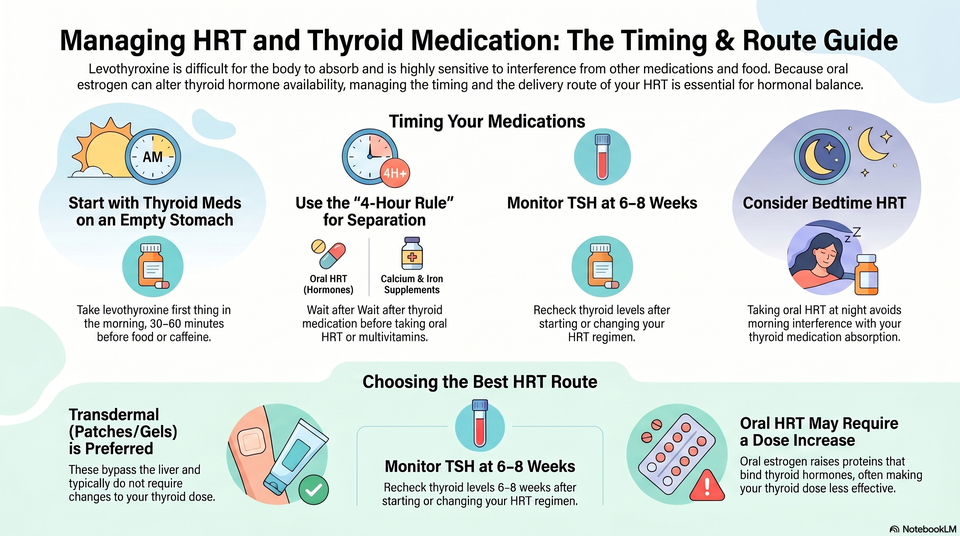
How should a woman manage the timing of her HRT if she is also taking thyroid hormone replacement therapy (levothyroxine)?
Thyroid replacement and HRT can often be managed together, but monitoring matters because symptoms and blood tests can overlap.
Direct answer
HRT and levothyroxine can usually be managed together, but oral oestrogen may increase thyroid-binding globulin and alter thyroid hormone requirements in some women. TSH monitoring after starting or changing HRT is more important than trying to separate doses by guesswork. The safest next step is planned thyroid monitoring after HRT changes rather than adjusting thyroid replacement by symptoms alone.
A useful answer explains oral oestrogen, thyroid-binding globulin and TSH review in plain English.
Educational only. Suitability and next steps should be confirmed after consultation. Results vary. Not a cure.

Thyroid and HRT
At a glance
These are the main points to understand before deciding whether a medicine, device, contraception or HRT plan needs review.
At a glance
Practical safety summary
Main area
Thyroid and HRT
Pattern
Monitoring after change
Watch for
Symptom overlap
Next step
TSH review
Important safety note
Levothyroxine dose changes should be guided by thyroid blood tests and clinician review, especially after starting or changing HRT.
Device
Monitoring
Risk review
Follow-up
Detailed answer
Detailed answer
The deeper answer starts by separating the role of HRT from contraception, disease treatment, medical devices and ongoing medicine monitoring.
Oral oestrogen and TBG
The reader wants a safe timing and monitoring answer for thyroid replacement and HRT.
Monitoring
Interactions
Red flags
Oral oestrogen and TBG
Start with the exact treatment, device or method involved, because the safe answer changes with the details.
Transdermal route difference
Clarify whether the question is about symptom control, contraception, endometrial protection, disease control, device accuracy or medicine levels.
TSH monitoring
The safest plan usually includes monitoring rather than self-adjusting treatment.
Symptom overlap
Follow-up should be planned when HRT, contraception, psychiatric medicines, anti-seizure medicines, anticoagulants, thyroid replacement or devices are involved.
How the research shapes the answer
The research supports treating thyroid and hrt as a structured safety and monitoring question rather than a simple yes-or-no HRT answer.
The benchmark shaped the search intent and structure, but final wording avoids dose advice, brand promotion, mechanism certainty and treatment promises.
Patient safety
Why this matters
These questions matter because a small wording mistake can blur contraception, HRT, disease control, medicine monitoring or device safety.
Roles must be separated
HRT, contraception, disease treatment, device performance and medicine monitoring each answer different clinical questions.
Monitoring changes the plan
Readings, bleeding pattern, insertion date, side effects, symptom timing or blood tests may alter what is safest.
Evidence has limits
Some mechanisms are well understood, while others are plausible but not enough to guide self-adjustment.
Individual review matters
Complex medicines, devices, neurological disease, anticoagulation or hormone-sensitive history usually need tailored advice.
Precision protects safety
The most useful answer is clear enough to prepare a consultation but careful enough not to replace one.
This is especially important when medicines, devices, neurological conditions, anticoagulation, thyroid replacement or pelvic devices are involved.
Considerations
What to consider
A consultation should review exact medicines or device details, symptom timing, monitoring results, risks, red flags and who should coordinate follow-up.
Consultation priorities
Bring the exact method, medicine or device details, dates, readings, blood tests, bleeding pattern, side effects and what decision you need help making.
Readings
Side effects
Specialist input
Bring the exact details
List medicine names, dose schedule, device type, insertion date, HRT route, readings, side effects and symptom timing.
Ask what should be monitored
Useful review may involve bleeding pattern, TSH, INR, lithium level, seizure diary, glucose trends or mood symptoms.
Avoid changing treatment alone
Do not stop, start or adjust prescription medicines, HRT, contraception or devices without advice.
Clarify who owns follow-up
GP, menopause clinician, pharmacist, neurology, psychiatry, diabetes, haematology, thyroid or pelvic-health teams may each have a role.
What not to assume
Do not assume that HRT solves, worsens or replaces another treatment without reviewing the details.
Timing matters: symptoms, readings or bleeding after starting, stopping or changing HRT may need planned review rather than guesswork.
Common concerns and myths
Common misconceptions
These corrections keep the answer safe and prevent treatment roles being mixed together.
Myth: HRT and levothyroxine cannot be used together
Reality: monitoring and clinician review should guide changes, not a single assumption about hormones.
Myth: Timing alone prevents all interaction
Reality: monitoring and clinician review should guide changes, not a single assumption about hormones.
Myth: Menopause symptoms and hypothyroid symptoms are easy to separate
Reality: monitoring and clinician review should guide changes, not a single assumption about hormones.
Treatment roles are different
Contraception, womb protection, HRT symptom control, disease treatment and device monitoring are not interchangeable.
Monitoring is part of care
The right monitoring may involve symptoms, bleeding, blood tests, medicine levels, device readings or specialist review.
Safety checklist
Safety checklist
Use these checks to decide what needs routine discussion, planned monitoring or urgent review.
Is a prescription medicine involved?
Lithium, lamotrigine, stimulants, anticoagulants, thyroid replacement, psychiatric medicines and HRT should not be adjusted without advice.
Is a device or insertion date relevant?
Coils, pessaries, mesh, CGM sensors and patches need exact device details, dates and follow-up context.
Are readings or symptoms changing?
CGM trends, INR, TSH, lithium levels, seizures, mood, bleeding or device symptoms can all change the urgency.
Who needs to review it?
GP, pharmacist, menopause clinician, neurology, psychiatry, diabetes, haematology, thyroid or pelvic-health teams may need to coordinate.
More reassuring signs
The situation is more reassuring when symptoms are stable, monitoring is current, device instructions are being followed and there are no red flags.
Monitored
Reviewed
Reasons to seek advice
Levothyroxine dose changes should be guided by thyroid blood tests and clinician review, especially after starting or changing HRT.
Unstable
Unclear
When to escalate
When to seek medical help
These symptoms or situations should not be managed with general menopause advice alone.
Use NHS 111 online
Emergency symptoms
Chest pain, severe breathlessness, collapse, stroke-like symptoms, severe allergic reaction or life-threatening bleeding needs emergency help.
Medicine toxicity or control loss
Lithium toxicity symptoms, severe hypoglycaemia, seizure change, uncontrolled mood symptoms or dangerous readings need urgent advice.
Bleeding or clot symptoms
Postmenopausal bleeding, heavy bleeding, one-sided leg swelling, coughing blood or sudden severe pain should be assessed.
Device or pelvic complications
Mesh exposure symptoms, severe skin reactions, device failure, ulceration, discharge or severe pessary pain needs review.
Use NHS 111 for urgent advice or call 999 in a life-threatening emergency. This page is educational and does not replace individual medical assessment.
Additional clinical context
How to use this answer
Use this page to prepare a precise review of medicines, contraception, devices, HRT route, monitoring results and red flags.What to bring to a consultation
Helpful details include medicine names, dose schedule, device type, insertion or start dates, recent readings or blood tests, bleeding pattern, side effects and who currently manages the related condition.Regulatory resources
Authoritative resources
These resources support UK-facing information on hypothyroidism, levothyroxine, HRT route, thyroid-binding globulin and monitoring.
Next step
Book a clinical consultation
A consultation can review HRT route, levothyroxine timing, symptoms, recent TSH results and whether repeat thyroid monitoring is needed.
▶ View Research Sources (11 Sources)
These 11 source names are selected from 12 display-ready sources, with a raw audit trail of 51 imported records. Additional reviewed material included UK clinical guidance, professional society guidance, peer-reviewed clinical papers; duplicate, low-relevance and non-clinical records were removed before display.
Educational only. This information is for education only and is not a substitute for professional medical advice, diagnosis or treatment. Results vary. Not a cure.
