
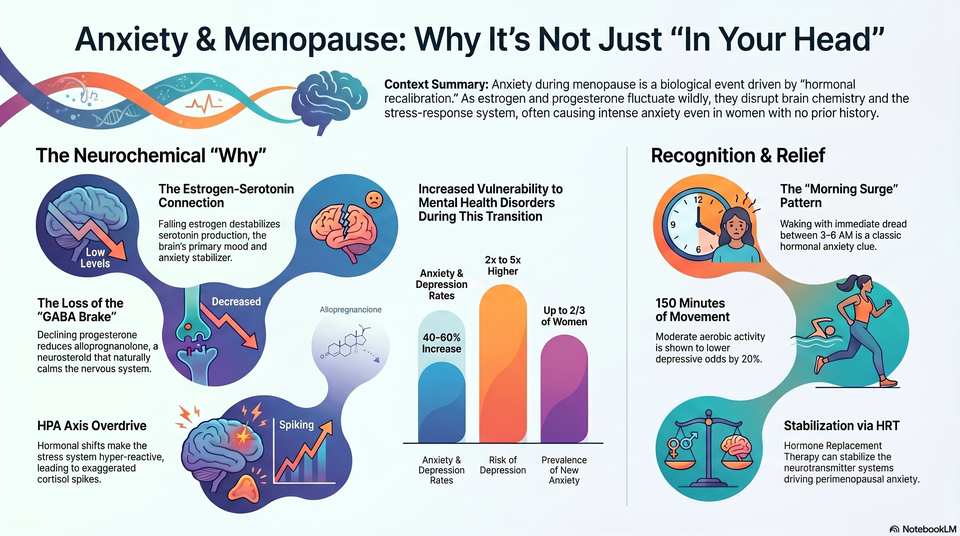

Why is my anxiety suddenly through the roof during the menopause transition?

Why is my anxiety suddenly through the roof during the menopause transition... | WHC Clinical FAQ

Can menopause cause severe mood swings and sudden rage?
Mood aware
Brain fog
Support first
Women’s Health Clinic FAQ
Why is my anxiety suddenly through the roof during the menopause transition?
Mood, anxiety and brain fog in perimenopause can feel frightening because they affect confidence, relationships, work and the sense of feeling like yourself.
Direct answer
Anxiety can worsen during the menopause transition because hormone fluctuation, sleep disruption, hot flushes, palpitations, stress load and previous anxiety vulnerability can interact. It still deserves proper assessment and support. Clinical context matters because age, bleeding pattern, symptom timing, contraception, medicines and medical history can change the safest interpretation. Seek review if symptoms are severe, unusual, persistent or difficult to explain. This keeps the answer practical without turning normal variation into false reassurance.
The safest answer validates symptoms while separating hormonal contribution, sleep disruption, mental-health history and situations needing urgent support.
Educational only. Suitability and next steps should be confirmed after consultation. Results vary. Not a cure.

Mood and brain fog
At a glance
These are the main points to understand before deciding whether symptoms are expected, need routine review or should be assessed promptly.
At a glance
Practical clinical summary
Main area
Mood and cognition
Pattern
Fluctuating symptoms
Watch for
Risk or escalation
Next step
Supportive assessment
Important safety note
Severe anxiety, rage, panic, low mood, intrusive thoughts or symptoms that feel unsafe deserve prompt support and should not be dismissed as just menopause.
Symptoms
Mechanism
Review
Safety
Detailed answer
Detailed answer
The deeper answer starts by matching the symptom or definition to the right phase of menopause, tissue change or pelvic-health pathway.
Hormone fluctuation and anxiety
The reader wants to know why anxiety has suddenly worsened and whether menopause can contribute.
Pattern
Assessment
Support
Hormone fluctuation and anxiety
This is the first distinction because it shapes whether the answer is about definition, ovarian signalling, tissue health, bladder symptoms or pelvic support.
Sleep and physical triggers
Symptoms should be interpreted alongside age, timing, cycle pattern, severity, medical history and whether the change is new or worsening.
Panic versus palpitations
Management should be discussed as a set of options rather than one automatic route, especially where hormones, bleeding, urinary symptoms or pelvic pain are involved.
Mental health history
Follow-up matters when symptoms persist, affect sleep, sex, bladder function or daily life, or when the diagnosis is uncertain.
How the research shapes the answer
• High Misdiagnosis Rates: Due to clinical training gaps, perimenopausal anxiety is frequently misdiagnosed as generalized anxiety disorder, panic disorder, adult-onset ADHD, or thyroid issues. • Unreliable Testing: Blood tests for hormones (like FSH and oestradiol) are notoriously unreliable for diagnosing perimenopause.
The benchmark was used for search intent and structure, but final wording was kept cautious, UK-facing and clinically useful.
Patient safety
Why this matters
Menopause can affect comfort, sleep, bleeding patterns, sexual health, urinary symptoms, confidence and long-term health, but not every symptom has the same cause.
It avoids missed causes
Symptoms that sound menopausal can also involve thyroid disease, pregnancy, infection, skin conditions, medication effects, prolapse or abnormal bleeding.
It validates symptoms
Being common does not make a symptom trivial; sleep loss, dryness, urgency or unpredictable bleeding can affect daily life and relationships.
It guides treatment choice
The right plan may involve reassurance, lifestyle support, pelvic-health care, non-hormonal options, hormone discussion, investigation or referral.
It keeps safety visible
Bleeding after menopause, severe pain, recurrent infection symptoms or rapid change should be checked rather than folded into a general menopause label.
Calm, individualised care
A strong answer should make the biology understandable without turning normal variation into fear.
It should also show when symptoms deserve help, because many menopause concerns are manageable once the cause is clear.
Considerations
What to consider
A consultation should confirm the likely cause, relevant history, examination or tests if needed, treatment options, follow-up and when another pathway is safer.
Consultation priorities
The consultation should clarify symptoms, age, period history, contraception, medical history, medicines, personal priorities and any red flags.
Pattern
Options
Follow-up
Before deciding
Check whether the question is about normal transition, early menopause, GSM, urinary symptoms, pelvic-floor change or bleeding that needs assessment.
Testing boundaries
Blood tests are not always useful in typical menopause after 45, but younger age, POI concern or unclear symptoms may need a different approach.
Treatment discussion
Treatment choices should be matched to symptoms, health background, personal preference, contraindications and realistic goals.
If symptoms change
New bleeding, pelvic pain, recurrent urinary symptoms, breast changes, weight loss, fever or unexplained night sweats should be reviewed.
What not to assume
Do not assume every change after 40 is menopause or that every menopause symptom has to be tolerated.
• Early Perimenopause (typically in a woman's 40s): New-onset anxiety can emerge even while periods are still mostly regular, typically worsening in the late luteal phase (the week before menstruation). • Late Perimenopause: This phase represents the peak risk for anxiety and.
Common concerns and myths
Common misconceptions
Online menopause advice can be either dismissive or overconfident. These corrections keep the answer balanced.
Myth: Anxiety is not a menopause symptom
Reality: the clinical picture depends on age, symptom pattern, history and whether there are features that need review.
Myth: It is just stress
Reality: the clinical picture depends on age, symptom pattern, history and whether there are features that need review.
Myth: Hormones explain every anxiety symptom
Reality: the clinical picture depends on age, symptom pattern, history and whether there are features that need review.
Common does not mean simple
Menopause can explain many patterns, but diagnosis still depends on context, age, bleeding history and symptom detail.
Support should be proportionate
Some symptoms need reassurance and practical advice; others need examination, testing, treatment discussion or referral.
Safety checklist
Safety checklist
Use these checks to decide whether symptoms can be discussed routinely or need more urgent advice.
Is the pattern expected?
Mild, fluctuating symptoms around the transition are different from severe, persistent, one-sided or rapidly worsening symptoms.
Is there unusual bleeding?
Postmenopausal bleeding, bleeding after sex, very heavy bleeding or bleeding with pain should be assessed.
Are bladder or pelvic symptoms present?
Urgency, recurrent UTI symptoms, leakage, pelvic pressure or pain may need urine testing, examination or pelvic-health review.
Is daily life affected?
Sleep loss, painful sex, dryness, mood change, flushes or fatigue are worth discussing when they affect wellbeing.
More reassuring signs
Symptoms are more reassuring when they are mild, improving, already assessed, and not linked with bleeding, fever, severe pain or unexplained weight loss.
Improving
Reviewed
Reasons to seek advice
• Psychiatric Emergencies: Immediate medical evaluation is required if experiencing thoughts of self-harm, suicide, or severe, debilitating depression. • Cardiac Rule-Out: Sudden, intense heart palpitations, shortness of breath, chest tightness, or dizziness should be medically evaluated to rule out cardiac events before.
Severe pain
Infection signs
When to escalate
When to seek medical help
Some symptoms should not be attributed to menopause without assessment.
Use NHS 111 online
Postmenopausal or unusual bleeding
Bleeding after menopause, bleeding after sex, very heavy bleeding or bleeding with pelvic pain should be assessed promptly.
Severe pain or rapid worsening
Sudden pelvic pain, severe vulval pain, urinary retention or rapidly worsening symptoms need medical advice.
Infection or systemic symptoms
Fever, flank pain, blood in urine, foul discharge, feeling very unwell or recurrent UTI symptoms should be checked.
Emergency symptoms
Call 999 for life-threatening symptoms such as collapse, chest pain, breathing difficulty or stroke-like symptoms.
Use NHS 111 for urgent advice or call 999 in a life-threatening emergency. This page is educational and does not replace individual medical assessment.
Additional clinical context
How to use this answer
This page is designed to help patients understand the most likely clinical meaning of the question, then decide what to raise in consultation.What to discuss at appointment
Useful details include age, last period, bleeding pattern, contraception, pregnancy possibility, medical history, medicines, symptom timing, vaginal or urinary symptoms and what feels most disruptive.Regulatory resources
Authoritative resources
These resources support UK-facing information on menopause-related mood, cognition, anxiety and support routes.
NHS - Menopause
UK patient baseline for mood changes, anxiety, memory and concentration symptoms.
NICE NG23 - Menopause: identification and management
UK guideline source for psychological symptoms and treatment boundaries.
Women's Health Concern - The menopause factsheet
Patient-facing UK source for mood, memory and symptom validation.
Next step
Book a clinical consultation
A consultation can review symptom timing, sleep, cycle pattern, mental-health history, medicines and the safest route for support.
▶ View Research Sources (12 Sources)
These 12 source names are selected from 24 display-ready sources, with a raw audit trail of 45 imported records. Additional reviewed material included peer-reviewed clinical papers; duplicate, low-relevance and non-clinical records were removed before display.
Educational only. This information is for education only and is not a substitute for professional medical advice, diagnosis or treatment. Results vary. Not a cure.
