

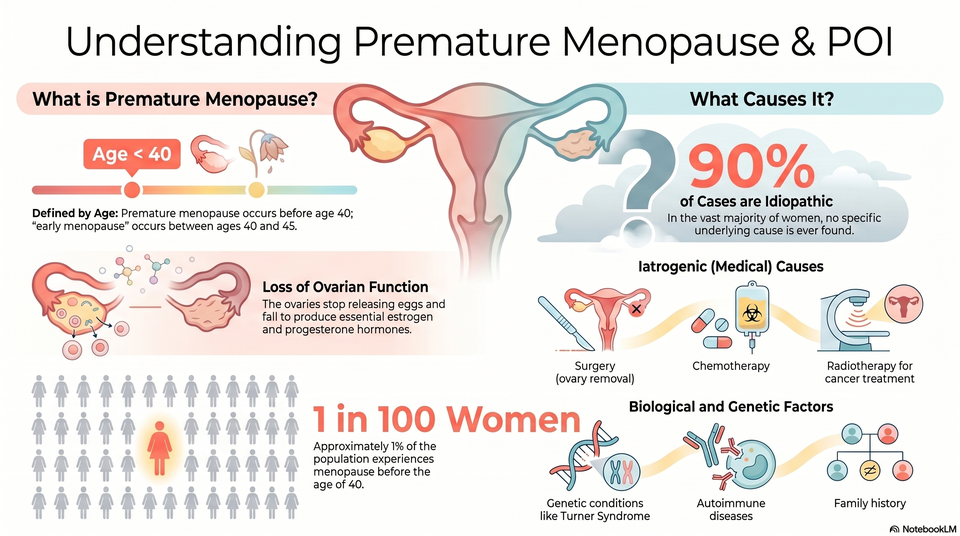


What is premature menopause and what causes it?

What is premature menopause and what causes it? | WHC Clinical FAQ

What is early menopause and how is it defined?
Age matters
POI aware
Specialist review
Women’s Health Clinic FAQ
What is premature menopause and what causes it?
Early or premature menopause can feel especially unsettling because it may affect symptoms, fertility, bone health, heart health and future treatment choices.
Direct answer
Premature menopause means menopause before 40. It may be linked to premature ovarian insufficiency, surgery, cancer treatment, autoimmune conditions, genetic factors or sometimes no identifiable cause. Clinical context matters because age, bleeding pattern, symptom timing, contraception, medicines and medical history can change the safest interpretation. Seek review if symptoms are severe, unusual, persistent or difficult to explain. This keeps the answer practical without turning normal variation into false reassurance.
The safest answer defines the age threshold first, then explains possible causes and why younger patients should not be dismissed.
Educational only. Suitability and next steps should be confirmed after consultation. Results vary. Not a cure.

Early menopause
At a glance
These are the main points to understand before deciding whether symptoms are expected, need routine review or should be assessed promptly.
At a glance
Practical clinical summary
Main area
Ovarian function
Pattern
Before 45
Watch for
Missed periods
Next step
Specialist assessment
Important safety note
Menopause symptoms before 45, and especially before 40, should be assessed rather than assumed to be stress or a normal variation.
Symptoms
Mechanism
Review
Safety
Detailed answer
Detailed answer
The deeper answer starts by matching the symptom or definition to the right phase of menopause, tissue change or pelvic-health pathway.
Definition before 40
The reader wants a medically careful explanation of menopause before 40, POI terminology and possible causes.
Pattern
Assessment
Support
Definition before 40
This is the first distinction because it shapes whether the answer is about definition, ovarian signalling, tissue health, bladder symptoms or pelvic support.
POI terminology
Symptoms should be interpreted alongside age, timing, cycle pattern, severity, medical history and whether the change is new or worsening.
Possible causes
Management should be discussed as a set of options rather than one automatic route, especially where hormones, bleeding, urinary symptoms or pelvic pain are involved.
Fertility and hormone implications
Follow-up matters when symptoms persist, affect sleep, sex, bladder function or daily life, or when the diagnosis is uncertain.
How the research shapes the answer
• Symptom Burden: Beyond amenorrhoea, patients suffer from vasomotor symptoms (hot flushes, night sweats), urogenital atrophy (vaginal dryness, dyspareunia), sleep disturbances, and severe psychological distress. Approximately 12-14% of women may remain asymptomatic despite low oestrogen. • Fertility Management: Standard IVF using the.
The benchmark was used for search intent and structure, but final wording was kept cautious, UK-facing and clinically useful.
Patient safety
Why this matters
Menopause can affect comfort, sleep, bleeding patterns, sexual health, urinary symptoms, confidence and long-term health, but not every symptom has the same cause.
It avoids missed causes
Symptoms that sound menopausal can also involve thyroid disease, pregnancy, infection, skin conditions, medication effects, prolapse or abnormal bleeding.
It validates symptoms
Being common does not make a symptom trivial; sleep loss, dryness, urgency or unpredictable bleeding can affect daily life and relationships.
It guides treatment choice
The right plan may involve reassurance, lifestyle support, pelvic-health care, non-hormonal options, hormone discussion, investigation or referral.
It keeps safety visible
Bleeding after menopause, severe pain, recurrent infection symptoms or rapid change should be checked rather than folded into a general menopause label.
Calm, individualised care
A strong answer should make the biology understandable without turning normal variation into fear.
It should also show when symptoms deserve help, because many menopause concerns are manageable once the cause is clear.
Considerations
What to consider
• Diagnostic Testing: Core tests include FSH, oestradiol, TSH, karyotyping, FMR1 premutation analysis, and 21OH-Abs. AMH testing is not a primary diagnostic tool but can aid in cases of uncertainty. • Treatment Modalities: Combined HRT (oestrogen plus a progestogen to protect the.
Consultation priorities
The consultation should clarify symptoms, age, period history, contraception, medical history, medicines, personal priorities and any red flags.
Pattern
Options
Follow-up
Before deciding
Check whether the question is about normal transition, early menopause, GSM, urinary symptoms, pelvic-floor change or bleeding that needs assessment.
Testing boundaries
Blood tests are not always useful in typical menopause after 45, but younger age, POI concern or unclear symptoms may need a different approach.
Treatment discussion
Treatment choices should be matched to symptoms, health background, personal preference, contraindications and realistic goals.
If symptoms change
New bleeding, pelvic pain, recurrent urinary symptoms, breast changes, weight loss, fever or unexplained night sweats should be reviewed.
What not to assume
Do not assume every change after 40 is menopause or that every menopause symptom has to be tolerated.
• Onset: May present acutely following surgical or oncological treatments (iatrogenic), or gradually with progressively irregular periods and menopausal symptoms. • Duration of Therapy: HRT is strongly recommended to continue until the average age of natural menopause (approximately 51 years) for primary.
Common concerns and myths
Common misconceptions
Online menopause advice can be either dismissive or overconfident. These corrections keep the answer balanced.
Myth: Premature menopause always has an obvious cause
Reality: the clinical picture depends on age, symptom pattern, history and whether there are features that need review.
Myth: POI means the ovaries never work again
Reality: the clinical picture depends on age, symptom pattern, history and whether there are features that need review.
Myth: Young women cannot have menopause symptoms
Reality: the clinical picture depends on age, symptom pattern, history and whether there are features that need review.
Common does not mean simple
Menopause can explain many patterns, but diagnosis still depends on context, age, bleeding history and symptom detail.
Support should be proportionate
Some symptoms need reassurance and practical advice; others need examination, testing, treatment discussion or referral.
Safety checklist
Safety checklist
Use these checks to decide whether symptoms can be discussed routinely or need more urgent advice.
Is the pattern expected?
Mild, fluctuating symptoms around the transition are different from severe, persistent, one-sided or rapidly worsening symptoms.
Is there unusual bleeding?
Postmenopausal bleeding, bleeding after sex, very heavy bleeding or bleeding with pain should be assessed.
Are bladder or pelvic symptoms present?
Urgency, recurrent UTI symptoms, leakage, pelvic pressure or pain may need urine testing, examination or pelvic-health review.
Is daily life affected?
Sleep loss, painful sex, dryness, mood change, flushes or fatigue are worth discussing when they affect wellbeing.
More reassuring signs
Symptoms are more reassuring when they are mild, improving, already assessed, and not linked with bleeding, fever, severe pain or unexplained weight loss.
Improving
Reviewed
Reasons to seek advice
• Consequences of Untreated POI: Withholding HRT leads to an 80% increased risk of cardiovascular mortality, accelerated osteoporosis/fragility fractures, and a higher risk of cognitive decline and dementia. • Autoimmune Adrenalitis: Autoimmune POI is strongly associated with Addison's disease (adrenal insufficiency), which.
Severe pain
Infection signs
When to escalate
When to seek medical help
Some symptoms should not be attributed to menopause without assessment.
Use NHS 111 online
Postmenopausal or unusual bleeding
Bleeding after menopause, bleeding after sex, very heavy bleeding or bleeding with pelvic pain should be assessed promptly.
Severe pain or rapid worsening
Sudden pelvic pain, severe vulval pain, urinary retention or rapidly worsening symptoms need medical advice.
Infection or systemic symptoms
Fever, flank pain, blood in urine, foul discharge, feeling very unwell or recurrent UTI symptoms should be checked.
Emergency symptoms
Call 999 for life-threatening symptoms such as collapse, chest pain, breathing difficulty or stroke-like symptoms.
Use NHS 111 for urgent advice or call 999 in a life-threatening emergency. This page is educational and does not replace individual medical assessment.
Additional clinical context
How to use this answer
This page is designed to help patients understand the most likely clinical meaning of the question, then decide what to raise in consultation.What to discuss at appointment
Useful details include age, last period, bleeding pattern, contraception, pregnancy possibility, medical history, medicines, symptom timing, vaginal or urinary symptoms and what feels most disruptive.Regulatory resources
Authoritative resources
These resources support UK-facing guidance on early menopause, premature ovarian insufficiency and treatment discussions.
NHS - Early menopause
UK patient baseline for menopause before 45 and symptom management.
NICE NG23 - Menopause: identification and management
UK guideline source for diagnosing menopause, early menopause and POI contexts.
RCOG - Treatment for symptoms of the menopause
Specialist UK patient source including premature menopause treatment context.
Next step
Book a clinical consultation
A consultation can review age, bleeding history, symptoms, fertility questions, risk factors and whether specialist menopause or gynaecology input is needed.
▶ View Research Sources (12 Sources)
These 12 source names are selected from 24 display-ready sources, with a raw audit trail of 31 imported records. Additional reviewed material included professional society guidance, peer-reviewed clinical papers; duplicate, low-relevance and non-clinical records were removed before display.
Educational only. This information is for education only and is not a substitute for professional medical advice, diagnosis or treatment. Results vary. Not a cure.
