

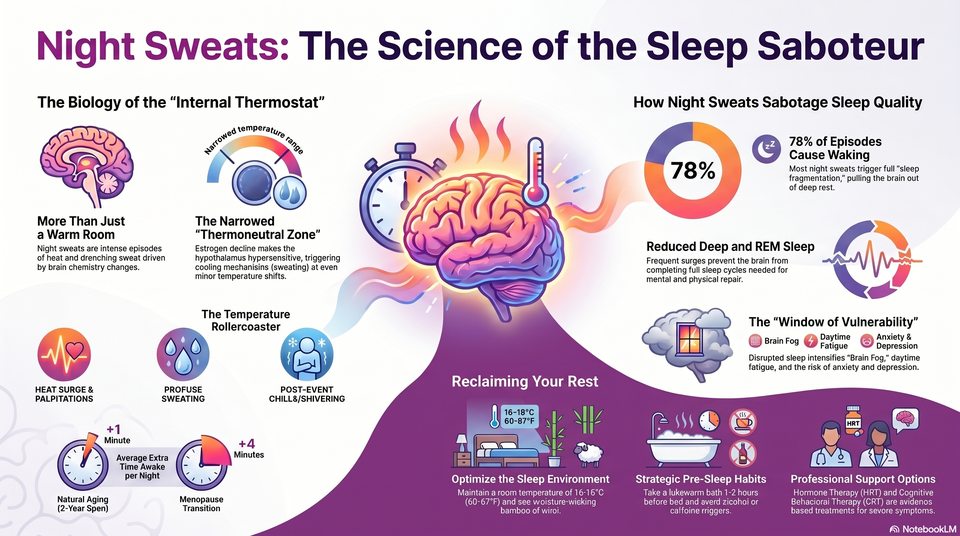


What are night sweats and how do they impact sleep quality?

What are night sweats and how do they impact sleep quality? | WHC Clinical FAQ

How do I stop menopausal night sweats from destroying my sleep?
Temperature control
Sleep impact
Quality of life
Women’s Health Clinic FAQ
What are night sweats and how do they impact sleep quality?
Hot flushes and night sweats can be physically disruptive, embarrassing and exhausting, so the explanation should go beyond saying they are common.
Direct answer
Night sweats are hot flushes that happen during sleep. They can cause waking, damp bedding, temperature swings and fragmented sleep, which may worsen fatigue, mood, concentration and quality of life. Clinical context matters because age, bleeding pattern, symptom timing, contraception, medicines and medical history can change the safest interpretation. Seek review if symptoms are severe, unusual, persistent or difficult to explain. This keeps the answer practical without turning normal variation into false reassurance.
A strong answer explains the brain temperature-control mechanism, the body response and when sweating or sleep disruption may need review.
Educational only. Suitability and next steps should be confirmed after consultation. Results vary. Not a cure.

Vasomotor symptoms
At a glance
These are the main points to understand before deciding whether symptoms are expected, need routine review or should be assessed promptly.
At a glance
Practical clinical summary
Main area
Brain-body response
Pattern
Heat and sweating
Watch for
Drenching sweats
Next step
Symptom review
Important safety note
Night sweats can be menopausal, but drenching sweats with fever, weight loss, chest symptoms or other unexplained illness should be checked.
Symptoms
Mechanism
Review
Safety
Detailed answer
Detailed answer
The deeper answer starts by matching the symptom or definition to the right phase of menopause, tissue change or pelvic-health pathway.
Night sweats as vasomotor symptoms
The reader wants to understand night sweats, broken sleep and fatigue.
Pattern
Assessment
Support
Night sweats as vasomotor symptoms
This is the first distinction because it shapes whether the answer is about definition, ovarian signalling, tissue health, bladder symptoms or pelvic support.
Sleep fragmentation
Symptoms should be interpreted alongside age, timing, cycle pattern, severity, medical history and whether the change is new or worsening.
Fatigue and mood
Management should be discussed as a set of options rather than one automatic route, especially where hormones, bleeding, urinary symptoms or pelvic pain are involved.
Triggers and environment
Follow-up matters when symptoms persist, affect sleep, sex, bladder function or daily life, or when the diagnosis is uncertain.
How the research shapes the answer
Menopause fundamentally alters sleep architecture, specifically reducing restorative slow-wave (deep) sleep and REM sleep, making sleep lighter and more easily disrupted. Sleep fragmentation is often mistakenly attributed solely to hormonal changes, causing comorbid conditions like OSA or Restless Legs Syndrome (RLS) to.
The benchmark was used for search intent and structure, but final wording was kept cautious, UK-facing and clinically useful.
Patient safety
Why this matters
Menopause can affect comfort, sleep, bleeding patterns, sexual health, urinary symptoms, confidence and long-term health, but not every symptom has the same cause.
It avoids missed causes
Symptoms that sound menopausal can also involve thyroid disease, pregnancy, infection, skin conditions, medication effects, prolapse or abnormal bleeding.
It validates symptoms
Being common does not make a symptom trivial; sleep loss, dryness, urgency or unpredictable bleeding can affect daily life and relationships.
It guides treatment choice
The right plan may involve reassurance, lifestyle support, pelvic-health care, non-hormonal options, hormone discussion, investigation or referral.
It keeps safety visible
Bleeding after menopause, severe pain, recurrent infection symptoms or rapid change should be checked rather than folded into a general menopause label.
Calm, individualised care
A strong answer should make the biology understandable without turning normal variation into fear.
It should also show when symptoms deserve help, because many menopause concerns are manageable once the cause is clear.
Considerations
What to consider
Sleep Environment: Maintain a cool bedroom temperature (15-19°C or 60-67°F), ensure cross-ventilation, and use layered bedding. Bedding and Clothing: Utilize breathable, moisture-wicking natural fabrics like cotton, bamboo, or wool to manage sweat, and avoid synthetic materials that trap heat. Dietary Adjustments: Eliminate.
Consultation priorities
The consultation should clarify symptoms, age, period history, contraception, medical history, medicines, personal priorities and any red flags.
Pattern
Options
Follow-up
Before deciding
Check whether the question is about normal transition, early menopause, GSM, urinary symptoms, pelvic-floor change or bleeding that needs assessment.
Testing boundaries
Blood tests are not always useful in typical menopause after 45, but younger age, POI concern or unclear symptoms may need a different approach.
Treatment discussion
Treatment choices should be matched to symptoms, health background, personal preference, contraindications and realistic goals.
If symptoms change
New bleeding, pelvic pain, recurrent urinary symptoms, breast changes, weight loss, fever or unexplained night sweats should be reviewed.
What not to assume
Do not assume every change after 40 is menopause or that every menopause symptom has to be tolerated.
Symptom Duration: Vasomotor symptoms last an average of 7.4 years, though some women may experience them for 10 to 20 years. Onset: Night sweats often begin during perimenopause (typically ages 40-50), preceding the complete cessation of menstruation by several years. Treatment Response.
Common concerns and myths
Common misconceptions
Online menopause advice can be either dismissive or overconfident. These corrections keep the answer balanced.
Myth: Night sweats are always menopause
Reality: the clinical picture depends on age, symptom pattern, history and whether there are features that need review.
Myth: Poor sleep is just stress
Reality: the clinical picture depends on age, symptom pattern, history and whether there are features that need review.
Myth: Damp bedding is too minor to mention
Reality: the clinical picture depends on age, symptom pattern, history and whether there are features that need review.
Common does not mean simple
Menopause can explain many patterns, but diagnosis still depends on context, age, bleeding history and symptom detail.
Support should be proportionate
Some symptoms need reassurance and practical advice; others need examination, testing, treatment discussion or referral.
Safety checklist
Safety checklist
Use these checks to decide whether symptoms can be discussed routinely or need more urgent advice.
Is the pattern expected?
Mild, fluctuating symptoms around the transition are different from severe, persistent, one-sided or rapidly worsening symptoms.
Is there unusual bleeding?
Postmenopausal bleeding, bleeding after sex, very heavy bleeding or bleeding with pain should be assessed.
Are bladder or pelvic symptoms present?
Urgency, recurrent UTI symptoms, leakage, pelvic pressure or pain may need urine testing, examination or pelvic-health review.
Is daily life affected?
Sleep loss, painful sex, dryness, mood change, flushes or fatigue are worth discussing when they affect wellbeing.
More reassuring signs
Symptoms are more reassuring when they are mild, improving, already assessed, and not linked with bleeding, fever, severe pain or unexplained weight loss.
Improving
Reviewed
Reasons to seek advice
Sleep Apnea Risk: Postmenopausal women are 2-3 times more likely to develop Obstructive Sleep Apnea (OSA). Loud snoring, choking/gasping during sleep, or severe morning headaches warrant urgent clinical evaluation. Other Medical Conditions: Persistent night sweats accompanied by unexplained weight loss, ongoing fever.
Severe pain
Infection signs
When to escalate
When to seek medical help
Some symptoms should not be attributed to menopause without assessment.
Use NHS 111 online
Postmenopausal or unusual bleeding
Bleeding after menopause, bleeding after sex, very heavy bleeding or bleeding with pelvic pain should be assessed promptly.
Severe pain or rapid worsening
Sudden pelvic pain, severe vulval pain, urinary retention or rapidly worsening symptoms need medical advice.
Infection or systemic symptoms
Fever, flank pain, blood in urine, foul discharge, feeling very unwell or recurrent UTI symptoms should be checked.
Emergency symptoms
Call 999 for life-threatening symptoms such as collapse, chest pain, breathing difficulty or stroke-like symptoms.
Use NHS 111 for urgent advice or call 999 in a life-threatening emergency. This page is educational and does not replace individual medical assessment.
Additional clinical context
How to use this answer
This page is designed to help patients understand the most likely clinical meaning of the question, then decide what to raise in consultation.What to discuss at appointment
Useful details include age, last period, bleeding pattern, contraception, pregnancy possibility, medical history, medicines, symptom timing, vaginal or urinary symptoms and what feels most disruptive.Regulatory resources
Authoritative resources
These resources support careful counselling on hot flushes, night sweats, sleep disturbance and menopause symptom management.
NHS - Menopause
UK patient baseline for hot flushes, night sweats and sleep disruption.
NICE NG23 - Menopause: identification and management
UK guideline source for vasomotor symptom assessment and management.
Women's Health Concern - Factsheets hub
Patient-facing UK source set for menopause symptom burden and practical management.
Next step
Book a clinical consultation
A consultation can review flush pattern, sleep, mood, medicines, health risks and whether menopause or another cause best explains symptoms.
▶ View Research Sources (12 Sources)
These 12 source names are selected from 24 display-ready sources, with a raw audit trail of 40 imported records. Additional reviewed material included professional society guidance, peer-reviewed clinical papers; duplicate, low-relevance and non-clinical records were removed before display.
Educational only. This information is for education only and is not a substitute for professional medical advice, diagnosis or treatment. Results vary. Not a cure.
