


🚫 **Laser/RF Safety: Contraindications & Implants Explained by Dr. Farzana Khan MD** (90 characters)

Should vaginal infections be treated before laser or RF tightening?

STOP! Is Vaginal Laser Safe? Dr. Khan Explains NICE Rules on Energy Devices
IUD-aware
Energy-device caution
Assessment first
Women’s Health Clinic FAQ
Can laser or RF heat damage an IUD?
IUD questions around vaginal laser or RF need careful language because the device is intrauterine, while treatment is vaginal and protocols vary.
Direct answer
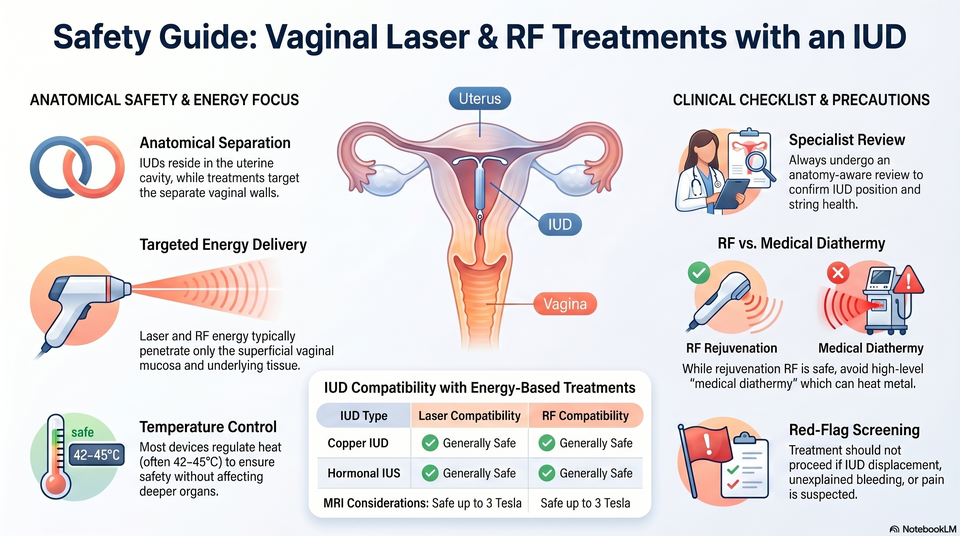
There is limited direct evidence that vaginal laser or RF damages an IUD, but absence of evidence is not the same as promised safety. Clinics should confirm device type, position, strings and symptoms before treatment. The safest sequence is to confirm device context and symptoms before deciding whether treatment can be discussed.
A responsible answer separates device position, strings, symptoms, pregnancy risk and evidence limits rather than giving a blanket yes or no.
Educational only. Suitability and next steps should be confirmed after consultation. Results vary. Not a cure.

IUD-aware suitability
At a glance
These are the main points to understand before deciding whether treatment can be discussed routinely or should wait.
At a glance
Contraception-aware suitability
Main area
IUD and energy treatment
Pattern
Check device context
Watch for
Pain, bleeding or missing strings
Next step
Clinician review
Important safety note
Pelvic pain, abnormal bleeding, fever, offensive discharge, suspected pregnancy or missing IUD strings should be assessed before elective vaginal treatment.
Symptoms
Pregnancy risk
Tissue comfort
Review
Detailed answer
Detailed answer
The deeper answer starts by separating contraception method, pregnancy risk, vaginal symptoms, healing and the limits of elective tightening.
Device location
The reader is worried that heat from laser or RF could affect an intrauterine device.
Timing
Symptoms
Safety
Device location
Start with the exact contraception method because an IUD, implant, injection, pill, ring, diaphragm, cap, tampon or cup creates a different practical question.
Laser and RF mechanisms
A loose feeling may overlap with dryness, friction, pain, bleeding changes, pelvic-floor symptoms, arousal comfort or true vaginal-wall laxity.
Heat and tissue depth
Laser, RF, HIFU or surgery should not be used to bypass pregnancy exclusion, infection concerns, unexplained bleeding or device uncertainty.
Evidence limits
Treatment decisions should define whether the goal is comfort, symptom clarity, tissue support, sexual comfort or timing around contraception changes.
How the research shapes the answer
Elective vs. Curative: Vaginal tightening or rejuvenation is an elective procedure and does not replace proper diagnosis or medical treatments like vaginal oestrogen, pelvic floor rehabilitation, or infection control. Evidence Limitations: Authoritative bodies, including NICE, emphasize that long-term safety and efficacy evidence.
The benchmark shaped search intent and structure, but final wording avoids device hype, universal aftercare dates, self-removal advice and promises language.
Patient safety
Why this matters
Contraception-aware vaginal laxity advice matters because timing, pregnancy risk, bleeding, tissue comfort and device details can all change the safest next step.
It prevents false reassurance
Contraception status can affect safety checks, symptoms, pregnancy risk and treatment timing.
It separates symptom causes
Dryness, irritation, pain, bleeding changes, pelvic-floor symptoms and laxity can feel related but need different responses.
It protects contraceptive cover
Removing or pausing a method without planning alternatives can create pregnancy risk.
It improves consent
Patients need to know where evidence is limited and where clinic protocols may differ.
Better timing protects choice
Delaying treatment for contraception, pregnancy or symptom checks does not mean treatment is impossible; it means the plan is safer and clearer.
The safest page helps the patient know what to clarify before committing to a procedure.
Considerations
What to consider
Patient Preparation: Patients should provide their clinician with their most recent cervical screening dates, HPV results, and specific details about their IUD type and insertion date. Symptom Mapping: A detailed timeline of the patient's symptoms (e.g., location, frequency, triggers) must be documented.
Consultation priorities
Bring details about contraception type, recent changes, bleeding, pain, discharge, pregnancy possibility, dryness, irritation, vaginal product use, pelvic-floor symptoms and treatment goals.
Symptoms
Timing
Protection
Identify the method
Clarify whether the issue is an IUD, intrauterine hormonal system, implant, injection, pill, ring, barrier method or menstrual product.
Check symptom pattern
Ask about bleeding, pain, discharge, dryness, missing strings, infection symptoms and pregnancy possibility.
Plan timing
Recent emergency contraception, method changes or post-treatment healing may mean elective treatment should wait.
Protect contraception
If a method is removed or paused, contraception cover and pregnancy testing need clear planning.
What not to assume
Do not assume contraception method alone proves suitability, causes structural laxity or can be ignored during treatment planning.
Pre-Treatment Phase: Patients must undergo a thorough medical history and pelvic assessment. Any active symptoms like abnormal bleeding or pain must be resolved prior to scheduling the procedure. Treatment Course: A standard laser or RF protocol typically involves 3 sessions spaced 4.
Common concerns and myths
Common misconceptions
These corrections keep the answer practical, specific and clinically cautious.
Myth: No published damage reports means no risk
Reality: suitability depends on contraception method, symptoms, pregnancy risk, tissue comfort, healing status and realistic goals.
Myth: Every energy device behaves the same
Reality: device type, position, symptoms and strings need checking; there is rarely a useful blanket rule.
Myth: The IUD can be ignored because treatment is vaginal
Reality: device type, position, symptoms and strings need checking; there is rarely a useful blanket rule.
Method details matter
IUDs, intrauterine hormonal systems, systemic methods and vaginal products each raise different suitability and timing questions.
Treatment has limits
Vaginal tightening cannot promise contraception-related symptom improvement, collagen response, lubrication change, pregnancy safety or pain relief.
Safety checklist
Safety checklist
Use these checks to decide whether treatment can be discussed routinely or should wait for contraception, pregnancy or symptom review.
Is the contraception method clear?
Know whether the issue involves an IUD, intrauterine system, implant, injection, pill, ring, barrier method, tampon or cup.
Could pregnancy be possible?
Possible pregnancy, recent emergency contraception or uncertain cover should pause elective treatment decisions.
Are there symptoms that need review?
Pelvic pain, abnormal bleeding, fever, discharge, missing strings, severe dryness or infection symptoms should change timing.
Are goals realistic?
The plan should define whether the aim is comfort, dryness support, symptom clarity, sexual comfort or laxity assessment.
More reassuring signs
The situation is more reassuring when contraception cover is clear, symptoms are stable, pregnancy is not suspected and there is no pain, bleeding, discharge or infection sign.
Covered
No red flags
Reasons to seek advice
Device Interactions: The use of high-level medical RF (diathermy) is contraindicated for patients with a copper IUD in place. Masking Pathology: Treating perceived 'vaginal laxity' without proper evaluation can mask serious underlying conditions such as pelvic organ prolapse or pelvic floor dysfunction..
Bleeding
Pain
When to escalate
When to seek medical help
These symptoms or situations should not be managed with general vaginal-tightening advice alone.
Use NHS 111 online
Pregnancy possibility
If pregnancy is possible, elective vaginal tightening should wait until this is clarified.
Pain, bleeding or infection signs
Pelvic pain, unexplained bleeding, fever or offensive discharge should be assessed.
IUD string concerns
Missing, longer or newly felt strings, or pain with an IUD, should be reviewed before treatment.
Emergency symptoms
Call 999 for life-threatening symptoms such as collapse, severe bleeding, chest pain, breathing difficulty or stroke-like symptoms.
Use NHS 111 for urgent advice or call 999 in a life-threatening emergency. This page is educational and does not replace individual medical assessment.
Additional clinical context
How to use this answer
Use this page to prepare a focused discussion about contraception method, pregnancy possibility, vaginal symptoms and treatment timing. The aim is to understand whether the question is about device position, hormonal symptoms, vaginal product friction, pregnancy risk or true laxity.What to bring to consultation
Helpful details include contraception type, insertion or change date, bleeding pattern, pain, discharge, missing strings, pregnancy possibility, emergency contraception use, vaginal product use, dryness, pelvic-floor symptoms and treatment goals.Regulatory resources
Authoritative resources
These resources support UK-facing information on IUDs, intrauterine systems, contraception counselling and vaginal energy-device evidence boundaries.
NHS - Intrauterine device
UK patient baseline for copper IUD position, strings, checks and removal context.
NHS - Intrauterine system
UK patient source for hormonal intrauterine systems and practical checks.
FSRH - Intrauterine contraception guideline
UK specialist contraception guideline for IUD and intrauterine-system safety context.
Next step
Book a clinical consultation
A consultation can review device type, string status, symptoms, pregnancy risk, infection concerns, treatment goals and whether contraception review is needed first.
▶ View Research Sources (12 Sources)
These 12 source names are selected from 12 display-ready sources, with a raw audit trail of 80 imported records. Additional reviewed material included UK clinical guidance, professional society guidance, peer-reviewed clinical papers; duplicate, low-relevance and non-clinical records were removed before display.
Educational only. This information is for education only and is not a substitute for professional medical advice, diagnosis or treatment. Results vary. Not a cure.
