


Can surgical tightening affect bladder symptoms? | WHC Clinical FAQ

Does high intra-abdominal pressure affect non-surgical tightening results?

Can altered sensation happen after non-surgical tightening?
Compartment aware
Bladder and bowel
Support check
Women’s Health Clinic FAQ
Can surgical tightening affect bladder symptoms?
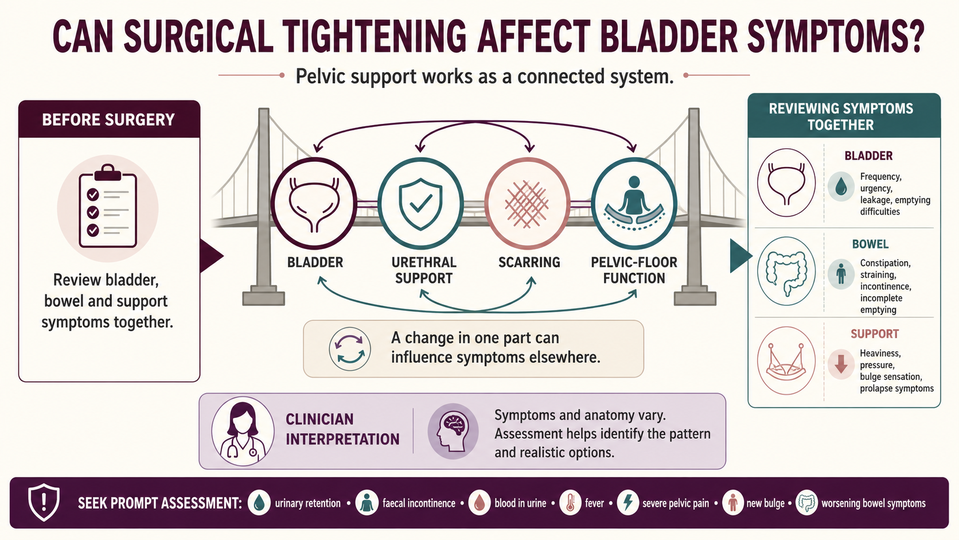
Surgical tightening can affect more than vaginal sensation because bladder, bowel and pelvic support symptoms share the same pelvic-floor space.
Direct answer
Surgical tightening can affect bladder symptoms because pelvic support, urethral support, scarring and pelvic-floor function are closely connected. The safest interpretation reviews bladder, bowel and support symptoms together before surgery.
A useful answer separates urinary symptoms, bowel symptoms, prolapse, posterior support and pelvic-floor coordination before surgery is discussed.
Educational only. Suitability and next steps should be confirmed after consultation. Results vary. Not a cure.

Pelvic compartments
At a glance
These are the main points to understand before deciding whether surgery, revision or prolapse repair is the right pathway.
At a glance
Surgical decision summary
Main area
Bladder and bowel function
Pattern
Shared pelvic support
Watch for
New leakage or constipation
Next step
Compartment assessment
Important safety note
Urinary retention, faecal incontinence, blood in urine, fever, severe pelvic pain, new bulge or worsening bowel symptoms should be assessed promptly.
Bowel
Support
Referral
Follow-up
Detailed answer
Detailed answer
The deeper answer starts by separating anatomy, prior treatment history, scar tissue, pain, pelvic-floor function, bladder and bowel symptoms, childbirth plans and realistic surgical goals.
Bladder symptoms
The reader wants to know whether surgery, revision surgery or prolapse repair is appropriate, what prior treatment or scarring may change, and what risks or trade-offs should be discussed before deciding.
Scars
Function
Consent
Bladder symptoms
Start with the diagnosis: support defect, perineal change, scar problem, pain pattern, narrowing, prolapse or another pelvic-floor issue.
Bowel symptoms
Previous surgery, laser, radiofrequency, childbirth injury, pain and healing problems should be part of the surgical history.
Pelvic support
The goal should be specific, such as support, comfort, opening repair, symptom relief, scar release or prolapse management.
Compartment assessment
Treatment decisions should include alternatives, recovery, pain risk, bladder and bowel effects, future childbirth and follow-up.
How the research shapes the answer
• Efficacy Against SUI: Based on Cochrane reviews, anterior vaginal repair has a higher failure rate for curing primary stress incontinence (38%) compared to open abdominal retropubic suspensions (17%). Patients undergoing anterior repair also face a much higher risk of needing repeat.
The research synthesis shaped the structure, while final wording avoids surgical technique instructions, device hype, treatment ranking, certainty claims and overconfident revision promises.
Patient safety
Why this matters
Surgical and revision decisions can affect comfort, sex, bladder function, bowel function, future childbirth and confidence, so the page must go beyond simple tightening language.
It links compartments
Vaginal support, bladder function and bowel emptying can interact.
It avoids symptom swapping
One symptom improving should not create a new bladder or bowel problem.
It guides investigation
Urinary or bowel symptoms may need separate assessment before surgery.
It supports referral
Complex symptoms may need specialist pelvic-floor review.
Assessment protects outcomes
A cautious surgical discussion does not dismiss symptoms; it helps match treatment to the right anatomical and functional goal.
The strongest decision is one where benefits, limits, pain risk, alternatives, recovery and follow-up are clear before treatment.
Considerations
What to consider
• anaesthesia Options: The procedure can be performed under general anaesthesia (patient asleep) or regional/spinal anaesthesia (numb from the waist down). • Mesh vs. Native Tissue: The standard anterior colporrhaphy uses the patient's own native tissue (fascia) and dissolvable sutures. Due to.
Consultation priorities
Bring your prior procedures, birth history, pain pattern, scar concerns, urinary or bowel symptoms, prolapse sensations, sexual comfort concerns and future pregnancy plans.
Scars
Pain
Options
List urinary symptoms
Leakage, urgency, retention or recurrent infection symptoms should be discussed.
List bowel symptoms
Constipation, trapping, splinting or incomplete emptying can matter.
Check prolapse signs
Bulge or pressure changes the pathway.
Plan follow-up
Bladder and bowel changes should be monitored after repair.
What not to assume
Do not assume surgery is automatically the next step, revision is simple, or tightening surgery only affects sexual sensation.
• Hospital Stay: The procedure is generally performed as a day case or requires a 1 to 2-day hospital stay. • Initial Recovery (Days 1-7): A urinary catheter and vaginal pack may be in place for the first 24 to 48 hours..
Common concerns and myths
Common misconceptions
These corrections keep the answer anatomy-aware, pain-aware and realistic.
Myth: Vaginal tightening cannot affect bladder symptoms
Reality: bladder, bowel and vaginal support symptoms can overlap and should be reviewed together.
Myth: Bowel symptoms are unrelated to posterior repair
Reality: prolapse repair treats support defects and should not be confused with simple narrowing.
Myth: Pelvic compartments can be assessed separately from symptoms
Reality: bladder, bowel and vaginal support symptoms can overlap and should be reviewed together.
Revision has limits
Scar tissue, pain and tissue quality can make revision less predictable than a first procedure.
Support is not the same as narrowing
Prolapse repair, posterior repair, perineoplasty and cosmetic tightening may overlap in language but have different aims.
Safety checklist
Safety checklist
Use these checks before deciding whether symptoms can wait for routine review or need earlier medical advice.
Is the diagnosis clear?
Know whether the issue is prolapse, perineal change, scar tissue, narrowing, pain, pelvic-floor spasm or laxity.
Are pain or scar symptoms present?
Painful sex, pulling, burning, tight scars or altered sensation should be mapped before treatment.
Are bladder or bowel symptoms present?
Urinary retention, leakage, bowel emptying problems or faecal incontinence can change the pathway.
Are future birth plans relevant?
Pregnancy plans and birth history should be discussed before elective repair.
More reassuring signs
The situation is more reassuring when symptoms are stable, there are no red flags, the diagnosis is clear, alternatives have been discussed and follow-up is planned.
Mapped
Reviewed
Reasons to seek advice
Urinary retention, faecal incontinence, blood in urine, fever, severe pelvic pain, new bulge or worsening bowel symptoms should be assessed promptly.
Retention
Severe pain
When to escalate
When to seek medical help
These symptoms should not be managed with general vaginal-tightening or surgery-comparison advice alone.
Use NHS 111 online
Bleeding that needs review
Postmenopausal bleeding, bleeding after sex or unexplained bleeding should be assessed promptly.
Severe or worsening pain
Severe pelvic, vulval or vaginal pain, rapidly worsening symptoms or new painful sex after surgery needs medical advice.
Bladder, bowel or support symptoms
Urinary retention, faecal incontinence, a new bulge, fever, offensive discharge or marked pelvic pressure should be checked.
Emergency symptoms
Call 999 for life-threatening symptoms such as collapse, severe bleeding, chest pain, breathing difficulty or stroke-like symptoms.
Use NHS 111 for urgent advice or call 999 in a life-threatening emergency. This page is educational and does not replace individual medical assessment.
Additional clinical context
How to use this answer
Use this page to prepare a focused discussion about anatomy, previous treatments, scars, pain, support symptoms, bladder or bowel effects and what surgery or revision would realistically aim to improve.What to bring to consultation
Helpful details include prior laser, radiofrequency or surgery, dates, healing problems, childbirth history, urinary or bowel symptoms, prolapse sensations, pain with sex, scar tenderness, future pregnancy plans and what outcome would feel meaningful.Regulatory resources
Authoritative resources
These resources support explanation of urinary symptoms, bowel effects, prolapse, pelvic-floor repair and specialist assessment.
Next step
Book a clinical consultation
A consultation can review bladder symptoms, bowel symptoms, pelvic pressure, prolapse signs, pain and whether surgical tightening is the right pathway.
▶ View Research Sources (12 Sources)
These 12 source names are selected from 12 display-ready sources, with a raw audit trail of 60 imported records. Additional reviewed material included UK clinical guidance, professional society guidance, peer-reviewed clinical papers, evidence reviews; duplicate, low-relevance and non-clinical records were removed before display.
Educational only. This information is for education only and is not a substitute for professional medical advice, diagnosis or treatment. Results vary. Not a cure.
