



Can vaginal vault changes feel like laxity after hysterectomy?

Can bracing incorrectly during exercise affect vaginal tone?
Can hysterectomy change vaginal support?
Sensation-aware
Position-specific
Pelvic mechanics
Women’s Health Clinic FAQ
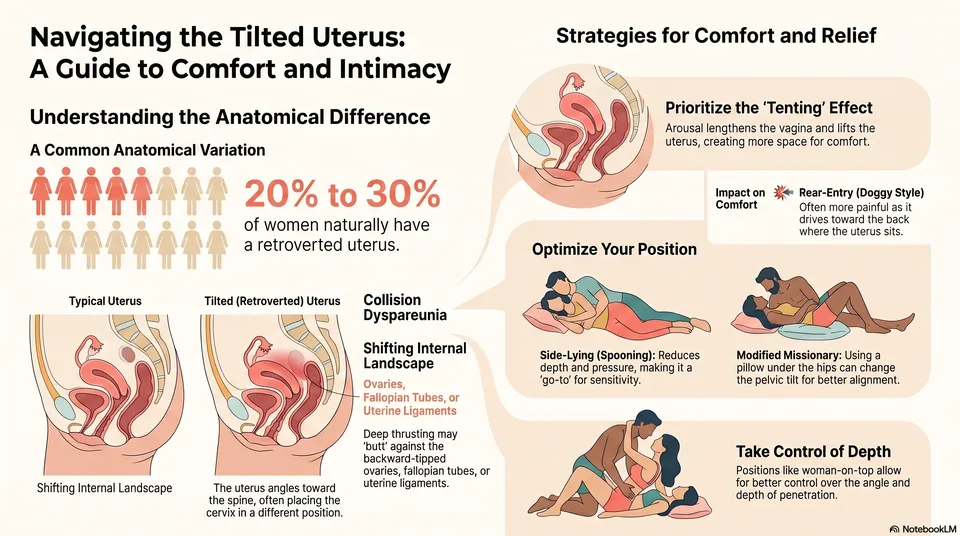
Can a tilted uterus make the vagina feel different during sex?
Vaginal sensation can vary with pelvic anatomy, arousal, position, pelvic-floor tone, uterine angle, vaginal length and support mechanics.
Direct answer
A tilted uterus can make sex feel different for some women by changing the angle of the cervix and upper vagina, but it does not automatically mean the vagina is loose. The safest sequence is to map when symptoms occur and whether pain, arousal, angle or support explains the change.
The safest answer explains why symptoms can change by position without assuming the cause is simple laxity.
Educational only. Suitability and next steps should be confirmed after consultation. Results vary. Not a cure.

Pelvic mechanics
At a glance
These are the main points to understand before deciding whether symptoms need pelvic-floor review, prolapse assessment, tissue care or treatment discussion.
At a glance
Anatomy-led summary
Main area
Sensation and mechanics
Pattern
Position-dependent
Watch for
Pain or bleeding
Next step
Symptom mapping
Important safety note
Pain during sex, bleeding after sex, deep pelvic pain, new pelvic pressure or symptoms that are worsening should be assessed rather than treated as simple laxity.
Support
Sensation
Assessment
Goals
Detailed answer
Detailed answer
The deeper answer starts by locating the symptom: opening, deeper canal, wall support, perineum, pelvic floor, external tissues or position-dependent mechanics.
Uterine angle
The reader wants to know whether uterine position affects sensation during sex.
Function
Symptoms
Plan
Uterine angle
Start by identifying the anatomical level, because introital, canal, wall, apical, perineal and external tissue issues are not interchangeable.
Vaginal apex
A loose feeling may overlap with prolapse, gaping, dryness, pain, arousal, position, pelvic-floor tone, childbirth trauma or tissue quality.
Penetration angle
Laser, RF or surgery should not be used to bypass pelvic-floor assessment, prolapse review, pain assessment or red-flag symptoms.
Pain versus laxity
Treatment decisions should define whether the goal is support, comfort, friction, opening support, tissue health, examination tolerance or symptom clarity.
How the research shapes the answer
• A healthcare provider can diagnose a retroverted uterus through a routine bimanual pelvic examination or via an ultrasound. • Accurate diagnosis typically requires a transvaginal ultrasound performed with a completely empty bladder. • While often benign, a retroverted uterus has a.
The benchmark shaped search intent and structure, but final wording avoids device hype, universal recovery timelines, probe instructions and procedure ranking.
Patient safety
Why this matters
Anatomy matters because two people can describe looseness but have different causes, risks and treatment pathways.
It prevents the wrong target
A loose feeling can come from the opening, canal, wall support, pelvic floor, perineum, external tissues, dryness or prolapse.
It improves treatment choice
Different anatomical levels may need different conservative, device, surgical or specialist pathways.
It protects sexual comfort
Pain, dryness, arousal, position and tissue quality can change sensation and should not be reduced to tightness alone.
It keeps safety visible
Bulge, bleeding, pain, urinary symptoms, bowel symptoms or new vulval change should alter the timing of elective treatment.
Assessment protects choice
A careful review does not mean treatment is impossible; it means the plan should match the actual anatomy and symptom pattern.
The safest page helps the patient understand what needs checking before a procedure is discussed.
Considerations
What to consider
• Avoid deep, unchecked thrusts and positions like rear-entry, and opt for shallow-entry, side-lying (spooning), or woman-on-top positions to control depth and angle. • Ample foreplay is critical; during arousal, the vagina lengthens and the uterus lifts slightly out of the pelvis.
Consultation priorities
Bring details about birth history, tears, episiotomy, gaping, bulge, heaviness, urinary symptoms, bowel symptoms, pain, dryness, position-specific symptoms and treatment goals.
Symptoms
History
Goals
Map the level
Clarify whether symptoms are at the opening, deeper canal, anterior wall, posterior wall, apex, perineum or external vulval tissues.
Check related symptoms
Ask about bulge, pressure, urinary symptoms, bowel symptoms, pain, dryness, gaping, birth trauma and position-specific changes.
Separate appearance from function
Visible gaping, labial change or asymmetry may not mean the deeper canal is loose.
Match the pathway
Pelvic-health physiotherapy, moisturisers, prolapse review, energy-device discussion, surgery or referral each has a different role.
What not to assume
Do not assume a loose feeling means one problem, one procedure or one anatomical level.
• A tilted uterus is most often a normal, developmental anatomical variant present from birth. • It can also be acquired later in life due to pelvic scarring, endometriosis, fibroids, childbirth, or menopause. • During pregnancy, a retroverted uterus typically shifts forward.
Common concerns and myths
Common misconceptions
These corrections keep the answer practical, specific and clinically cautious.
Myth: A tilted uterus causes vaginal laxity
Reality: suitability depends on anatomy, symptoms, pelvic-floor function, tissue comfort, red flags and realistic goals.
Myth: Different sensation means something is wrong
Reality: sensation can change with position, arousal, pelvic angle, pain, tissue comfort and support mechanics.
Myth: Treatment should target tightness without assessing pain or anatomy
Reality: treatment should follow anatomical assessment rather than starting with a procedure preference.
Location matters
Opening, canal, wall, perineal and external tissue symptoms may need different care.
Treatment has limits
Vaginal tightening cannot promise improved sensation, friction, orgasm, support restoration, pain relief or lasting results.
Safety checklist
Safety checklist
Use these checks to decide whether treatment can be discussed routinely or should wait for assessment.
Where is the symptom?
Clarify whether the concern is at the opening, deeper canal, vaginal wall, perineum, pelvic floor or external tissues.
Could this be prolapse or support change?
Bulge, heaviness, pressure, urinary retention or bowel symptoms should not be treated as simple laxity.
Is pain, bleeding or dryness present?
Pain during sex, bleeding, discharge, severe dryness or new vulval change should change timing and pathway.
Are goals realistic?
The plan should define whether the aim is support, comfort, tissue health, friction, confidence or symptom clarity.
More reassuring signs
The situation is more reassuring when symptoms are stable, there is no bulge, severe pain, bleeding, discharge or new vulval change, and goals are realistic.
Mapped
No red flags
Reasons to seek advice
• While anatomical variation is normal, a tilted uterus resolved backwards by scar tissue can be a sign of underlying pathology. • Seek prompt medical care if sexual pain is severe, sharp, stabbing, sudden in onset, or worsening over time. • Red.
Bulge
Pain
When to escalate
When to seek medical help
These symptoms or situations should not be managed with general vaginal-tightening advice alone.
Use NHS 111 online
Bleeding or new vulval change
Unexplained bleeding, bleeding after sex, ulceration, sores, new lumps or persistent vulval change should be assessed.
Bulge or pressure symptoms
A worsening bulge, pelvic pressure, urinary retention or bowel dysfunction may indicate prolapse or another support issue.
Pain symptoms
Severe pelvic pain, painful sex that is worsening or new deep pain needs medical assessment.
Emergency symptoms
Call 999 for life-threatening symptoms such as collapse, severe bleeding, chest pain, breathing difficulty or stroke-like symptoms.
Use NHS 111 for urgent advice or call 999 in a life-threatening emergency. This page is educational and does not replace individual medical assessment.
Additional clinical context
How to use this answer
Use this page to prepare a focused discussion about where the symptom is felt and what else happens with it. The aim is to understand whether the concern is introital laxity, canal laxity, wall support, perineal body change, external tissue change, pain, dryness or prolapse overlap.What to bring to consultation
Helpful details include birth history, tears or episiotomy, pelvic-floor symptoms, gaping, bulge, heaviness, urinary or bowel symptoms, pain, dryness, position-specific changes, previous treatment and personal goals.Regulatory resources
Authoritative resources
These resources support UK-facing information on pelvic-floor health, painful sex, pelvic pain and position-dependent support symptoms.
Next step
Book a clinical consultation
A consultation can review when symptoms occur, sexual position pattern, pain, arousal, pelvic-floor tone, uterine angle, vaginal length and support findings.
▶ View Research Sources (12 Sources)
These 12 source names are selected from 12 display-ready sources, with a raw audit trail of 164 imported records. Additional reviewed material included UK clinical guidance, professional society guidance, peer-reviewed clinical papers; duplicate, low-relevance and non-clinical records were removed before display.
Educational only. This information is for education only and is not a substitute for professional medical advice, diagnosis or treatment. Results vary. Not a cure.
