


Why Sex Can Still Hurt When HRT Is Working

Painful Sex After Baby or Menopause? Why It's So Common & How to Treat It 💔

Painful Sex SOLVED? Vaginal Laser & RF vs Dryness, Atrophy & Laxity.
WHC signature intimate-menopause editorial
HRT Fixed My Hot Flushes — So Why Is Sex Still Painful?
Why vaginal symptoms can persist even when the rest of menopause feels under control.
The hot flushes may have stopped. Sleep may be better, mood steadier and energy less elusive. Desire may even have returned. And yet penetration is still dry, burning or painful. If HRT is working, why can this one part of life still feel so difficult?
Key takeaways
- ✓HRT can be working — and sex can still hurt. Menopause symptom control is not all-or-nothing.
- ✓Systemic HRT and vaginal oestrogen have different purposes; NICE includes people using systemic HRT in its recommendation to offer vaginal oestrogen for menopause-associated genitourinary symptoms.
- ✓Desire, arousal and lubrication are related but not interchangeable.
- ✓Painful sex is a symptom, not a diagnosis. GSM is only one possible contributor.
- ✓Repeated pain can teach the pelvic floor to guard, so pain may continue after dryness starts to improve.
- ✓Persistent pain, bleeding, skin change, fissures, unusual discharge or deep pelvic pain warrant assessment.
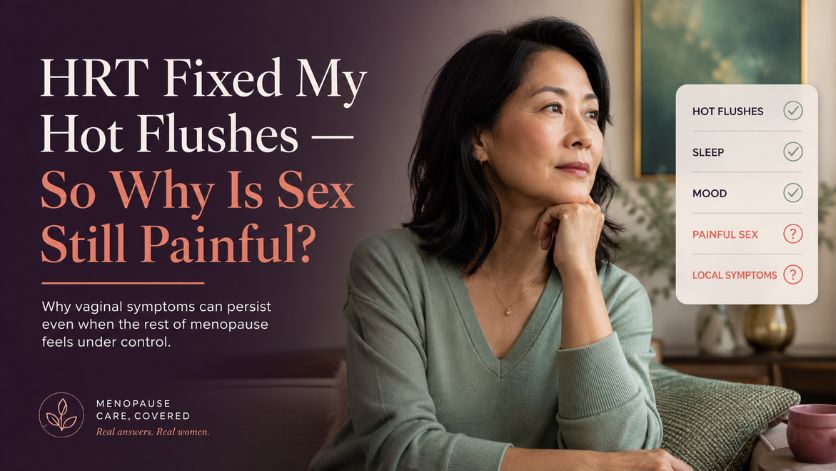
Feeling better overall does not invalidate a symptom that remains local, specific and important.
Executive summary
Symptom control is not a single switch
Systemic HRT circulates through the body and may improve vasomotor symptoms such as hot flushes and night sweats. Local vaginal oestrogen is directed towards menopause-associated genitourinary symptoms. NICE recommends offering it for those symptoms, including to people already using systemic HRT.
That does not make every episode of painful sex a hormone problem. Dryness or GSM may coexist with vulval skin disease, fissuring, infection, scar tissue, pelvic-floor overactivity, persistent vulval pain or a deeper pelvic cause.
The useful question is therefore not simply whether the systemic HRT dose is “strong enough”. It is where the pain occurs, what it feels like, when it happens, what has improved and what still needs a diagnosis.
“My HRT worked. So why didn’t this?”
Menopause symptoms do not always rise and fall together. A treatment can make a profound difference to temperature regulation, sleep or mood while leaving local vulvovaginal discomfort partly or wholly unchanged. That is not necessarily evidence that systemic treatment has failed.
The tissues involved in genitourinary symptoms have their own local needs, and individual responses to treatment vary. NICE explicitly says vaginal oestrogen should be offered for genitourinary symptoms associated with menopause, including when someone already uses systemic HRT.
Equally, the presence of menopause does not explain every genital or pelvic symptom. Painful sex describes an experience. It does not tell us whether the main driver is fragile tissue, inflammation, skin disease, infection, muscle guarding, nerve-related pain, scarring or something deeper in the pelvis.
Systemic HRT
Used for broader menopause symptoms across the body. Formulation depends on clinical circumstances, including whether progestogen is needed.
Improvement in hot flushes does not guarantee that local genital symptoms will fully resolve.
Vaginal oestrogen
Available in local forms such as creams, gels, tablets, pessaries or a ring. Its main role is local genitourinary symptom management.
The NHS notes that it may help vaginal dryness and irritation but does not treat hot flushes, mood symptoms or insomnia.
GSM: the local cluster that can persist
Genitourinary syndrome of menopause, or GSM, describes symptoms and tissue changes linked with lower oestrogen around and after menopause. It can affect the vulva and vagina as well as the urethra and bladder. Dryness is common, but it is not the whole syndrome.
Possible symptoms include burning, irritation, soreness, fragile-feeling tissue, discomfort during sex and urinary discomfort. Some people notice a gradual change; others first become aware of it during penetration or when urine contacts sore tissue.
GSM may be a strong possibility when symptoms fit, but it should not become a label placed over every complaint. A skin condition, infection or pelvic-floor problem can look similar, and more than one process may be present at the same time.
“I still want sex — so why am I dry?”
Desire is an interest in sexual activity. Arousal includes psychological and physiological responses. Lubrication is one physical response, while sensation and orgasm are further parts of sexual experience. These systems interact, but they are not interchangeable measures of attraction or relationship quality.
A woman can want sex, feel mentally engaged and enjoy intimacy while still having inadequate lubrication or uncomfortable tissue. That mismatch can be especially confusing after HRT has improved energy or libido. It does not prove that she is insufficiently aroused or rejecting a partner.
Reduced lubrication can have several contributors, including menopause-related tissue change, medicines, stress, pain anticipation, the time or context needed for arousal and other health conditions. One dry experience is not automatically disease; recurrent discomfort deserves a more specific conversation.
Lubrication is not a referendum on desire.
Lubricant and moisturiser are not the same tool
A lubricant is primarily used around sexual activity to reduce friction. A vaginal moisturiser is used regularly to support ongoing moisture and comfort. Either may help selected symptoms, and NICE says they can be used alone or alongside vaginal oestrogen where appropriate.
Neither product establishes the diagnosis. Lubricant may reduce friction while leaving tissue inflammation, a dermatosis or muscle guarding untreated. Products can also irritate sensitive skin, so persistent stinging after repeated product changes is a reason to reassess rather than keep adding more.
What exactly does “painful sex” mean?
Location is useful clinical information. Pain at the vulva or vaginal opening raises a different set of questions from pain felt deep in the pelvis. The distinction is not perfect, and more than one pattern can coexist, but it helps an assessment move beyond the single word “dyspareunia”.
| Pattern | How it may feel | Questions it can raise |
|---|---|---|
| Entry or superficial pain | Burning, stinging, tearing or pain at touch or initial penetration. | GSM, fissures, skin disease, irritation, infection, scar tissue, vulvodynia or pelvic-floor guarding. |
| Deep pain | A deeper ache, pressure or sharp pelvic pain during or after penetration. | Endometriosis, pelvic pathology, prolapse, pelvic-floor involvement, infection or postsurgical change. |
Burning or “paper-cut” pain can accompany fragile tissue, fissures, friction or vulval skin disease. Soreness may continue after sex, and urine can sting when it touches irritated skin. Bleeding should not simply be normalised as dryness, especially after menopause.
Deep pain should not be folded into a vaginal-dryness explanation without thought. NICE includes deep pain during or after intercourse among symptoms that can suggest endometriosis, while other gynaecological, pelvic-floor or postsurgical causes may also need consideration.
When dryness begins a pain–guarding cycle
Dry or fragile tissue can make penetration hurt. The nervous system learns from that experience and prepares for the next one. Pelvic-floor muscles may tighten protectively before or during touch, relaxation becomes harder and the pressure of penetration creates more pain.
This is a physiological protective response, not a failure to relax correctly or evidence that pain is imagined. Anticipation can be part of the body’s learned safety response even when the person wants intimacy and feels emotionally safe.
The pelvic floor is not always weak. Overactivity, poor coordination and difficulty lengthening can contribute to entry pain. For someone whose muscles are already guarding, an instruction to perform more forceful contractions may miss the problem.
A pelvic-health physiotherapist can assess tone, coordination, breathing, relaxation and relevant movement patterns. This does not mean the pain is “all muscular”. Tissue symptoms, skin health and other causes may need treatment at the same time.
When the cause is not simply dryness
Vulval skin disease
Lichen sclerosus, lichen planus, dermatitis and contact reactions can cause pain, soreness, itching, fissures or visible change.
RCOG advises assessment because the right treatment depends on the condition; repeated empirical thrush treatment may worsen irritation.
Infection
Candidiasis, bacterial vaginosis, urinary infection or an STI where relevant may cause overlapping symptoms.
Persistent burning after repeated treatment deserves reassessment, testing where indicated and a review of whether infection still fits.
Persistent vulval pain
Vulvodynia or other persistent vulval pain can exist without active infection and may involve several contributors.
The absence of a simple visual explanation does not make the pain unreal; specialist or multidisciplinary care may be appropriate.
Deep pelvic causes
Endometriosis, pelvic inflammatory disease, ovarian or other pelvic pathology, prolapse and postsurgical change can contribute to deep pain.
Symptoms, examination preferences and the need for investigation should be discussed individually.
Scar tissue after childbirth, pelvic surgery or radiotherapy may change stretch or sensitivity. Medicines and wider medical conditions can influence lubrication or sexual response. Relationship strain may result from repeated pain without being its original cause.
These possibilities are not a self-diagnosis checklist. They explain why a single intervention may help one layer while another persists, and why treatment response can provide useful information without proving a diagnosis by itself.
Where vaginal oestrogen fits
NICE recommends offering vaginal oestrogen for genitourinary symptoms associated with menopause, including to people already using systemic HRT. The choice between cream, gel, tablet, pessary or ring should be shared, taking account of preference and suitability.
NICE describes vaginal oestrogen as locally absorbed, with minimal absorption into the bloodstream compared with systemic HRT. Serious adverse effects are described as very rare, but this is not a reason to make blanket safety promises or ignore unexplained bleeding.
Low-dose vaginal oestrogen generally does not require systemic progestogen solely for endometrial protection because systemic absorption is minimal. Personal prescribing still belongs with a qualified clinician who can consider the preparation, medical history and any bleeding.
For someone with a personal history of breast cancer, NICE recommends non-hormonal moisturisers or lubricants first and allows consideration of vaginal oestrogen when symptoms continue. People taking an aromatase inhibitor should work with a breast-cancer specialist; uncertainty about recurrence risk must be discussed honestly.
What about testosterone, prasterone or ospemifene?
Testosterone may be considered for selected women with low sexual desire after a clinical review. It is not a primary treatment for painful penetration caused by GSM, skin disease, infection or pelvic-floor pain. Improving desire does not remove a source of pain.
NICE says vaginal prasterone may be considered when vaginal oestrogen or non-hormonal moisturisers or lubricants have been ineffective or are not tolerated. Ospemifene may be considered when locally applied treatment is impractical. Availability, suitability and risks require individual discussion.
What about laser, PRP and “regenerative” treatments?
NICE says vaginal laser should not be offered for menopause-associated genitourinary symptoms except as part of a randomised controlled trial. This restriction matters because plausible biological explanations and early studies are not the same as established patient benefit.
Claims for PRP, polynucleotides, fillers or other regenerative or aesthetic interventions must be judged by indication and evidence. They should not be described as cures for dyspareunia or placed ahead of diagnosis, established local treatments, suitable non-hormonal options or pelvic-floor assessment.
If dryness improves but sex still hurts
Improvement is useful information, but it does not prove that GSM was the only cause. Pelvic-floor guarding may remain, a fissure or dermatosis may still be active, scar tissue may limit comfortable stretch or pain pathways may have become sensitised.
The remaining pain may also point towards infection or a deeper pelvic cause that was never addressed. Treatment duration and how a local treatment is being used may matter, but simply escalating without reassessing the symptom pattern can delay the right next step.
Treatment response is diagnostic information, not proof that the pain left behind is imaginary. A review can ask what changed, what did not, where discomfort remains and whether the working diagnosis needs to expand.
Should I keep trying penetration?
No one should feel obliged to push through pain to preserve a relationship, prove desire or “keep the vagina healthy”. Repeated painful penetration can reinforce anticipation and guarding. Pausing or changing sexual activity is not treatment failure.
Intimacy does not need to centre on penetration, and not everyone wants sexual activity. If comfortable penetration is a personal goal, assessment and diagnosis-led treatment can help shape a gradual return without treating pain as something to overcome by willpower.
A partner may misread avoidance as rejection, while the person in pain may fear that dryness will be read as absent desire. Clear language—“I want closeness, but this hurts”—can reduce pressure. Psychosexual support may help some individuals or couples alongside medical and physical care.
What a useful assessment should ask
A good consultation begins with the person’s description. Is the pain at the entrance or deep? Is it burning, tearing, pressure or aching? Does it occur with touch, initial penetration, deeper movement, orgasm or afterwards? Is there dryness, bleeding, discharge, urinary discomfort or visible skin change?
The clinician may ask about systemic HRT, local oestrogen, medicines, infection history, contraception, childbirth, surgery, pelvic-floor symptoms and relevant skin or pelvic conditions. Desire, arousal and relationship context can be discussed without assuming that any answer explains the pain.
Examination or testing may help, but not every consultation must begin with an invasive examination. The purpose, alternatives and consent should be clear. A person can decline or pause an examination, and a suitable plan can be discussed.
Seek assessment rather than assuming it is “just menopause”
- persistent, severe or worsening pain
- bleeding during or after sex, bleeding between periods or any postmenopausal bleeding
- new vulval colour, texture or architectural change, ulcers, lesions or persistent fissures
- unusual discharge, recurrent infection symptoms or symptoms that do not respond as expected
- deep pelvic pain, pelvic pressure, prolapse symptoms or pain linked with bowel or bladder symptoms
Urgent help may be needed for severe acute pelvic pain, heavy bleeding, fainting, fever or feeling systemically unwell. The appropriate route depends on severity and context.
A diagnosis-led treatment map
If GSM predominates
Discuss suitable moisturisers or lubricants, vaginal oestrogen and selected alternatives in line with preferences and medical history.
If the pelvic floor guards
Consider pelvic-health physiotherapy focused on assessment, coordination, relaxation and graded rehabilitation where desired.
If skin disease or infection is present
Use condition-specific treatment based on examination and appropriate testing rather than repeated guesswork.
If pain is persistent or deep
Specialist vulval, pain or gynaecological assessment and investigation may be appropriate, depending on the pattern.
These pathways are not mutually exclusive. Someone may need local tissue treatment and pelvic-floor rehabilitation, or treatment for a dermatosis alongside support for a pain–guarding cycle.
The better question is not only “Is my HRT strong enough?” Ask whether the pain is local or deep, whether GSM remains active, whether the vulval skin is healthy, whether the pelvic floor is guarding and whether another diagnosis needs investigation.
The point is not to make sex another menopause task
There is no requirement to be sexually active, to choose penetration or to treat a symptom that is not troubling you. The purpose of care is not to restore a particular version of sexual life for someone else.
But when pain matters to you, it deserves more than “use more lubricant”, “increase your HRT” or “try to relax”. Systemic treatment can be successful while local treatment, pelvic-floor care or investigation is still needed.
A precise explanation can also undo some of the emotional damage that pain creates. Dryness need not be interpreted as absent desire; guarding need not be interpreted as rejection; a persistent symptom need not erase the real benefits of HRT. When each part is named accurately, treatment and communication can become less loaded.
HRT can be working — and sex can still hurt. Both statements can be true. The next step is not blame; it is a clearer description, a cause and a treatment matched to that cause.
Frequently asked questions
Questions women often ask when HRT is helping—but sex still hurts
These answers are general education. Persistent or unexplained pain needs individual assessment.
Can sex still be painful even if HRT is working?
Yes. Systemic HRT may improve hot flushes, sleep or mood while local genitourinary symptoms persist. Pain can also have a cause unrelated to GSM, including skin disease, infection, pelvic-floor guarding or deeper pelvic conditions.
Can vaginal oestrogen be used with systemic HRT?
NICE recommends offering vaginal oestrogen for menopause-associated genitourinary symptoms, including in people already using systemic HRT. Suitability, formulation, history and any unexplained bleeding should still be reviewed individually.
Why am I dry if I still feel desire?
Desire, arousal and lubrication are related but separate. A person can want sex and feel mentally aroused while local tissue change, medicines, pain anticipation or other factors reduce lubrication or comfort.
Is painful sex always caused by vaginal dryness?
No. Dryness may contribute, but pain can arise from fissures, vulval dermatoses, infection, pelvic-floor overactivity, persistent vulval pain, scar tissue or deep pelvic causes. Location and symptom quality help guide assessment.
Will lubricant treat GSM?
Lubricant can reduce friction during sexual activity, but it does not diagnose the cause or reverse every tissue change. Vaginal moisturisers and vaginal oestrogen have different roles, and another diagnosis may need its own treatment.
Can pelvic-floor tension cause painful penetration?
It can contribute. Repeated pain may lead to protective muscle guarding and difficulty relaxing. Pelvic-health physiotherapy can assess tone and coordination, while other tissue, skin or pelvic causes are addressed.
Does testosterone treat painful sex?
Testosterone may be considered for selected women with low sexual desire, but it is not a primary treatment for pain caused by GSM, infection, skin disease or pelvic-floor dysfunction. Desire treatment and pain treatment are not interchangeable.
When should bleeding after sex be checked?
Bleeding during or after sex, bleeding between periods or any bleeding after menopause should be discussed with a healthcare professional. Do not assume it is only friction or dryness.
