


Should partner opinion influence treatment decisions?
Should partner opinion influence treatment decisions? | WHC Clinical FAQ
Autonomy
Relationships
Consent
Women’s Health Clinic FAQ
Should partner opinion influence treatment decisions?
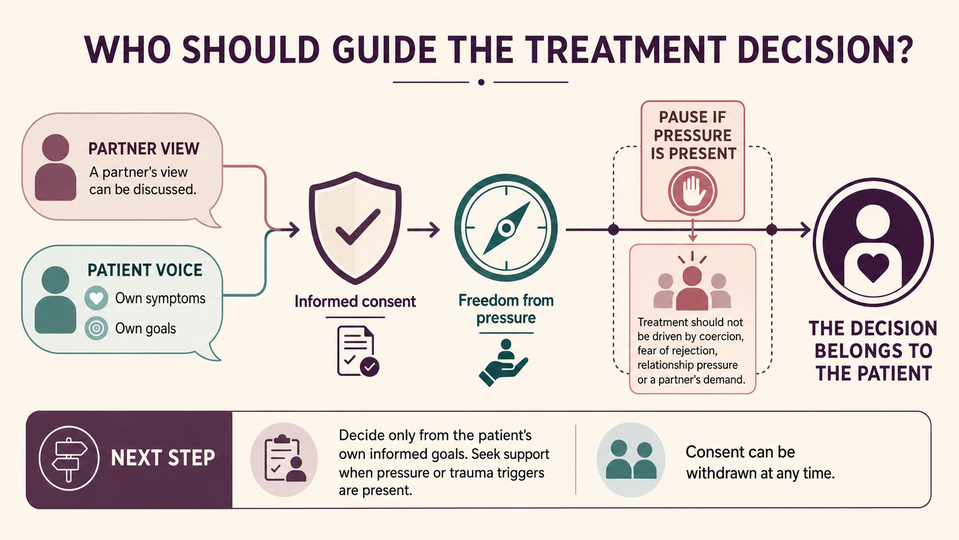
Treatment decisions should be based on the patient's own symptoms and goals, not pressure from a partner, relationship conflict or shame.
Direct answer
A partner's view can be discussed, but treatment decisions should be based on the patient's own symptoms, goals, consent and freedom from pressure. The realistic next step is to pause if pressure is present and make decisions only from the patient's own informed goals.
Physical treatment may help selected symptoms, but it cannot resolve coercion, communication problems, anxiety, low desire or relationship distress.
Educational only. Suitability and next steps should be confirmed after consultation. Results vary. Not a cure.

Autonomy first
At a glance
These are the main points before deciding whether a fear, comment, sexual concern or marketing claim reflects a real anatomical problem.
At a glance
Decision summary
Main area
Decision-making
Pattern
Patient-led
Watch for
Pressure
Next step
Pause if unsure
Important safety note
Pause and seek support if treatment is being driven by coercion, fear of rejection, relationship pressure, distress, trauma triggers or a partner's demand.
Goals
Pressure
Support
Consent
Detailed answer
The clinical answer
The answer starts by separating sexual myths, normal variation, arousal, pelvic-floor symptoms, consent, psychological safety and treatment limits.
Patient autonomy
The reader wants to know whether a fear, partner comment, sexual experience, body-image worry or marketing claim reflects a real anatomical problem, and how to choose care without shame or pressure.
Sensation
Consent
Support
Patient autonomy
Start with the exact concern: looseness, pain, dryness, reduced sensation, body-image worry, partner pressure and relationship distress are not the same issue.
Relationship context
Normal anatomy varies widely, and sexual sensation can be affected by arousal, lubrication, anxiety, partner factors, menopause and pelvic-floor function.
Consent free from pressure
Consent matters: treatment should not be driven by shame, virginity claims, coercion, pressure selling or a partner's demand.
Physical versus relational goals
Seek review when symptoms include pain, bleeding, a new bulge, urinary or bowel change, persistent numbness, distress or body-image fixation.
How the research shapes the answer
The research supports treating this as a decision-making question rather than a generic tightening-results question.
The research synthesis shaped the structure, while final wording avoids shame language, sexual-history judgement, result promises, device hype, treatment ranking and pressure-led framing.
Patient safety
Why this matters
These questions matter because myths, shame and pressure can push people towards treatment before the real symptom, context or safety issue is understood.
It protects autonomy
The patient's own goals should drive decisions.
It avoids false promises
Treatment cannot resolve relationship conflict.
It identifies coercion
Pressure from a partner is a reason to pause.
It supports honest goals
Physical, sexual and relational concerns need separating.
Pressure-free care is safer
Good care should leave a patient feeling informed and respected, not frightened about normal anatomy or rushed into treatment.
The right next step may be reassurance, pelvic-floor assessment, menopause care, counselling, psychosexual support, treatment, or no treatment.
Considerations
What to consider
Isolation is Mandatory: Providers must always separate the patient from their partner and any children over 18 months of age before asking any screening questions about abuse [40, 41]. Confidentiality Disclosures: Before screening, clinicians must explicitly explain the limits of confidentiality (e.g..
Decision priorities
Track symptoms, consent, pressure, arousal, pain, dryness, bleeding, pelvic support, body-image distress, relationship context and whether treatment expectations are realistic.
Consent
Context
Support
Whose goal is this?
Treatment should be for the patient, not to satisfy pressure.
Check relationship safety
Fear, coercion or threat changes the care plan.
Separate symptom types
Physical discomfort and relationship distress need different support.
Allow time
A pressure-free decision should not feel rushed.
What not to assume
Do not assume a fear, partner comment, media comparison or marketing claim proves a structural problem.
Routine Enquiry Timelines: Assessment for domestic abuse and reproductive coercion should be conducted routinely, at least annually, and during specific clinical visits such as initial consultations, prenatal care, STI/HIV testing, and emergency contraception appointments [18, 19]. Immediate Safety Timelines: If a patient.
Common concerns and myths
Common misconceptions
These corrections keep the page anti-shame, consent-aware and clinically realistic.
Myth: Treatment can resolve relationship conflict
Reality: treatment decisions need patient-led consent and should pause when pressure or coercion is present.
Myth: A partner's preference should decide treatment
Reality: treatment decisions need patient-led consent and should pause when pressure or coercion is present.
Myth: Consent is valid even when pressure is high
Reality: treatment decisions need patient-led consent and should pause when pressure or coercion is present.
Context changes the answer
The same concern can need reassurance, examination, pelvic-health care, menopause care, counselling or safeguarding depending on symptoms and pressure.
Treatment cannot resolve every concern
Physical treatment cannot promise sexual confidence, relationship repair, body-image relief or a specific sensation.
Safety checklist
Safety checklist
Use these checks before deciding whether to continue self-management, book assessment, seek counselling or avoid a pressured treatment decision.
Is there pressure?
Partner pressure, shame, fear, coercion or sales urgency is a reason to pause.
Are there physical symptoms?
Pain, dryness, bleeding, bulge, urinary symptoms, bowel symptoms or numbness need assessment.
Is worry becoming intrusive?
Repeated checking, avoidance, distress or body-image fixation may need support before treatment.
Are expectations realistic?
Treatment should not be expected to prove virginity, resolve a relationship or promises sexual satisfaction.
More reassuring signs
The situation is more reassuring when there is no pressure, no red-flag symptom, expectations are realistic and the decision feels calm, informed and patient-led.
Informed
Patient-led
Reasons to seek advice
Clinical Red Flags: Warning signs of coercion include frequent unexplained injuries, delayed pregnancy care, recurrent STIs or UTIs, multiple unintended pregnancies, chronic unexplained pain, and non-compliance with treatment [25-27]. Behavioural Red Flags: An overly dominant partner who answers questions for the patient.
Bleeding
Pain
When to escalate
When to seek medical help
These symptoms or situations should not be managed with reassurance or marketing claims alone.
Use NHS 111 online
Physical symptoms
Bleeding, pain, a new bulge, urinary or bowel symptoms, offensive discharge, fever or persistent numbness should be assessed.
Pressure or coercion
Fear, partner pressure, threats, virginity pressure or high-pressure sales should prompt a pause and support.
Psychological distress
Intrusive worry, repeated checking, trauma triggers, avoidance or repeated treatment seeking should be discussed safely.
Emergency symptoms
Call 999 for life-threatening symptoms such as collapse, severe bleeding, chest pain, breathing difficulty or stroke-like symptoms.
Use NHS 111 for urgent advice or call 999 in a life-threatening emergency. This page is educational and does not replace individual medical assessment.
Additional clinical context
How to use this answer
Use this page to separate myths, pressure and marketing claims from symptoms that need assessment. The key question is whether the concern is patient-led, informed and realistic, or driven by shame, coercion, distress, body-image comparison or untreated symptoms.What to bring to review
Helpful details include the main worry, symptom pattern, pain, dryness, bleeding, urinary or bowel symptoms, arousal changes, partner context, pressure, body-image distress, prior treatments, expectations and what would feel like a safe outcome.Regulatory resources
Authoritative resources
These resources support advice on consent, relationship wellbeing, sexual health and autonomy in genital-procedure decisions.
Next step
Book a clinical consultation
A consultation can clarify whether symptoms are physical, relational, psychosexual or mixed, and whether treatment is appropriate for the patient's own goals.
▶ View Research Sources (12 Sources)
These 12 source names are selected from 12 display-ready sources, with a raw audit trail of 71 imported records. Additional reviewed material included UK clinical guidance, professional society guidance, peer-reviewed clinical papers, evidence reviews; duplicate, low-relevance and non-clinical records were removed before display.
Educational only. This information is for education only and is not a substitute for professional medical advice, diagnosis or treatment. Results vary. Not a cure.
