

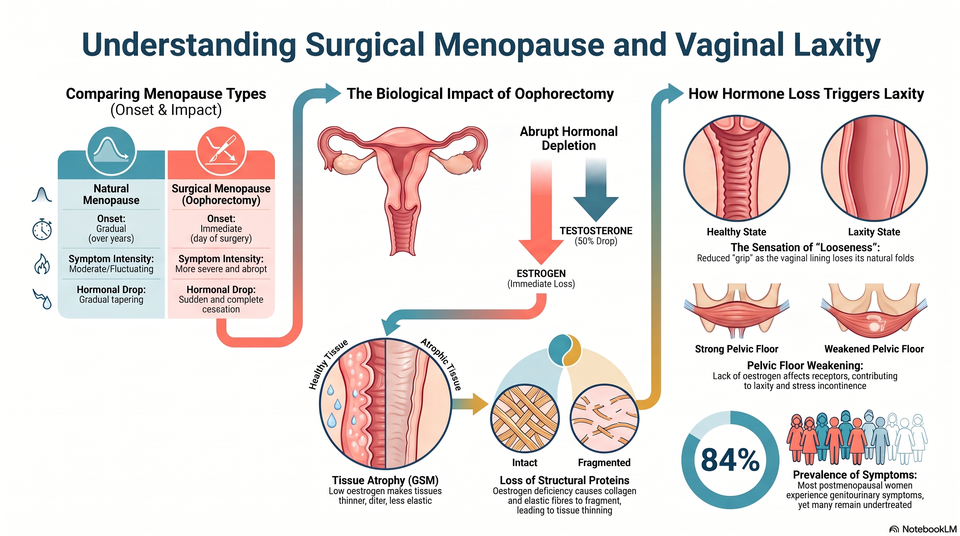


Can low oestrogen after oophorectomy worsen laxity symptoms?

Can low oestrogen after oophorectomy worsen laxity symptoms? | WHC Clinical FAQ

Can local oestrogen reduce the feeling of laxity? | WHC Clinical FAQ
Surgical menopause
Abrupt low oestrogen
Support check
Women’s Health Clinic FAQ
Can low oestrogen after oophorectomy worsen laxity symptoms?
Oophorectomy can cause a sudden low-oestrogen state, which may quickly affect vaginal hydration, elasticity and comfort.
Direct answer
Low oestrogen after oophorectomy can worsen laxity-like symptoms by rapidly reducing vaginal hydration, elasticity and comfort. That does not mean every symptom is structural laxity; GSM, pain, prolapse and pelvic-floor support still need assessment. The safest next step is menopause-aware assessment of GSM, support, pain and treatment suitability.
A useful answer explains abrupt tissue change while still checking GSM, pain, prolapse and pelvic-floor support rather than assuming one cause.
Educational only. Suitability and next steps should be confirmed after consultation. Results vary. Not a cure.

Surgical menopause
At a glance
These are the main points to understand before deciding whether symptoms need tracking, tissue care, pelvic-floor review, menopause assessment or treatment discussion.
At a glance
Hormone-aware summary
Main area
Surgical menopause
Pattern
Rapid tissue change
Watch for
Bleeding or severe pain
Next step
Menopause review
Important safety note
New bleeding, severe pelvic pain, discharge, recurrent urinary symptoms, new bulge or notable symptom change after surgery should be assessed.
Tissue
Support
Safety
Timing
Detailed answer
Detailed answer
The deeper answer starts by separating hormone-related tissue change, dryness, friction, pH, sexual sensation, pelvic-floor support and true structural laxity.
Surgical menopause
The reader wants to understand abrupt low-oestrogen change after ovary removal.
Tissue
Symptoms
Plan
Surgical menopause
Start with the hormone or timing factor most relevant to the question, because cycle, menopause and surgical menopause can change tissue sensation.
Rapid tissue change
A loose feeling may overlap with dryness, reduced friction, pain, pH change, arousal, prolapse, pelvic-floor weakness or true support change.
GSM symptoms
Tissue care, hormone discussions and moisturisers should not bypass bleeding checks, pain assessment, prolapse review or suitability assessment.
Support assessment
Treatment decisions should define whether the aim is comfort, tissue health, support, sexual function, safety, symptom clarity or treatment timing.
How the research shapes the answer
Under-treatment Epidemic: Approximately 70% of postmenopausal women experience symptoms of GSM, yet only around 7% receive proper treatment, largely due to embarrassment or the misconception that these symptoms are an inevitable part of ageing [20]. Investigational Devices: While heavily marketed for "vaginal.
The benchmark shaped search intent and structure, but final wording avoids prescription-brand promotion, device hype, universal recovery deadlines, procedure ranking and overconfident treatment claims.
Patient safety
Why this matters
Hormone-related vaginal symptoms can be confusing because dryness, reduced sensation, comfort, bleeding pattern and support can all change how tightness feels.
It separates mimicry from structure
Dryness, low-oestrogen tissue, pH change, arousal, pain and cycle phase can all mimic or amplify a loose feeling.
It avoids over-treatment
Treating tissue comfort or bleeding context first may clarify whether any structural laxity remains.
It keeps medicines in context
Hormone options, DHEA and testosterone need suitability assessment and should not be framed as tightening treatments.
It protects safety
Bleeding, infection symptoms, pain, new vulval change or prolapse symptoms should change the pathway before elective treatment.
Assessment protects choice
A careful review does not mean treatment is impossible; it means the plan should match tissue comfort, safety, support and goals.
The safest page helps patients understand what may be hormone-related and what still needs examination or referral.
Considerations
What to consider
Vaginal Oestrogen Administration: The standard initiation protocol for local oestrogen (pessaries, tablets, or creams) is nightly application for the first two weeks, followed by a maintenance dose of twice weekly [24, 25]. Endometrial Protection: Because systemic absorption of local vaginal oestrogen is.
Consultation priorities
Bring details about cycle phase, bleeding pattern, menopause stage, ovary surgery, dryness, pain, discharge, urinary symptoms, moisturiser or lubricant use, hormone treatment, pelvic-floor symptoms and treatment goals.
Symptoms
Treatment
Goals
Map the timing
Note cycle phase, period pattern, perimenopause, menopause, surgical menopause, symptom triggers and whether the concern is constant or fluctuating.
Check tissue symptoms
Ask about dryness, irritation, painful sex, discharge, recurrent urinary symptoms, vulval change and lubricant or moisturiser response.
Separate sensation from support
Reduced friction or sexual sensation may involve arousal, blood flow, pain, hormones or tissue comfort rather than vaginal width.
Clarify treatment readiness
Bleeding, GSM, infection symptoms, pain or unclear anatomy should be addressed before tightening or energy-device discussion.
What not to assume
Do not assume hormone-related symptoms are always structural laxity, always temporary, always menopause-related or always ready for a procedure.
Onset and Progression: Unlike vasomotor symptoms (hot flushes) which may fluctuate, GSM and its structural tissue changes are progressive and will not resolve spontaneously without treatment [9, 10]. Symptom Manifestation: While the full anatomical effects of oestrogen deprivation can take years to.
Common concerns and myths
Common misconceptions
These corrections keep the answer specific, hormone-aware and clinically cautious.
Myth: Oophorectomy only affects hot flushes
Reality: pH, microbiome and discharge symptoms can affect comfort and should be checked before elective treatment.
Myth: All post-surgery looseness is structural
Reality: the answer depends on hormones, tissue comfort, bleeding pattern, pelvic-floor function, support symptoms and realistic goals.
Myth: Hormone status removes the need for examination
Reality: hormone options may support tissue symptoms for suitable patients, but they are not structural tightening treatments.
Symptoms can mimic each other
Dryness, pH change, arousal, pelvic-floor support and prolapse can all alter perceived tightness.
Treatment has limits
No hormone, moisturiser, device or exercise can promise improved friction, sensation, elasticity, support restoration or lasting results.
Safety checklist
Safety checklist
Use these checks to decide whether symptoms can be discussed routinely or need earlier medical advice.
Is there bleeding?
Postmenopausal, postcoital, heavy or unexplained bleeding should be assessed before elective vaginal treatment.
Could this be GSM or dryness?
Dryness, irritation, reduced friction or painful sex may mimic or amplify a loose feeling.
Are support symptoms present?
Bulge, heaviness, urinary retention, leakage or bowel symptoms should change timing and pathway.
Are goals realistic?
The plan should define whether the aim is comfort, tissue health, support, sexual sensation, safety or treatment timing.
More reassuring signs
The situation is more reassuring when symptoms are stable or cyclic, there is no unusual bleeding, severe pain, discharge, new bulge, urinary retention or new vulval change, and goals are realistic.
Mapped
No red flags
Reasons to seek advice
Vaginal Bleeding: Any unscheduled, unexplained, or postmenopausal vaginal bleeding must be urgently investigated to rule out endometrial hyperplasia or malignancy before attributing it solely to GSM [15, 16]. Contraindications for Systemic HRT: Systemic hormone therapy is strictly contraindicated in patients with untreated.
Pain
Discharge
When to escalate
When to seek medical help
These symptoms or situations should not be managed with general vaginal-tightening advice alone.
Use NHS 111 online
Bleeding that needs review
Postmenopausal bleeding, bleeding after sex, very heavy bleeding or unexplained bleeding should be assessed promptly.
Infection or irritation signs
Offensive discharge, fever, recurrent urinary symptoms, severe burning or pelvic pain should be checked.
Bulge or urinary retention
A new bulge, urinary retention, worsening leakage or bowel symptoms may indicate support problems needing review.
Emergency symptoms
Call 999 for life-threatening symptoms such as collapse, severe bleeding, chest pain, breathing difficulty or stroke-like symptoms.
Use NHS 111 for urgent advice or call 999 in a life-threatening emergency. This page is educational and does not replace individual medical assessment.
Additional clinical context
How to use this answer
Use this page to prepare a focused discussion about hormone timing, tissue comfort, dryness, bleeding pattern, pelvic-floor support and whether symptoms are temporary or persistent. The aim is to understand whether the concern is GSM, cycle variation, sexual-sensation change, pH-related irritation, prolapse overlap or true laxity.What to bring to consultation
Helpful details include cycle timing, bleeding pattern, menopause stage, oophorectomy or hysterectomy history, dryness, pain, discharge, recurrent urinary symptoms, current hormone treatment, moisturiser or lubricant use, prolapse symptoms, pelvic-floor symptoms and treatment goals.Regulatory resources
Authoritative resources
These resources support UK-facing information on menopause, surgical recovery, vaginal dryness and low-oestrogen tissue symptoms.
Next step
Book a clinical consultation
A consultation can review surgical history, hormone status, GSM symptoms, pelvic-floor support, pain, urinary symptoms and treatment suitability.
▶ View Research Sources (12 Sources)
These 12 source names are selected from 12 display-ready sources, with a raw audit trail of 55 imported records. Additional reviewed material included UK clinical guidance, professional society guidance, peer-reviewed clinical papers; duplicate, low-relevance and non-clinical records were removed before display.
Educational only. This information is for education only and is not a substitute for professional medical advice, diagnosis or treatment. Results vary. Not a cure.
