



Can vaginal tightening fix prolapse issues?

Can vaginal tightening fix prolapse issues?

Can vaginal tightening fix prolapse issues? | WHC Clinical FAQ
Prior repair
Mesh-aware
Specialist review
Women’s Health Clinic FAQ
Can previous prolapse repair affect vaginal tightening options?
Previous prolapse repair or pelvic mesh can change vaginal tightening options because anatomy, scarring, support and pain patterns may be different.
Direct answer
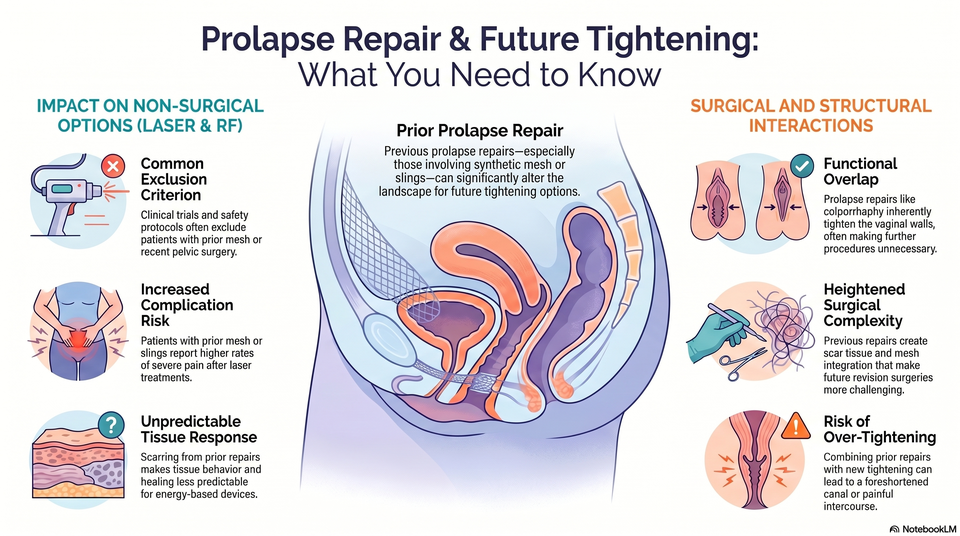
Previous prolapse repair can affect vaginal tightening options because scar tissue, altered anatomy, mesh, sutures or changed support can alter safety and results. The previous operation needs to be understood before laser, RF or further surgery is considered. The safest sequence is specialist-aware review of prior repair or mesh details before any device or surgical plan.
A safe answer avoids blanket permission or refusal, then explains why operation details and specialist review matter.
Educational only. Suitability and next steps should be confirmed after consultation. Results vary. Not a cure.

Repair history
At a glance
These are the main points to understand before deciding whether symptoms need surgical review, menopause care, pelvic-health assessment or treatment discussion.
At a glance
Post-surgical suitability
Main area
Prior repair or mesh
Pattern
Altered anatomy
Watch for
Pain or exposure
Next step
Specialist-aware review
Important safety note
Mesh exposure symptoms, new pain, bleeding, discharge, worsening bulge, urinary retention or bowel dysfunction should be reviewed before any laser, RF or surgical treatment.
Vault support
Cuff comfort
Mesh or scars
Review
Detailed answer
Detailed answer
The deeper answer starts by separating post-surgical anatomy, support symptoms, tissue health, pain and the limits of elective tightening.
Repair type
The reader has prior prolapse surgery and wants to know whether treatment options change.
Healing
Assessment
Goals
Repair type
Start with the operation history because hysterectomy, ovary removal, mesh, prolapse repair and scars change the clinical context.
Altered anatomy
A loose feeling may reflect vault support, prolapse, tissue dryness, scar discomfort, pain or vaginal-wall laxity, so the symptom needs careful mapping.
Scar and support
Laser, RF or surgery should not be used to bypass surgical review, mesh history, cuff tenderness, pain assessment or prolapse evaluation.
Mesh or sutures
Treatment decisions should define whether the goal is comfort, support, tissue health, examination tolerance, sexual comfort or symptom clarity.
How the research shapes the answer
The research supports treating prior repair or mesh as a post-surgical assessment question rather than a routine device-choice question.
The benchmark shaped search intent and structure, but final wording avoids device hype, universal healing timelines, probe instructions and procedure ranking.
Patient safety
Why this matters
Post-surgical vaginal laxity questions matter because surgery can change anatomy, support, comfort, tissue health and future examination needs.
It prevents the wrong target
Post-surgical symptoms can come from vault support, prolapse, GSM-type tissue change, scarring, pain or true vaginal-wall laxity.
It protects healing and anatomy
Cuff integrity, scars, mesh, prior repairs and altered vaginal shape can change what is safe or comfortable.
It improves consent
Patients need to know what laser, RF, surgery or further tightening can and cannot reasonably address.
It guides sequencing
Surgical review, menopause care, pelvic-health physiotherapy or records review may need to happen before treatment decisions.
Assessment protects choice
A cautious review does not mean treatment is impossible; it means the plan should respect surgical anatomy and current symptoms.
The safest page helps the patient understand what needs checking before a procedure is discussed.
Considerations
What to consider
Records Retrieval: Patients must provide complete operative reports from their previous prolapse surgeries so the current clinician knows exactly what techniques and materials (e.g., synthetic mesh vs. biological grafts) were used [2]. Specialist Evaluation: Patients with prior POP surgery seeking vaginal tightening.
Consultation priorities
Bring details about hysterectomy type, ovary removal, mesh or repair history, operation notes, cuff tenderness, pain, bleeding, discharge, prolapse symptoms, urinary or bowel symptoms and treatment goals.
Symptoms
Records
Goals
Know the operation type
Clarify hysterectomy type, ovary removal, cervix status, cuff symptoms, prolapse repair and any mesh or implant details.
Map the symptom
Separate looseness from bulge, heaviness, pain, dryness, tenderness, urinary symptoms, bowel symptoms or pain during sex.
Check healing and pain
Ongoing bleeding, discharge, tenderness, scar pain or new pain should change the timing of elective treatment.
Bring useful records
Operation notes, discharge letters, histology, mesh cards and previous pelvic-floor assessments help avoid guesswork.
What not to assume
Do not assume a post-surgical loose feeling is simple laxity, or that a device can safely treat symptoms without knowing the anatomy.
Assessment Phase: Evaluating a patient with a prior prolapse repair requires extended consultation time to review previous surgical notes, conduct a physical exam, and potentially utilize imaging to map existing mesh or scar tissue [15, 16]. Treatment Sequencing: If mesh complications are.
Common concerns and myths
Common misconceptions
These corrections keep the answer practical, specific and clinically cautious.
Myth: Past prolapse repair is irrelevant
Reality: prolapse and laxity can feel similar, but they need different assessment and treatment pathways.
Myth: Laser or RF avoids all surgical-history issues
Reality: suitability depends on operation history, healing, anatomy, symptoms, tissue health and realistic goals.
Myth: Revision surgery and tightening are interchangeable
Reality: prior repair, mesh and surgical anatomy can change suitability and often need specialist-aware review.
Anatomy matters
Vault support, cuff comfort, scarring, mesh and prolapse can change both symptoms and suitability.
Treatment has limits
Vaginal tightening cannot treat vault prolapse, mesh complications, adhesions, scar pain, surgical menopause or unexplained pelvic pain.
Safety checklist
Safety checklist
Use these checks to decide whether treatment can be discussed routinely or should wait for post-surgical assessment.
Is the surgical history clear?
Hysterectomy type, ovary removal, cervix status, mesh, prolapse repair and complications should be clarified where possible.
Could this be prolapse or vault support?
Bulge, heaviness, pressure, urinary retention or bowel symptoms should not be treated as simple laxity.
Is there pain, bleeding or cuff concern?
Tenderness, pain during sex, bleeding, discharge, fever or suspected tissue opening should change timing and urgency.
Are the goals realistic?
The plan should define whether the aim is comfort, support, tissue health, examination tolerance or symptom clarity.
More reassuring signs
The situation is more reassuring when healing is complete, symptoms are stable, records are available and there is no bulge, severe pain, bleeding or infection sign.
Healed
Records available
Reasons to seek advice
Transvaginal Mesh History: This is a major red flag. Using thermal energy devices over synthetic mesh can cause catastrophic local reactions, including levator ani spasms and severe fibrotic banding [6, 7]. Unexplained Symptoms: Severe pelvic pain, unexplained vaginal bleeding, recurrent urinary tract.
Bulge
Pain
When to escalate
When to seek medical help
These symptoms or situations should not be managed with general vaginal-tightening advice alone.
Use NHS 111 online
Bleeding or tissue concerns
Unexplained bleeding, tissue opening, non-healing areas, fever or offensive discharge need medical advice.
Pelvic support red flags
A worsening bulge, urinary retention, bowel dysfunction or severe pelvic pressure should be assessed.
Pain red flags
Severe pelvic pain, worsening painful sex, new cuff tenderness or pain after treatment should be reviewed.
Emergency symptoms
Call 999 for life-threatening symptoms such as collapse, severe bleeding, chest pain, breathing difficulty or stroke-like symptoms.
Use NHS 111 for urgent advice or call 999 in a life-threatening emergency. This page is educational and does not replace individual medical assessment.
Additional clinical context
How to use this answer
Use this page to prepare a focused discussion about post-surgical anatomy, pelvic support and treatment suitability. The aim is to understand whether the concern is vault support, prolapse, GSM-type tissue change, scar pain, adhesions, cuff tenderness or vaginal-wall laxity.What to bring to consultation
Helpful details include operation notes, discharge summaries, ovary or cervix status, mesh or implant details, histology where relevant, previous prolapse repairs, pelvic-floor assessments, complications, current pain, bleeding, discharge, bulge symptoms and treatment goals.Regulatory resources
Authoritative resources
These resources support UK-facing information on pelvic mesh, prolapse repair, energy-device evidence limits and specialist urogynaecology review.
GOV.UK - Mesh pause high-vigilance restriction period
UK safety context for pelvic mesh vigilance.
NICE NG123 - Urinary incontinence and pelvic organ prolapse
UK guideline for prolapse, mesh and specialist pelvic-floor pathways.
NHS - Pelvic organ prolapse
Patient baseline for prolapse symptoms and treatment routes.
Next step
Book a clinical consultation
A consultation can review previous repair type, mesh details, operation notes, pain, scarring, prolapse signs and whether specialist input is needed before treatment.
▶ View Research Sources (12 Sources)
These 12 source names are selected from 12 display-ready sources, with a raw audit trail of 59 imported records. Additional reviewed material included UK clinical guidance, professional society guidance, peer-reviewed clinical papers, evidence reviews; duplicate, low-relevance and non-clinical records were removed before display.
Educational only. This information is for education only and is not a substitute for professional medical advice, diagnosis or treatment. Results vary. Not a cure.
