

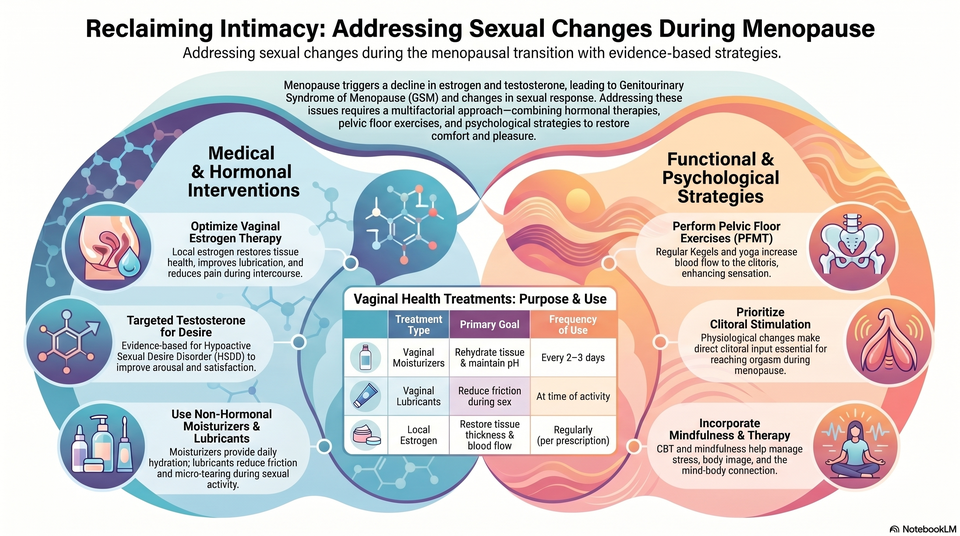


How do you address changes in sexual response, arousal, and orgasm during menopause?

How do you address changes in sexual response, arousal, and orgasm during m... | WHC Clinical FAQ

Menopause Pain & Low Arousal? Expert Guide to GSM, Oestrogen & Intimacy Solutions 💡
GSM aware
Pain matters
Product caution
Women’s Health Clinic FAQ
How do you address changes in sexual response, arousal, and orgasm during menopause?
Vaginal dryness, GSM and sexual response changes need precise, non-shaming advice because pain, friction and avoidance can quickly affect intimacy.
Direct answer
Changes in arousal, sexual response and orgasm during menopause can be linked to vaginal dryness, blood flow, pelvic floor tension, pain, sleep, mood, medicines, relationship safety and desire. Addressing them usually means checking physical comfort, stimulation, context, expectations and whether GSM or pain needs treatment. Clinical review is important if there is pain, bleeding, recurrent urinary symptoms, sores or distress around intimacy.
A useful answer separates moisturisers, lubricants, devices, pelvic-floor support and clinical treatment instead of presenting products as quick resolves.
Educational only. Suitability and next steps should be confirmed after consultation. Results vary. Not a cure.

GSM and intimacy
At a glance
These are the main points to understand before deciding what support, conversation, assessment or adjustment may help.
At a glance
Practical clinical summary
Main area
Vaginal comfort
Pattern
Dryness or pain
Watch for
Bleeding or sores
Next step
Cause-led review
Important safety note
Painful sex, bleeding after sex, vulval sores, persistent burning or recurrent urinary symptoms should be assessed rather than managed with products alone.
Context
Support
Boundaries
Review
Detailed answer
Detailed answer
The deeper answer starts by matching the symptom to the real-life setting, because work, relationships and intimacy are affected by both biology and context.
Arousal and lubrication
The reader wants a sensitive, non-shaming explanation of sexual response changes.
Practical steps
Communication
Safety
Arousal and lubrication
Start by naming the specific symptom or situation, because fatigue, pain, low desire, brain fog and conflict need different support.
Orgasm changes
Look at the setting around the symptom, including work demands, sleep, relationship safety, products, medicines and emotional pressure.
Pain and avoidance
The most useful plan is practical and proportionate, with clear language for what can be tried and when review is needed.
Medication and mood
Follow-up matters when symptoms persist, affect safety, confidence, sex, sleep, performance or emotional closeness.
How the research shapes the answer
The research supports a cause-led GSM and sexual wellbeing pathway that separates dryness, pain, arousal, pelvic floor tension and product choice.
The benchmark shaped the search intent and structure, but final wording avoids legal overclaiming, product promotion, blame and pressure-based intimacy advice.
Patient safety
Why this matters
Menopause can affect work, sleep, confidence, body image, desire, communication and sexual comfort, but the impact is easier to manage when it is named clearly.
Dryness and arousal differ
Lubrication can be affected by GSM, arousal, medicines, stress, pain and relationship context.
Products do different jobs
Moisturisers support baseline dryness, lubricants reduce friction, and dilators are used for graded comfort or narrowing.
Pain changes desire
The body can learn to avoid sex when touch has become painful or threatening.
Assessment protects safety
Bleeding, sores, infection, pelvic floor pain or skin disease can overlap with GSM.
Practical, not blaming
A good answer should make the next conversation easier, whether that conversation is with a manager, partner, clinician or therapist.
It should also protect privacy, consent and safety rather than pushing disclosure, endurance or quick resolves.
Considerations
What to consider
A consultation should review pain, bleeding, dryness, product use, urinary symptoms, pelvic floor signs, medicines and whether GSM treatment is needed.
Conversation priorities
Useful details include symptom timing, what has changed, what makes it worse, what has already been tried and what support would feel realistic.
Pacing
Options
Follow-up
Match the product to the symptom
Choose moisturiser, lubricant, dilator or clinical treatment based on dryness, friction, narrowing, pain or fear.
Avoid irritating products
Fragrance, unsuitable oils, high-osmolality products or poorly fitted devices can worsen irritation.
Stop pushing through pain
Continuing through pain can reinforce guarding and avoidance.
Discuss GSM treatment
Persistent GSM may need clinical treatment rather than repeated product changes.
What not to assume
Do not assume the person is less capable, less interested, less loving or simply being difficult.
Comfort may improve only when the cause is addressed; repeated product switching without assessment can delay effective care.
Common concerns and myths
Common misconceptions
Menopause advice can become dismissive, overly legalistic or too product-focused. These corrections keep the answer balanced.
Myth: Orgasm change means sexual function is lost
Reality: dryness, pain, arousal and product choice need cause-led assessment rather than one generic solution.
Myth: It is all psychological
Reality: dryness, pain, arousal and product choice need cause-led assessment rather than one generic solution.
Myth: More effort is the answer
Reality: dryness, pain, arousal and product choice need cause-led assessment rather than one generic solution.
Context changes the answer
The same symptom can need a workplace adjustment, relationship conversation, clinical review or specialist therapy depending on context.
Support should reduce pressure
The aim is safer communication and better care, not forced disclosure, endurance or blame.
Safety checklist
Safety checklist
Use these checks to decide whether self-management is enough or whether support should be escalated.
Is there pain, bleeding or danger?
Painful sex, postmenopausal bleeding, severe pain, coercion, unsafe work or crisis symptoms should not be minimised.
Is privacy protected?
At work and in relationships, support should not require more disclosure than the person feels safe sharing.
Is the plan realistic?
Adjustments, intimacy changes or sleep arrangements work best when they are specific, agreed and reviewed.
Is specialist support needed?
Occupational health, counselling, psychosexual therapy, pelvic-health physiotherapy or menopause care may be useful.
More reassuring signs
The situation is more reassuring when symptoms are stable, boundaries are respected, support is agreed and there are no red flags.
Respectful
Reviewed
Reasons to seek advice
Painful sex, bleeding after sex, vulval sores, persistent burning or recurrent urinary symptoms should be assessed rather than managed with products alone.
Bleeding
Safety
When to escalate
When to seek medical help
These symptoms or situations should not be managed with general menopause advice alone.
Use NHS 111 online
Bleeding after sex
Bleeding after sex or postmenopausal bleeding should be assessed.
Vulval skin changes
Sores, ulcers, new lumps, colour change or persistent itching should be reviewed.
Severe or persistent pain
Painful sex, pelvic pain or burning that does not settle needs cause-led assessment.
Infection signs
Fever, foul discharge, blood in urine or feeling unwell with urinary symptoms needs advice.
Use NHS 111 for urgent advice or call 999 in a life-threatening emergency. This page is educational and does not replace individual medical assessment.
Additional clinical context
How to use this answer
Use this page to identify what needs a practical change, what needs a better conversation and what needs clinical or specialist review.What to bring to a conversation
Helpful details include symptom timing, work or relationship impact, sleep, pain, bleeding, products tried, medicines, mood changes, boundaries and the specific support that would feel useful.Regulatory resources
Authoritative resources
These resources support UK-facing information on GSM, vaginal dryness, painful sex, lubricants, moisturisers and sexual comfort.
NHS - Vaginal dryness
UK patient source for dryness, lubricants, moisturisers and medical review.
British Menopause Society - Genitourinary syndrome of menopause
Professional source for GSM, tissue change and treatment boundaries.
Women's Health Concern - Vaginal dryness
Patient-facing UK source for dryness, painful sex and practical care.
Next step
Book a clinical consultation
A consultation can review dryness, pain, arousal, orgasm change, pelvic floor symptoms, product use and whether GSM treatment or psychosexual support may help.
▶ View Research Sources (12 Sources)
These 12 source names are selected from 12 display-ready sources, with a raw audit trail of 42 imported records. Additional reviewed material included UK clinical guidance, professional society guidance, peer-reviewed clinical papers, evidence reviews; duplicate, low-relevance and non-clinical records were removed before display.
Educational only. This information is for education only and is not a substitute for professional medical advice, diagnosis or treatment. Results vary. Not a cure.

