

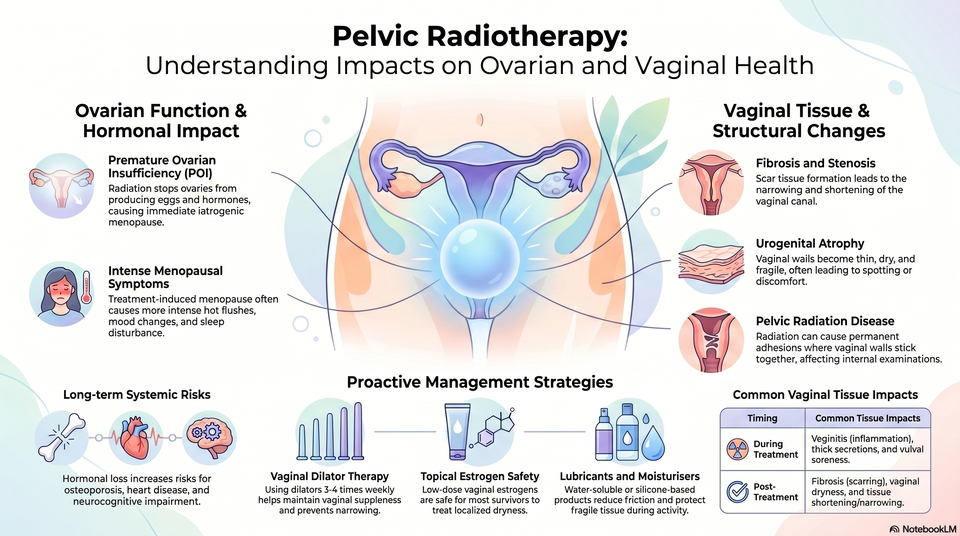


How do pelvic radiation treatments impact ovarian function and vaginal tissue health?

How do pelvic radiation treatments impact ovarian function and vaginal tiss... | WHC Clinical FAQ

Can the O-Shot improve vaginal tissue quality?
Pelvic radiation
Tissue health
Long-term care
Women’s Health Clinic FAQ
How do pelvic radiation treatments impact ovarian function and vaginal tissue health?
Pelvic radiotherapy can affect ovarian function, vaginal tissue, sexual comfort, bladder symptoms and long-term pelvic health.
Direct answer
Pelvic radiation can affect ovarian function by damaging follicles and can affect vaginal tissue by causing dryness, narrowing, reduced elasticity, fibrosis, soreness and sexual pain. The impact depends on dose, field, age, cancer treatment plan and whether ovaries were shielded or moved. The safest interpretation depends on age, treatment history, symptoms, medicines, fertility wishes, cancer history and any red flags. Clinical review is especially important when symptoms are sudden, severe, treatment-related or linked with mental-health, bleeding, breast, pelvic or fertility concerns.
A strong answer explains both ovarian hormone effects and local tissue effects, then shows when pelvic, sexual or oncology follow-up may help.
Educational only. Suitability and next steps should be confirmed after consultation. Results vary. Not a cure.

Pelvic radiotherapy
At a glance
These are the main points to understand before deciding whether symptoms are expected, need specialist review or need urgent advice.
At a glance
Practical clinical summary
Main area
Pelvic tissue
Pattern
Radiation effects
Watch for
Pain or bleeding
Next step
Specialist support
Important safety note
New bleeding, severe pelvic pain, infection symptoms or worsening bowel, bladder or vaginal symptoms after pelvic radiotherapy should be reviewed.
Symptoms
Risk
Options
Review
Detailed answer
Detailed answer
The deeper answer starts by identifying the cause and clinical context, because high-risk menopause questions are not safely answered by symptom labels alone.
Ovarian failure risk
The reader wants to understand ovarian failure, vaginal tissue change and sexual health after pelvic radiotherapy.
Assessment
Specialist input
Safety
Ovarian failure risk
Start with the specific clinical setting, because the same symptom can mean different things after surgery, cancer treatment, POI or natural transition.
Vaginal dryness and stenosis
Timing, severity, current medicines, bleeding pattern and age help decide whether routine review, specialist advice or urgent support is needed.
Fibrosis and elasticity
The care plan should explain likely mechanisms, realistic options and the limits of what any one treatment or strategy can achieve.
Dilator and pelvic floor support
Follow-up is important when symptoms persist, affect sex, sleep, mood, bladder function, fertility decisions or long-term health risk.
How the research shapes the answer
The research supports covering both ovarian effects and local pelvic tissue effects, including vaginal narrowing, dryness, fibrosis and sexual pain.
The benchmark shaped the structure, but final wording is conservative, UK-facing and designed for clinical decision-making rather than marketing.
Patient safety
Why this matters
Complex menopause questions can affect more than symptom comfort; they may involve fertility, cancer treatment, bone health, heart health, sexual wellbeing, pelvic tissue or mental health.
Ovaries are sensitive to radiation
Pelvic radiotherapy may reduce ovarian function depending on age, dose and treatment field.
Vaginal tissue can scar
Radiation may contribute to dryness, narrowing, reduced elasticity, soreness and painful sex.
Fibrosis changes comfort
Tissue stiffness and pelvic floor guarding can affect examinations, intimacy and daily comfort.
Long-term care matters
Dilator support, pelvic floor care, GSM treatment and surveillance may be needed after treatment.
A joined-up view
The best answer should make the mechanism understandable without flattening the emotional and medical complexity.
It should also make clear which details change the safest plan and which symptoms should not wait.
Considerations
What to consider
A consultation should review radiation field, treatment timing, ovarian function, vaginal symptoms, dilator support, pelvic floor needs and fertility questions.
Consultation priorities
Bring details of treatment history, operation notes, medicines, cycle pattern, fertility wishes, cancer history, mood symptoms and what feels most disruptive.
Risk
Team
Follow-up
Ask about treatment field and dose
The likely effect depends on whether ovaries, uterus, vagina and pelvic tissues were in the radiation field.
Discuss dilator guidance
Dilator use should be explained sensitively, with support for pain, trauma or uncertainty.
Review fertility implications
Ovarian and uterine effects can matter for fertility and pregnancy safety discussions.
Plan pelvic support
Pelvic health physiotherapy, sexual health support and oncology review may all be relevant.
What not to assume
Do not assume symptoms are harmless because they are menopausal, or untreatable because care is complex.
Some effects appear during treatment, while vaginal, bladder, bowel, ovarian and sexual-health effects may need longer-term surveillance.
Common concerns and myths
Common misconceptions
High-risk menopause advice can become too absolute. These corrections keep the answer balanced.
Myth: Radiation only affects the cancer site
Reality: the clinical picture depends on age, cause, symptom severity, medical history and the right specialist pathway.
Myth: Vaginal changes are too minor to discuss
Reality: the clinical picture depends on age, cause, symptom severity, medical history and the right specialist pathway.
Myth: Pain after treatment is always expected and untreatable
Reality: high-risk menopause decisions are rarely absolute; they depend on history, symptoms, medicines and specialist advice.
Clinical nuance matters
A simple answer may be reassuring, but complex menopause care often depends on the details.
Support should be realistic
The aim is safe, proportionate care, not certainty where the evidence or risk profile requires caution.
Safety checklist
Safety checklist
Use these checks to decide whether routine discussion is enough or whether specialist advice is needed.
What caused the menopause change?
Natural transition, POI, surgery, chemotherapy, endocrine therapy and pelvic radiation have different implications.
Who else needs to be involved?
Oncology, fertility, gynaecology, psychiatry, bone health or pelvic-health teams may be needed in complex cases.
Are medicines relevant?
Cancer therapies, psychiatric medicines, HRT, contraception and symptom medicines can all affect the safest plan.
Are there red flags?
Bleeding, severe pain, breast changes, infection signs or mental-health crisis symptoms should be assessed promptly.
More reassuring signs
The situation is more reassuring when symptoms are stable, already assessed, not severe and the right specialists are involved.
Stable
Follow-up
Reasons to seek advice
New bleeding, severe pelvic pain, infection symptoms or worsening bowel, bladder or vaginal symptoms after pelvic radiotherapy should be reviewed.
Severe pain
Mood crisis
When to escalate
When to seek medical help
These symptoms should not be managed with general menopause advice alone.
Use NHS 111 online
New bleeding
Vaginal, rectal or urinary bleeding after pelvic radiotherapy should be assessed.
Severe pelvic pain
Severe, worsening or one-sided pelvic pain needs medical advice.
Infection symptoms
Fever, foul discharge, flank pain or feeling very unwell should be checked promptly.
Bowel or bladder change
New loss of control, urinary retention, severe diarrhoea or blood in urine needs review.
Use NHS 111 for urgent advice or call 999 in a life-threatening emergency. This page is educational and does not replace individual medical assessment.
Additional clinical context
How to use this answer
Use this page to identify what is most likely to need routine discussion, specialist input or urgent advice.What to bring to a consultation
Helpful details include age, last period if relevant, operation or cancer-treatment history, medicines, fertility wishes, mood history, vaginal or urinary symptoms, bleeding pattern, breast symptoms and any previous test results.Regulatory resources
Authoritative resources
These resources support UK-facing information on pelvic radiotherapy effects, vaginal stenosis, ovarian function and long-term care.
Macmillan - Pelvic radiotherapy
UK source for pelvic radiotherapy effects, vaginal changes and support.
Cancer Research UK - Pelvic radiotherapy side effects
Oncology patient source for ovarian, bowel, bladder and vaginal tissue effects.
NHS - Radiotherapy
UK baseline for radiotherapy effects and review language.
Next step
Book a clinical consultation
A consultation can review treatment history, ovarian function, vaginal comfort, dilator support, pelvic floor symptoms, fertility questions and red flags.
▶ View Research Sources (12 Sources)
These 12 source names are selected from 12 curated sources. Additional reviewed material included UK clinical guidance, professional society guidance, peer-reviewed clinical papers; duplicate and low-relevance records were removed before display.
Educational only. This information is for education only and is not a substitute for professional medical advice, diagnosis or treatment. Results vary. Not a cure.
