



Does HRT actually increase the risk of breast cancer, and what do current statistics say?

Does HRT actually increase the risk of breast cancer, and what do current s... | WHC Clinical FAQ

What is localized vaginal estrogen therapy, and does it carry the same risks as systemic HRT?
Risk context
Contraindications
Alternatives
Women’s Health Clinic FAQ
Does HRT actually increase the risk of breast cancer, and what do current statistics say?
HRT risk questions deserve careful, non-frightening language because many patients have heard extreme claims in both directions.
Direct answer
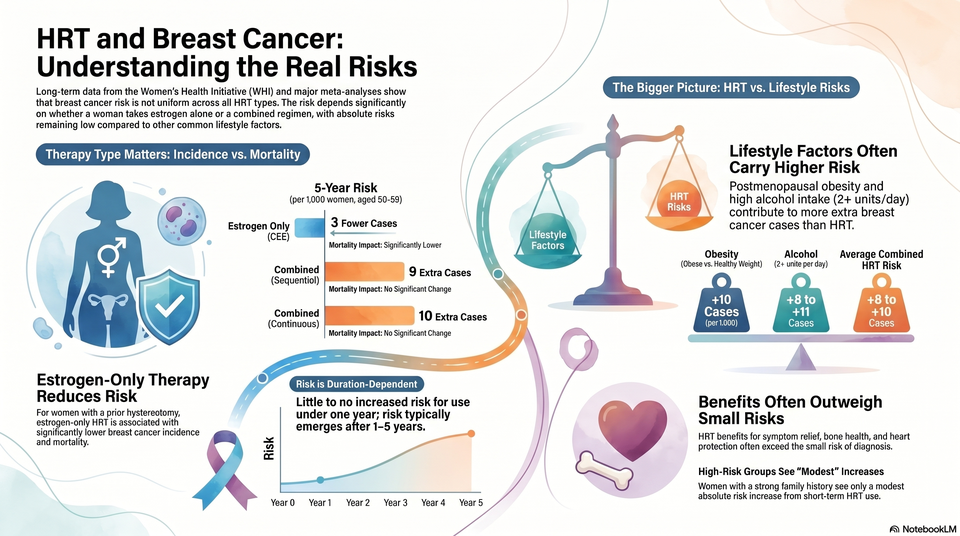
Some forms of HRT are associated with a small increase in breast cancer risk, especially combined HRT used for longer durations, while oestrogen-only risk differs. Risk should be discussed using absolute numbers and personal factors, not frightening headlines. The safest decision depends on symptoms, womb status, route, dose, medical history, personal risk factors and treatment goals. A clinician should confirm suitability, discuss alternatives and explain what needs review over time.
The safest page should separate absolute risk, personal baseline risk, contraindications and situations where alternatives or specialist review are needed.
Educational only. Suitability and next steps should be confirmed after consultation. Results vary. Not a cure.

HRT risk
At a glance
These are the main points to understand before deciding whether symptoms are expected, need routine review or should be assessed promptly.
At a glance
Practical clinical summary
Main area
Risk assessment
Pattern
Personal factors
Watch for
Bleeding or cancer history
Next step
Clinical review
Important safety note
Unexplained vaginal bleeding, some hormone-sensitive cancers, active clotting disorders, active liver disease or complex medical history may change HRT suitability.
Symptoms
Mechanism
Review
Safety
Detailed answer
Detailed answer
The key is to separate the treatment type, the symptom target and the safety question before deciding whether HRT, a local option, testosterone or a non-hormonal route is appropriate.
Absolute versus relative risk
The reader wants breast cancer risk explained in absolute, balanced terms.
Pattern
Assessment
Support
Absolute versus relative risk
HRT risk is best explained with absolute numbers and personal baseline risk rather than frightening headlines.
Combined versus oestrogen-only HRT
Combined and oestrogen-only HRT can have different risk profiles, and route may also matter.
Duration and baseline risk
Some situations rule out HRT, while others need specialist advice or an alternative route.
Family history and screening
If HRT is not suitable, symptom support can still include non-hormonal or local options where appropriate.
How the research shapes the answer
The research supports a shared-decision approach: symptoms matter, but so do route, dose, womb status, cancer history, clot risk, bleeding pattern and follow-up.
The benchmark guides structure and search intent; final wording avoids prescription advertising, resolved outcomes and one-size-fits-all claims.
Patient safety
Why this matters
HRT decisions can affect symptom control, bleeding expectations, sexual comfort, long-term health discussions and anxiety about risk, so the explanation needs to be precise.
Risk needs context
HRT risk is best explained with absolute numbers and personal baseline risk rather than frightening headlines.
Type of HRT matters
Combined and oestrogen-only HRT can have different risk profiles, and route may also matter.
Contraindications are not all equal
Some situations rule out HRT, while others need specialist advice or an alternative route.
Alternatives still exist
If HRT is not suitable, symptom support can still include non-hormonal or local options where appropriate.
A shared decision, not a script
A good HRT discussion should make the mechanism, likely benefit, uncertainty and safety boundary understandable.
The right plan may involve systemic HRT, local treatment, testosterone discussion, non-hormonal options, investigation, referral or no medicine at all.
Considerations
What to consider
A useful consultation starts with the exact symptom target, womb status, bleeding pattern, medical history, medicines, family history and the patient’s priorities.
Consultation priorities
Bring symptom timing, menstrual or bleeding history, contraception, womb status, breast or clot history, current medicines and the outcome you most want to improve.
Pattern
Options
Follow-up
Personal risk factors
Breast history, clot history, liver disease, blood pressure, migraine, smoking and family history may affect suitability.
Bleeding first
Unexplained vaginal bleeding should be assessed before starting or changing systemic HRT.
Use absolute-risk framing
Risk should be discussed in understandable numbers where available, not only in relative percentages.
Plan review
Risk and benefit should be reviewed as age, symptoms, dose, route and health background change.
What not to assume
Do not assume HRT is automatically right, automatically unsafe, or the only route to symptom support.
Timelines and review points vary: some symptoms may change within weeks, while risk, bleeding and treatment fit need planned follow-up.
Common concerns and myths
Common misconceptions
Online menopause advice can be either dismissive or overconfident. These corrections keep the answer balanced.
Myth: All HRT has the same breast cancer risk
Reality: risk is not the same for every treatment or every patient, so it should be discussed in context.
Myth: Any increase means HRT is never suitable
Reality: the answer depends on individual benefit-risk review, not a universal rule.
Myth: Risk statistics apply equally to everyone
Reality: treatment decisions depend on symptoms, medical history, risk factors, route, dose and patient preference.
Precision reduces fear
Many HRT myths come from mixing different treatments, routes, risks and patient groups together.
Review keeps the plan current
Suitability can change as symptoms, age, health history, dose, route and personal priorities change.
Safety checklist
Safety checklist
Use these checks to decide whether the question can be discussed routinely or needs more prompt medical advice.
What treatment type is this?
Systemic HRT, local vaginal oestrogen, testosterone and non-hormonal medicines have different indications and safety discussions.
Is the womb present?
Womb status affects whether progestogen protection is usually needed with systemic oestrogen.
Are there risk factors?
Cancer history, clot history, liver disease, migraine, blood pressure, medicines and family history can change suitability.
Is there bleeding or urgent illness?
Unexplained bleeding, chest symptoms, stroke-like symptoms or severe allergic symptoms should not wait for routine review.
More reassuring signs
The situation is more straightforward when symptoms are stable, risks are known, bleeding has been assessed where relevant and the plan has a review point.
Improving
Reviewed
Reasons to seek advice
Unexplained vaginal bleeding, some hormone-sensitive cancers, active clotting disorders, active liver disease or complex medical history may change HRT suitability.
Cancer history
Chest symptoms
When to escalate
When to seek medical help
Some symptoms or history details should be assessed before starting, changing or continuing treatment.
Use NHS 111 online
Unexplained bleeding
Postmenopausal bleeding, bleeding after sex, or unexplained persistent bleeding should be assessed promptly.
Breast changes
A new breast lump, nipple discharge, skin dimpling or one-sided breast change should be checked.
Clot or cardiac symptoms
Chest pain, severe breathlessness, one-sided leg swelling or collapse needs urgent advice.
Neurological symptoms
Stroke-like symptoms, sudden severe headache or new weakness need urgent assessment.
Use NHS 111 for urgent advice or call 999 in a life-threatening emergency. This page is educational and does not replace individual medical assessment.
Additional clinical context
How to use this answer
Use the page to understand the decision point behind the HRT question, then bring symptom details, medical history and personal priorities to a clinician for shared decision-making.What to discuss at appointment
Useful details include womb status, bleeding pattern, contraception, breast history, clot history, liver or cardiovascular history, migraine, medicines, family history, symptom goals and what you would like treatment to improve.Regulatory resources
Authoritative resources
These resources support careful UK-facing discussion of HRT risk, breast cancer context, contraindications and alternatives.
NICE NG23 - Menopause: identification and management
UK guideline anchor for HRT risks, contraindications and individualised discussion.
British Menopause Society - WHC recommendations on HRT
Professional consensus source for balanced breast, VTE and cardiovascular risk framing.
Cancer Research UK - HRT and cancer risk
UK cancer authority for breast cancer risk communication.
Next step
Book a clinical consultation
A consultation can review personal and family history, bleeding symptoms, breast history, clot risk, cardiovascular risk and suitable alternatives if HRT is not appropriate.
▶ View Research Sources (12 Sources)
These 12 source names are selected from 12 display-ready sources, with a raw audit trail of 39 imported records. Additional reviewed material included UK clinical guidance, professional society guidance, peer-reviewed clinical papers; duplicate, low-relevance and non-clinical records were removed before display.
Educational only. This information is for education only and is not a substitute for professional medical advice, diagnosis or treatment. Results vary. Not a cure.
