



Does lichen sclerosus indicate immune system problems?

What is lichen sclerosus and what causes it?

What dietary changes help lichen sclerosus?
Research context
Uncertainty
No overinterpretation
Women’s Health Clinic FAQ
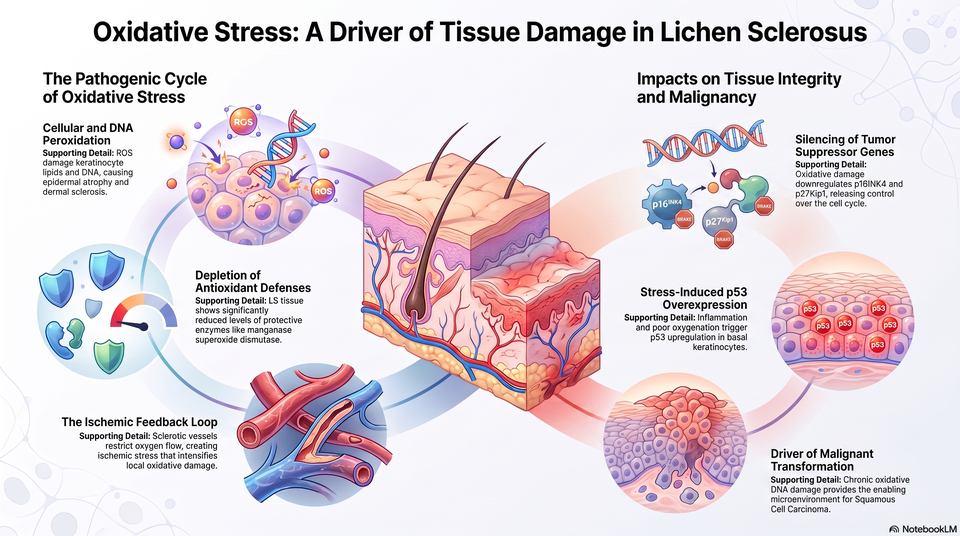
Does oxidative stress contribute to the tissue damage seen in lichen sclerosus?
Mechanism research may help explain lichen sclerosus, but it should not be turned into routine tests, supplement promises or unsupported treatment changes.
Direct answer
Oxidative stress is a research area in lichen sclerosus pathogenesis, but it should not be translated into supplement promises or used instead of evidence-based clinical care.
The safest answer keeps ECM1 antibodies, oxidative stress and hormonal questions in context while returning to practical clinical care.
Educational only. Suitability and next steps should be confirmed after consultation. Results vary. Not a cure.

Research context
At a glance
These are the main points to understand before deciding whether symptoms need self-care, prescribed treatment, specialist review or urgent advice.
At a glance
Clinical summary
Main area
Mechanism research
Care pattern
Evidence-limited
Watch for
Overclaiming
Next step
Clinical context
Important safety note
New, changing or painful skin symptoms should be assessed rather than repeatedly self-treated, especially if there is bleeding, ulceration, urinary change or rapid scarring.
Symptoms
Treatment
Review
Safety
Detailed answer
The clinical answer
The useful answer starts by separating active inflammation, established scarring, irritant symptoms, infection, GSM overlap, urinary involvement and non-standard treatment claims.
Direct answer
The reader wants a clear, clinically safe answer to an advanced lichen sclerosus concern, with enough context to know when symptoms suggest active disease, scarring, malignancy risk, irritant exposure, pelvic-floor overlap or evidence-limited treatment claims.
Scarring
Treatment
Follow-up
Direct answer
Start with the exact concern and the anatomy involved, because vulval skin, vaginal tissue, the introitus, foreskin, meatus and urethra need different thinking.
What the research suggests
Symptoms should be interpreted alongside appearance, fissures, pain, urinary features, treatment history and whether the problem is new or changing.
What remains uncertain
Treatment choices should keep prescribed anti-inflammatory care central and frame adjunctive or supportive options realistically.
Clinical relevance
Follow-up matters when symptoms persist, recur, affect sex or urination, or change vulval or penile architecture.
How the research shapes the answer
Standard of Care: The gold standard of care remains ultrapotent topical corticosteroids (e.g., clobetasol propionate 0.05%), which suppress the underlying immune-mediated inflammation driving the oxidative stress. Topical Calcineurin Inhibitors: Tacrolimus and pimecrolimus serve as.
The research synthesis shaped the structure, while final wording avoids complete treatment framing, sexual-wellness marketing, treatment ranking, device hype and promises of tissue reversal.
Patient safety
Why this distinction matters
This distinction matters because lichen sclerosus can be missed, over-simplified or overtreated when symptoms are reduced to itching, dryness, cosmetic concern or sexual discomfort alone.
It keeps science honest
Mechanism research is not the same as routine clinical testing.
It avoids false causation
Hormonal associations should not be overstated.
It blocks supplement hype
Oxidative stress research does not prove supplement benefit.
It returns to care
Symptoms and examination still drive management.
Calm, precise care
Good lichen sclerosus information should reduce shame and confusion while making review thresholds clearer.
The right next step may be reassurance, swabs, biopsy, steroid review, GSM care, urology, paediatric review, specialist vulval care or urgent advice.
Considerations
What to consider
Induction Regimen: Treatment usually begins with daily application of an ultrapotent steroid ointment for 4 weeks, tapering to alternate days, and then to a twice-weekly maintenance schedule. Maintenance Protocol: Most patients require ongoing application.
Consultation priorities
Track symptoms, visible change, fissures, pain, urine stinging, urinary stream, treatment use, irritants, sexual discomfort, scarring and whether symptoms are improving.
Examination
Treatment
Follow-up
Separate research from care
ECM1 or oxidative-stress findings are not routine patient tests.
Avoid single-cause claims
Lichen sclerosus is multifactorial and not explained by one trigger.
Review medicines individually
Contraception questions should consider the whole history.
Do not self-treat mechanisms
Supplements or treatment changes should not replace standard care.
What not to assume
Do not assume every flare is thrush, every white patch is lichen sclerosus, or every symptom can be solved with a procedure.
Onset and Progression: Oxidative damage accumulates silently alongside chronic inflammation. Without intervention, patients experience a progressive loss of tissue elasticity, resulting in dense fibrotic scarring and anatomical distortion over months to years. Treatment Response.
Common concerns and myths
Common misconceptions
These corrections keep the page practical, cautious and less vulnerable to online overclaims.
Myth: One mechanism explains every case
Reality: symptoms, examination and treatment response matter more than assumptions.
Myth: Hormonal contraception is a proven cause
Reality: symptoms, examination and treatment response matter more than assumptions.
Myth: Oxidative-stress research proves supplement treatment
Reality: symptoms, examination and treatment response matter more than assumptions.
Diagnosis comes first
Similar symptoms can come from lichen sclerosus, thrush, GSM, vitiligo, lichen planus, irritant dermatitis, urinary infection or pelvic-floor guarding.
Treatment should stay proportionate
Supportive care, prescribed treatment, hormones, surgery, dilators and adjunctive options have different roles and should not be blurred together.
Safety checklist
Safety checklist
Use these checks to decide whether symptoms are more suitable for routine review, specialist review or urgent advice.
Is the diagnosis clear?
Persistent or recurrent symptoms should not be repeatedly treated without examination.
Is disease active?
Itch, fissures, soreness, texture change or new whitening may suggest active inflammation.
Is function affected?
Pain with sex, urine stinging, narrowing, stream change or daily discomfort should be discussed.
Are red flags present?
Bleeding, non-healing ulcers, new lumps, rapid change or urinary retention need prompt advice.
More reassuring signs
The situation is more reassuring when symptoms are improving, diagnosis is clear, treatment technique is understood and follow-up is planned.
Known plan
Review booked
Reasons to seek advice
Seek advice for severe pain, unexplained bleeding, non-healing ulcers, new lumps, urinary stream change, retention, fever, spreading redness or safeguarding concerns.
Ulcer
Urinary change
When to escalate
When to seek medical help
Some symptoms should not be managed with self-care, online advice or repeat treatment alone.
Use NHS 111 online
Changing skin
A new lump, non-healing ulcer, bleeding, rapid scarring or marked colour or texture change should be assessed.
Pain or urinary change
Severe pain, urine retention, stream change, spraying or persistent urine stinging should be reviewed.
Infection or safeguarding concerns
Fever, spreading redness, discharge, child safeguarding concerns or unexplained injury patterns need appropriate advice.
Emergency symptoms
Call 999 for life-threatening symptoms such as collapse, chest pain, breathing difficulty or severe allergic reaction.
Use NHS 111 for urgent advice or call 999 in a life-threatening emergency. This page is educational and does not replace individual medical assessment.
Additional clinical context
How to use this answer
Use this page to separate active lichen sclerosus, established scarring, irritant symptoms, urinary involvement, GSM overlap and treatment marketing. The safest next step depends on symptoms, examination and whether the concern is changing.What to bring to review
Helpful details include symptom timing, itch, soreness, fissures, urine stinging, urinary stream, visible change, sexual discomfort, treatment use, irritants, previous swabs or biopsy, and whether symptoms are improving or worsening.Regulatory resources
Authoritative resources
These resources support cautious advice on lichen sclerosus pathogenesis, hormonal uncertainty, ECM1 antibodies and oxidative-stress research.
NHS - Lichen sclerosus
Patient-facing source for known uncertainty around cause.
British Association of Dermatologists - Lichen sclerosus in females
Specialist source for autoimmune and hormonal context.
British Journal of Dermatology - BAD guideline
Professional guideline anchor for aetiology and management.
Next step
Book a confidential consultation
A consultation can connect research questions to real symptoms, examination findings, treatment history and practical next steps.
▶ View Research Sources (12 Sources)
These 12 source names are selected from 12 display-ready sources, with a raw audit trail of 57 imported records. Additional reviewed material included UK clinical guidance, peer-reviewed clinical papers, evidence reviews; duplicate, low-relevance and non-clinical records were removed before display.
Educational only. This information is for education only and is not a substitute for professional medical advice, diagnosis or treatment. Results vary. Not a cure.
