

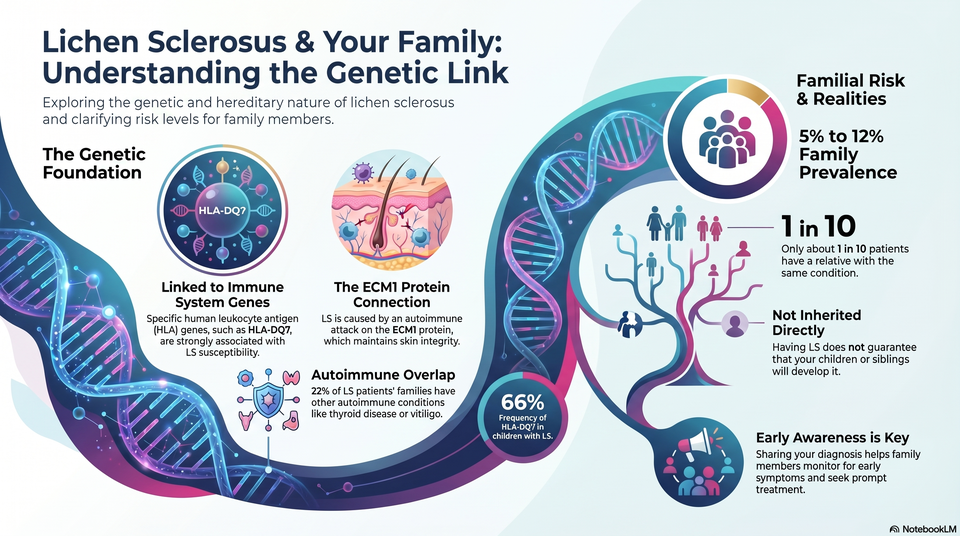


Does lichen sclerosus run in families genetically?

Does lichen sclerosus run in families genetically? | WHC Clinical FAQ
Can children get lichen sclerosus?
Diagnosis first
Long-term care
Vulval skin safety
Women’s Health Clinic FAQ
Does lichen sclerosus run in families genetically?
Lichen sclerosus questions deserve a calm answer because symptoms can be intimate, persistent and easily mistaken for thrush, dryness or irritation.
Direct answer
Lichen sclerosus can sometimes occur in families and may have genetic or immune associations, but it is not inherited in a simple predictable way.
The safest page separates symptom relief from disease control, explains when review matters, and avoids implying that self-care or adjunctive treatments replace prescribed care.
Educational only. Suitability and next steps should be confirmed after consultation. Results vary. Not a cure.

Vulval skin care
At a glance
These are the main points to understand before deciding what care or treatment pathway is appropriate.
At a glance
Practical clinical summary
Main area
Vulval skin
Care pattern
Ongoing care
Watch for
Skin change
Next step
Planned follow-up
Important safety note
Symptoms in intimate areas should not be self-diagnosed from appearance alone. Assessment helps separate inflammation, low-oestrogen change, infection, pelvic-floor symptoms and skin conditions.
Symptoms
Treatment options
Red flags
Follow-up
Detailed answer
Detailed answer
The deeper answer depends on matching the symptom to the right tissue and diagnosis. That is especially important when online pages blur vulval skin, vaginal tissue, prolapse and sexual discomfort.
Family clustering
The reader wants genetics and family risk explained without implying a simple inheritance pattern.
Diagnosis
Treatment
Review
Family clustering
This is the first distinction to make because it shapes whether advice is about skin care, vaginal tissue, pelvic floor or specialist referral.
Genetic susceptibility
Symptoms should be interpreted alongside timing, severity, visible change, treatment history and whether the problem is new or worsening.
Autoimmune links
Treatment choices should be presented as options to discuss, not as a single automatic pathway.
What relatives should know
Follow-up matters when symptoms persist, recur, alter skin architecture or affect sex, urination, exercise or daily comfort.
How the research shapes the answer
Frequent Misdiagnosis: Early or symptomatic LS is highly prone to misdiagnosis; it is frequently mistaken for recurrent thrush (yeast infections) or atrophic vaginitis associated with the genitourinary syndrome of menopause [10, 22]. Steroid Phobia.
The benchmark structure was used for search intent, but the final wording is deliberately more cautious than promotional clinic pages.
Patient safety
Why this distinction matters
Many intimate-health symptoms sound similar online, but the safest treatment plan depends on the underlying cause.
It avoids missed diagnosis
Itching, burning, dryness, pain or white skin change can point to different conditions that need different care.
It protects treatment choice
Supportive measures, prescribed treatment, device-based care and referral each have different roles.
It keeps expectations realistic
Some treatments support comfort or symptoms, but they may not reverse scarring, repair prolapse or remove the need for monitoring.
It supports safer follow-up
Persistent, worsening or changing symptoms should be reviewed rather than repeatedly self-managed.
Calm, practical care
A strong page should help patients understand what may be common, what needs review and what questions to bring to consultation.
It should validate symptoms without turning normal variation or manageable conditions into fear.
Considerations
What to consider
Application Technique: A 'pea-sized' amount or 0.5 Finger-Tip Units (FTU) is generally enough to cover the affected anogenital area for each application [15, 25]. Ointments are preferred over creams due to a lower risk.
Consultation priorities
The consultation should clarify symptoms, anatomy, medical history, medicines, menopause or cancer-treatment context, previous treatments and any skin changes.
Examination
Options
Follow-up
Before treatment
Confirm whether symptoms are due to vulval skin disease, vaginal atrophy, infection, pelvic-floor change, prolapse or another cause.
Treatment boundaries
Device treatments, complementary therapies and self-care should not be presented as substitutes for diagnosis or prescribed treatment.
Ongoing care
Long-term symptoms may need maintenance care, flare planning, skin checks or review with a specialist service.
If symptoms change
New bleeding, ulcers, urinary problems, severe pain or visible skin change should be assessed promptly.
What not to assume
Do not assume every intimate symptom is thrush, menopause, laxity or a cosmetic problem.
Costs, treatment course and suitability should be confirmed through WHC guidance or consultation rather than competitor claims.
Common concerns and myths
Common misconceptions
Online advice can make intimate symptoms sound simpler than they are. These corrections keep the page clinically safer.
Myth: LS is always inherited
Reality: assessment is needed before deciding whether this applies to your symptoms.
Myth: Children will definitely get LS
Reality: symptom control, tissue care and long-term review can be separate issues.
Myth: No family history means LS is impossible
Reality: supportive measures may help comfort, but they should not delay appropriate medical review.
Diagnosis comes first
The same symptom can come from skin inflammation, low-oestrogen change, infection, pelvic-floor guarding or prolapse.
Treatment should be proportionate
A safe plan may include reassurance, skin care, prescribed treatment, physiotherapy, device treatment or specialist referral depending on the diagnosis.
Safety checklist
Safety checklist
Use these checks to decide whether to monitor, book review, pause treatment or seek urgent advice.
Is this new or changing?
New pain, bleeding, ulcers, colour change or altered vulval architecture should be checked.
Is there a known diagnosis?
Treatment advice is safer when it is based on examination rather than assumptions.
Are symptoms affecting daily life?
Pain with sex, exercise, urination, clothing or washing is worth discussing.
Do you know red flags?
Severe pain, heavy bleeding, urinary difficulty, fever, spreading redness or non-healing ulcers need advice.
More reassuring signs
Symptoms that are mild, improving, already assessed and supported by a clear care plan are more reassuring.
Known plan
Review booked
Reasons to seek advice
Cancer Risk: Untreated or poorly controlled vulvar LS carries a small (<5%) but clinically significant risk of developing into squamous cell carcinoma (SCC) or its precursor, differentiated vulvar intraepithelial neoplasia (dVIN) [13, 18]. Red.
Bleeding
Skin change
When to escalate
When to seek medical help
Some intimate symptoms need prompt advice because early assessment can prevent delay in the right care.
Use NHS 111 online
Severe pain or rapid worsening
Sudden severe pain, rapidly worsening symptoms or difficulty passing urine should be assessed promptly.
Bleeding, ulcers or suspicious skin change
Unexplained bleeding, non-healing ulcers, new lumps, colour change or scarring should not be ignored.
Infection signs
Fever, spreading redness, pus, feeling unwell or significant swelling needs medical advice.
Emergency symptoms
Call 999 for life-threatening symptoms such as collapse, chest pain, breathing difficulty or severe allergic reaction.
Use NHS 111 for urgent advice or call 999 in a life-threatening emergency. This page is educational and does not replace individual medical assessment.
Additional clinical context
How the research was used
The Stage A reports, source guide, benchmark synthesis and payload were read before assembly. Promotional wording was softened where it risked turning a clinical question into a sales claim.Why the page stays cautious
Intimate symptoms need precise language. The page keeps vulval skin, vaginal tissue, pelvic-floor symptoms and treatment suitability separate so the advice remains useful without overpromising.Regulatory resources
Authoritative resources
These resources support evidence-aware counselling, diagnosis, long-term care and escalation for vulval skin symptoms.
NHS - Lichen sclerosus
UK patient baseline for symptoms, diagnosis, treatment and review.
British Association of Dermatologists - Lichen sclerosus in females
Patient leaflet covering symptoms, topical steroid treatment, long-term care and monitoring.
BSSVD - Vulval lichen sclerosus follow-up guidance
Specialist UK vulval guidance for follow-up, cancer-risk review and referral thresholds.
Next step
Book a confidential consultation
A confidential consultation can review symptoms, skin changes, treatment history and whether specialist vulval or gynaecology care is appropriate.
▶ View Research Sources (12 Sources)
These 12 source names are selected from 24 display-ready sources, with a raw audit trail of 50 imported records. Additional reviewed material included UK clinical guidance, professional society guidance, peer-reviewed clinical papers; duplicate, low-relevance and non-clinical records were removed before display.
Educational only. This information is for education only and is not a substitute for professional medical advice, diagnosis or treatment. Results vary. Not a cure.
