



Can CO2 laser be combined with Botox or dermal fillers?

Can treating lichen sclerosus prevent cancer?

What is CO2 laser skin resurfacing and what does it treat?
Standard care first
Evidence aware
No overclaims
Women’s Health Clinic FAQ
Can fractional carbon dioxide laser treat vulval lichen sclerosus?
Adjunctive lichen sclerosus treatments need careful explanation because commercial pages can overstate tissue regeneration or sexual-function benefits.
Direct answer
Fractional carbon dioxide laser is not first-line lichen sclerosus care; it may be discussed only as a specialist adjunct where evidence limits, ongoing steroid care and surveillance are made clear.
The safest answer keeps topical anti-inflammatory treatment, diagnosis and surveillance central before discussing laser, PRP or other adjunctive options.
Educational only. Suitability and next steps should be confirmed after consultation. Results vary. Not a cure.

Adjunctive options
At a glance
These are the main points to understand before deciding whether symptoms need self-care, prescribed treatment, specialist review or urgent advice.
At a glance
Clinical summary
Main area
Adjunctive care
Care pattern
Evidence-limited
Watch for
Overclaiming
Next step
Specialist review
Important safety note
New, changing or painful skin symptoms should be assessed rather than repeatedly self-treated, especially if there is bleeding, ulceration, urinary change or rapid scarring.
Symptoms
Treatment
Review
Safety
Detailed answer
The clinical answer
The useful answer starts by separating active inflammation, established scarring, irritant symptoms, infection, GSM overlap, urinary involvement and non-standard treatment claims.
Direct answer
The reader wants a clear, clinically safe answer to a lichen sclerosus concern, with enough context to know when symptoms suggest active disease, scarring, another diagnosis, urinary involvement or an overclaimed treatment option.
Scarring
Treatment
Follow-up
Direct answer
Start with the exact concern and the anatomy involved, because vulval skin, vaginal tissue, the introitus, foreskin, meatus and urethra need different thinking.
Standard care first
Symptoms should be interpreted alongside appearance, fissures, pain, urinary features, treatment history and whether the problem is new or changing.
Evidence limits
Treatment choices should keep prescribed anti-inflammatory care central and frame adjunctive or supportive options realistically.
Adjunctive treatment boundaries
Follow-up matters when symptoms persist, recur, affect sex or urination, or change vulval or penile architecture.
How the research shapes the answer
Guideline Consensus: Guidelines from the British Association of Dermatologists (BAD) and the International Society for the Study of Vulvovaginal Disease (ISSVD) prioritize topical steroids and caution against replacing them universally with lasers outside of.
The research synthesis shaped the structure, while final wording avoids complete treatment framing, sexual-wellness marketing, treatment ranking, device hype and promises of tissue reversal.
Patient safety
Why this distinction matters
This distinction matters because lichen sclerosus can be missed, over-simplified or overtreated when symptoms are reduced to itching, dryness, cosmetic concern or sexual discomfort alone.
It avoids marketing drift
Adjunctive treatments should not be promoted ahead of standard care.
It protects surveillance
Lichen sclerosus still needs monitoring even if symptoms improve.
It clarifies evidence limits
Early or mixed evidence should be described honestly.
It supports consent
Patients need to understand uncertainty, alternatives and ongoing care.
Calm, precise care
Good lichen sclerosus information should reduce shame and confusion while making review thresholds clearer.
The right next step may be reassurance, swabs, biopsy, steroid review, GSM care, urology, paediatric review, specialist vulval care or urgent advice.
Considerations
What to consider
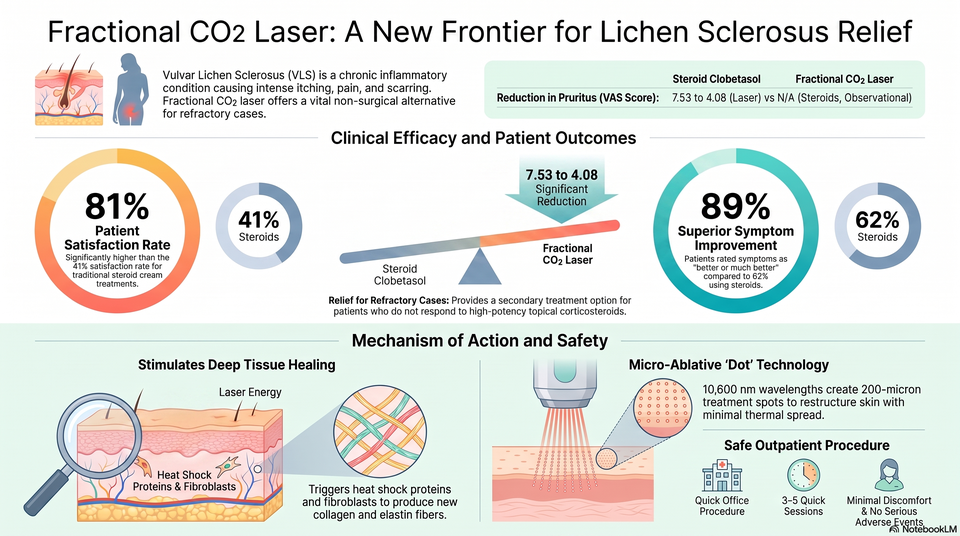
Setting: Treatments are performed in an outpatient clinic or office setting. anaesthesia: The procedure typically requires only a topical anaesthetic; general anaesthesia is not necessary. Financial Cost: Fractional carbon dioxide laser therapy is largely considered.
Consultation priorities
Track symptoms, visible change, fissures, pain, urine stinging, urinary stream, treatment use, irritants, sexual discomfort, scarring and whether symptoms are improving.
Examination
Treatment
Follow-up
Start with standard care
Diagnosis and prescribed anti-inflammatory treatment remain central.
Ask what problem is being treated
Active inflammation, scarring and sexual discomfort are different targets.
Discuss uncertainty
Adjunctive options should be framed as evidence-limited unless guidelines say otherwise.
Keep follow-up
Symptom change does not remove the need for monitoring.
What not to assume
Do not assume every flare is thrush, every white patch is lichen sclerosus, or every symptom can be solved with a procedure.
Standard Regimen: A typical treatment protocol involves 3 to 4 fractional carbon dioxide laser sessions spaced 4 to 6 weeks apart. Symptom Relief: Patients frequently report important reductions in itching, pain, and sexual dysfunction within.
Common concerns and myths
Common misconceptions
These corrections keep the page practical, cautious and less vulnerable to online overclaims.
Myth: Laser or PRP can replace standard lichen sclerosus care
Reality: adjunctive options need careful consent and should not replace diagnosis, prescribed treatment or monitoring.
Myth: Regeneration claims prove disease control
Reality: symptoms, examination and treatment response matter more than assumptions.
Myth: A marketing name makes an adjunctive treatment evidence-based
Reality: adjunctive options need careful consent and should not replace diagnosis, prescribed treatment or monitoring.
Diagnosis comes first
Similar symptoms can come from lichen sclerosus, thrush, GSM, vitiligo, lichen planus, irritant dermatitis, urinary infection or pelvic-floor guarding.
Treatment should stay proportionate
Supportive care, prescribed treatment, hormones, surgery, dilators and adjunctive options have different roles and should not be blurred together.
Safety checklist
Safety checklist
Use these checks to decide whether symptoms are more suitable for routine review, specialist review or urgent advice.
Is the diagnosis clear?
Persistent or recurrent symptoms should not be repeatedly treated without examination.
Is disease active?
Itch, fissures, soreness, texture change or new whitening may suggest active inflammation.
Is function affected?
Pain with sex, urine stinging, narrowing, stream change or daily discomfort should be discussed.
Are red flags present?
Bleeding, non-healing ulcers, new lumps, rapid change or urinary retention need prompt advice.
More reassuring signs
The situation is more reassuring when symptoms are improving, diagnosis is clear, treatment technique is understood and follow-up is planned.
Known plan
Review booked
Reasons to seek advice
Seek advice for severe pain, unexplained bleeding, non-healing ulcers, new lumps, urinary stream change, retention, fever, spreading redness or safeguarding concerns.
Ulcer
Urinary change
When to escalate
When to seek medical help
Some symptoms should not be managed with self-care, online advice or repeat treatment alone.
Use NHS 111 online
Changing skin
A new lump, non-healing ulcer, bleeding, rapid scarring or marked colour or texture change should be assessed.
Pain or urinary change
Severe pain, urine retention, stream change, spraying or persistent urine stinging should be reviewed.
Infection or safeguarding concerns
Fever, spreading redness, discharge, child safeguarding concerns or unexplained injury patterns need appropriate advice.
Emergency symptoms
Call 999 for life-threatening symptoms such as collapse, chest pain, breathing difficulty or severe allergic reaction.
Use NHS 111 for urgent advice or call 999 in a life-threatening emergency. This page is educational and does not replace individual medical assessment.
Additional clinical context
How to use this answer
Use this page to separate active lichen sclerosus, established scarring, irritant symptoms, urinary involvement, GSM overlap and treatment marketing. The safest next step depends on symptoms, examination and whether the concern is changing.What to bring to review
Helpful details include symptom timing, itch, soreness, fissures, urine stinging, urinary stream, visible change, sexual discomfort, treatment use, irritants, previous swabs or biopsy, and whether symptoms are improving or worsening.Regulatory resources
Authoritative resources
These resources support cautious counselling around lichen sclerosus standard care, energy-device evidence limits and genital procedure consent.
Next step
Book a confidential consultation
A consultation can review whether symptoms reflect active disease, scarring or another diagnosis before any adjunctive treatment is considered.
▶ View Research Sources (12 Sources)
These 12 source names are selected from 12 display-ready sources, with a raw audit trail of 57 imported records. Additional reviewed material included UK clinical guidance, peer-reviewed clinical papers, evidence reviews, clinical trial records; duplicate, low-relevance and non-clinical records were removed before display.
Educational only. This information is for education only and is not a substitute for professional medical advice, diagnosis or treatment. Results vary. Not a cure.
