
Why us?  Why us? please click dropdown
4.8/5 out of 3,500+ reviews
Regulated: CQC Registered | 1-5796078466
  • Verified Content: Approved by the Women’s Health Clinic Clinical Team.
  • Educational Use: This is not a substitute for professional medical advice, diagnosis, or treatment.
  • Clinical Assessment: Individual suitability is determined by a clinician; results may vary.
  • Non-NHS: Private healthcare provider only. Pricing varies by treatment and site. Availability varies by clinical location.
  • MEDICAL EMERGENCY:

    If you need urgent help, use NHS 111. For a life-threatening emergency, call 999.

 Author  Find more about the author
Dr Farzana Khan

Dr Farzana Khan

Verified

Dr Farzana Khan qualified as an MD from the University of Copenhagen in 2003. She has worked in dermatology and obstetrics & gynaecology across the North of England and completed her MRCGP (CCT, 2013) and the Diploma of the Faculty of Sexual & Reproductive Health (2013). Her clinical focus is vaginal health—including dryness/GSM, sexual function concerns, lichen sclerosus, and comfort or volume changes. She offers careful assessment, discusses medical and conservative options first, and considers selected regenerative or aesthetic treatments where appropriate. Dr Farzana also trains clinicians as a KOL/Trainer with Neauvia, Asclepion Laser, and RegenLab (since 2023). Ongoing CPD includes IMCAS, CCR, ACE and expert training in women’s intimate fillers, PRP, and polynucleotide injectables. Her approach is simple: clear explanations, realistic expectations, and shared decision-making. Authored and medically reviewed by Dr Farzana Khan.

MD MRCGP DFFP
Was this answer helpful?
Rate Dr Farzana's explanation

Assessment first
Evidence-aware
Safety focused

Women’s Health Clinic FAQ

Can the O-Shot make orgasms stronger?

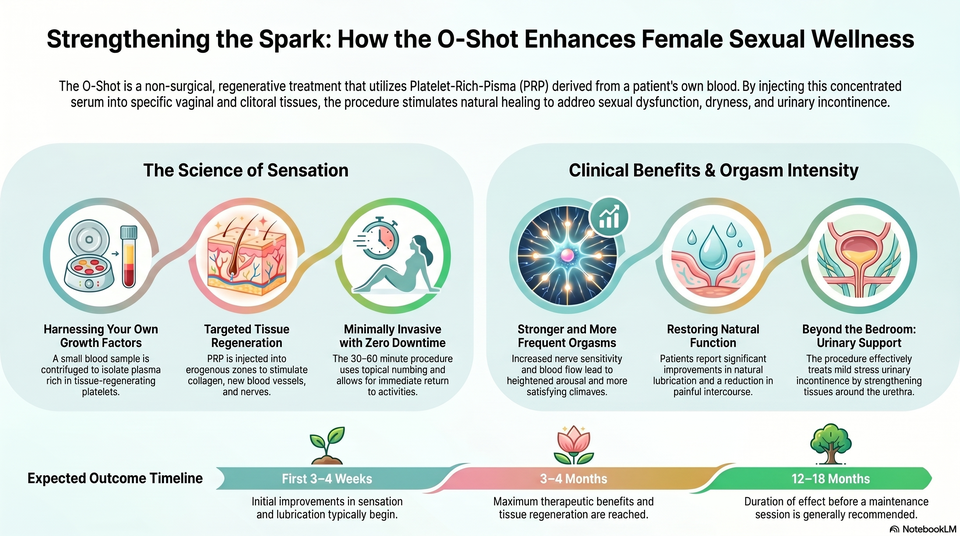
Some O-Shot pages claim stronger orgasms, but this is best discussed as a possible improvement in selected patients, not a promise. Orgasm intensity can be influenced by sensitivity, arousal, pelvic floor contractions, lubrication, comfort, hormones, emotional safety, and stimulation.

Direct answer

Some O-Shot pages claim stronger orgasms, but this is best discussed as a possible improvement in selected patients, not a promise. Orgasm intensity can be influenced by sensitivity, arousal, pelvic floor contractions, lubrication, comfort, hormones, emotional safety, and stimulation.

The most useful plan starts with the underlying cause, not the treatment name. Your clinician should review symptoms, medical history, alternatives, expected benefits, limitations and safety.

Educational only. Suitability must be confirmed after consultation. Results vary. Not a cure.

Women's Health Clinic consultation for Can the O-Shot make orgasms stronger?
Consultation-led care

At a glance

These are the main points to understand before deciding whether this option is suitable.

At a glance

Clinical summary

Biological Mechanism

Utilizes concentrated autologous platelets to trigger the thrombin cascade and degranulation.

Primary Goal

Restoration of vaginal health by enhancing local blood flow, mucosal thickness, and natural lubrication to resolve dyspareunia and.

Regulatory Status

In the UK, this is a private healthcare intervention.

Clinical Positioning

An emerging regenerative option for GSM-related atrophy when standard hormonal receptor-binding therapies are declined or provide incomplete symptomatic.

Important safety note

Transient Spotting: Minor bleeding post-injection.

Consultation
Suitability
Evidence
Safety
Aftercare


Detailed answer

Detailed answer

PRP remains an emerging modality, and its marketing frequently outpaces its validated clinical utility. Hierarchy of Care: UK guidelines prioritize 1) Non-hormonal foundations (Hyaluronic acid), 2) Local hormones (Vaginal oestrogen/DHEA), and 3) Regenerative adjuncts only after failure of the former. Evidence Gap and Skepticism: While the Sukgen study showed promise, critics like Dr.

Clinical context

Hierarchy of Care: UK guidelines prioritize 1) Non-hormonal foundations (Hyaluronic acid), 2) Local hormones (Vaginal oestrogen/DHEA), and 3) Regenerative adjuncts only after failure of the former.

Mechanism
Evidence
Symptoms
Alternatives

What it means

Hierarchy of Care: UK guidelines prioritize 1) Non-hormonal foundations (Hyaluronic acid), 2) Local hormones (Vaginal oestrogen/DHEA), and 3) Regenerative adjuncts only after failure of the former.

Why it happens

Evidence Gap and Skepticism: While the Sukgen study showed promise, critics like Dr.

Evidence limits

Mechanism vs. Oestrogen: Unlike oestrogen, which binds to receptors to reverse atrophy, PRP aims to trigger a regenerative wound-healing response via growth factor-mediated tissue remodeling.

Treatment fit

Suitability depends on history, symptoms, examination where appropriate and discussion of alternatives.

What this means in practice

Preparation: Approximately 18mL of venous blood is drawn using a 21-G needle into specialized vacuumed tubes. Centrifugation: The blood is centrifuged at 3200 rpm for 8 minutes to isolate the "Buffy coat" (platelets and leukocytes) from the erythrocytes and plasma.

Treatment Schedule: A standard clinical protocol typically involves 3–4 sessions spaced at 4-week intervals. Clinical Progression: Functional improvements are gradual, typically manifesting over several weeks as tissue remodeling occurs. Injections do not provide the immediate relief seen with lubricants.


Patient safety

Why proper assessment matters

Assessment helps separate marketing claims from safe, individualised clinical decision-making.

It checks the cause

Hierarchy of Care: UK guidelines prioritize 1) Non-hormonal foundations (Hyaluronic acid), 2) Local hormones (Vaginal oestrogen/DHEA), and 3) Regenerative adjuncts only after failure of the former.

It protects safety

Transient Spotting: Minor bleeding post-injection.

It reviews alternatives

Preparation: Approximately 18mL of venous blood is drawn using a 21-G needle into specialized vacuumed tubes.

It sets expectations

Treatment Schedule: A standard clinical protocol typically involves 3–4 sessions spaced at 4-week intervals.

A clinical decision, not a shortcut

The safest final page should explain what the intervention may do, what it cannot promise, and when another route may be better.

Treatment should be discussed with realistic goals, informed consent, clear aftercare and a plan for review.


Considerations

What to consider

Preparation: Approximately 18mL of venous blood is drawn using a 21-G needle into specialized vacuumed tubes. Centrifugation: The blood is centrifuged at 3200 rpm for 8 minutes to isolate the "Buffy coat" (platelets and leukocytes) from the erythrocytes and plasma. Activation: The isolate is typically mixed with Calcium Chloride (0.

Consultation priorities

The Procedure: Patients describe a sensation of pressure and a brief "sting" or "scratch" during the 4–9 injection points.

History
Consent
Aftercare
Follow-up

Before treatment

The Procedure: Patients describe a sensation of pressure and a brief "sting" or "scratch" during the 4–9 injection points.

During care

Immediate Recovery: A 24–72 hour window of mild discomfort is expected.

Aftercare

Outcome Metrics: Subjective success is often characterized by a "calmer" day-to-day vulval feel and the restoration of a comfortable "glide" during intimacy.

When to reassess

If expected improvement does not occur, the plan should be reviewed rather than repeated automatically.

Practical expectations

Treatment Schedule: A standard clinical protocol typically involves 3–4 sessions spaced at 4-week intervals.

Centrifugation: The blood is centrifuged at 3200 rpm for 8 minutes to isolate the "Buffy coat" (platelets and leukocytes) from the erythrocytes and plasma.


Common concerns and myths

Common misconceptions

Clear patient information should correct over-simple claims and keep expectations realistic.

Myth: Stronger orgasm is a certain O-Shot result.

Reality: suitability depends on the symptom pattern, medical history, contraindications, alternatives and individual goals.

Myth: Orgasm strength only depends on clitoral sensitivity.

Reality: results vary, evidence may be developing, and non-response should prompt reassessment.

Myth: If orgasms are not intense, PRP is always the missing.

Reality: injections, devices and intimate procedures can still carry risks and need proper consent and aftercare.

Evidence and advertising

Evidence Gap and Skepticism: While the Sukgen study showed promise, critics like Dr.

Alternatives

Preparation: Approximately 18mL of venous blood is drawn using a 21-G needle into specialized vacuumed tubes.


Safety checklist

Safety checklist

Use these questions to decide whether treatment should be discussed, delayed or redirected.

Has the cause been assessed?

Symptoms should be reviewed in context before selecting a treatment.

Are red flags absent?

Transient Spotting: Minor bleeding post-injection.

Are alternatives clear?

Preparation: Approximately 18mL of venous blood is drawn using a 21-G needle into specialized vacuumed tubes.

Is follow-up planned?

The clinic should explain aftercare, review timing and when to seek help.

Reassuring signs

Proceeding is more reasonable when goals are clear, red flags have been checked, and expectations are realistic.

Clear goals
No red flags
Follow-up plan

Reasons to pause

Transient Spotting: Minor bleeding post-injection.

Pain
Bleeding
Infection


When to escalate

When to seek medical help

Some symptoms should be assessed before any elective intimate treatment. Use NHS 111 online

Severe or worsening pain

Transient Spotting: Minor bleeding post-injection.

Bleeding or discharge

Localized Soreness: Tenderness at injection sites for 24–72 hours.

Infection signs

Bruising: Particularly around the clitoral and vestibular areas.

Emergency symptoms

Call 999 in a life-threatening emergency, including collapse, chest pain or breathing difficulty.

Use NHS 111 for urgent advice or call 999 in a life-threatening emergency. This page is educational and does not replace individual medical assessment.

More clinical detail

Benchmark positioning

  • WHC can win by turning a promotional claim into a realistic, patient-centred outcome discussion.

Clinical reality

  • Hierarchy of Care: UK guidelines prioritize 1) Non-hormonal foundations (Hyaluronic acid), 2) Local hormones (Vaginal oestrogen/DHEA), and 3) Regenerative adjuncts only after failure of the former.
  • Evidence Gap and Skepticism: While the Sukgen study showed promise, critics like Dr.
  • Mechanism vs. Oestrogen: Unlike oestrogen, which binds to receptors to reverse atrophy, PRP aims to trigger a regenerative wound-healing response via growth factor-mediated tissue remodeling.

Timeline and expectations

  • Treatment Schedule: A standard clinical protocol typically involves 3–4 sessions spaced at 4-week intervals.
  • Clinical Progression: Functional improvements are gradual, typically manifesting over several weeks as tissue remodeling occurs. Injections do not provide the immediate relief seen with lubricants.
  • Functional Objectives: Measurable goals include improved glide during penetration, a reduction in micro-tears at the posterior fourchette, and the alleviation of "sandpaper" sensations during physical activity.
  • Sustainability: Due to the persistent hypoestrogenic environment of GSM, there is a noted attrition of regenerative efficacy over time. A clinical review at 3–6 months is necessary to determine the requirement for maintenance sessions.

Practical logistics

  • Preparation: Approximately 18mL of venous blood is drawn using a 21-G needle into specialized vacuumed tubes.
  • Centrifugation: The blood is centrifuged at 3200 rpm for 8 minutes to isolate the "Buffy coat" (platelets and leukocytes) from the erythrocytes and plasma.
  • Activation: The isolate is typically mixed with Calcium Chloride (0.5 mL) to activate the thrombin cascade. A total 9mL PRP+PPP (Platelet-Poor Plasma) mixture is common.
  • Administration: Following the application of lidocaine/prilocaine cream, injections are performed using a 31-G needle.
  • Targeting: Specific sites include the distal one-third of the anterior vaginal wall and the clitoral area, often targeting clock positions 12, 3, 6, and 9 for the clitoral injections to maximize neurovascular stimulation.

Research sources

  • Sukgen et al. (2019): Demonstrated a significant jump in Female Sexual Function Index (FSFI) total scores from 13.61±3.78 (baseline) to 27.88±4.80 post-treatment, with notable improvements in the orgasm subdomain.
  • Pitsouni et al. (2017): Established the Vaginal Health Index (VHI) threshold of >15 as the marker for non-atrophic values, providing a benchmark for measuring PRP efficacy.
  • Gordon et al. (2019): A critical case series documenting severe complications, including fibrotic tissue at the apex and canal shortening to 2.5 cm, necessitating caution in "techno-vagina" procedures.
  • Runels et al. (2014): The initial pilot study regarding autologous PRP for sexual dysfunction, which catalyzed interest in the "O-Shot."

Next step

Book a clinical consultation

A consultation can confirm whether this treatment may be suitable, whether another pathway should come first, and what realistic outcomes and aftercare would look like.

View Full Research Bibliography (10 Sources)
• Can platelet-rich plasma (PRP) help vaginal dryness? - The Womens Health Clinic
• Efficacy and Safety of Platelet-Rich Plasma Injections for the Treatment of Female Sexual Dysfunction and Stress Urinary Incontinence: A Systematic Review - PMC
• Impact of a Single Session of Hybrid Carbon Dioxide 10600 Nanometer and 1540 Nanometer Laser With Platelet-Rich Plasma Treatment - Semantic Scholar
• Interventional procedure overview of transvaginal laser therapy for urogenital atrophy - NICE
• Platelet-rich plasma administration to the lower anterior vaginal wall to improve female sexuality satisfaction - Semantic Scholar
• Statement - BAAPS response to the FDA warning on vaginal rejuvenation
• The O shot is untested with a sketchy past - The Vajenda
• Vaginal injection of platelet-rich plasma improves sexual function | Contemporary OB/GYN
• Value of Injection of Plasma-Rich Platelets in the vaginal and the clitoris in cases with female sexual dysfunction - Ginekologia i Poloznictwo
• Value of injection of plasma-rich platelets in the vaginal mucosa in cases with vulvovaginal atrophy: a prospective double-blinded randomized controlled study - PMC

Educational only. This report is for educational purposes and does not constitute a substitute for professional medical advice. Suitability for PRP must be determined by a qualified clinician following a comprehensive pelvic examination. PRP is a symptomatic management tool, not a definitive treatment; results vary based on the individual's hormonal status and tissue health. In case of severe pain, heavy bleeding, or fever post-procedure, contact NHS 111 or 999 immediately. Results vary. Not a cure.

Loading directory...
