
Evidence-aware
Safety focused
Women’s Health Clinic FAQ
Can the O-Shot help leaking when coughing?
Leaking when coughing is commonly a stress incontinence pattern, and the O-Shot may be discussed by some clinics as a PRP option for selected mild symptoms.
Direct answer
Leaking when coughing is commonly a stress incontinence pattern, and the O-Shot may be discussed by some clinics as a PRP option for selected mild symptoms.
The most useful plan starts with the underlying cause, not the treatment name. Your clinician should review symptoms, medical history, alternatives, expected benefits, limitations and safety.
Educational only. Suitability must be confirmed after consultation. Results vary. Not a cure.

At a glance
These are the main points to understand before deciding whether this option is suitable.
At a glance
Clinical summary
Condition Treated
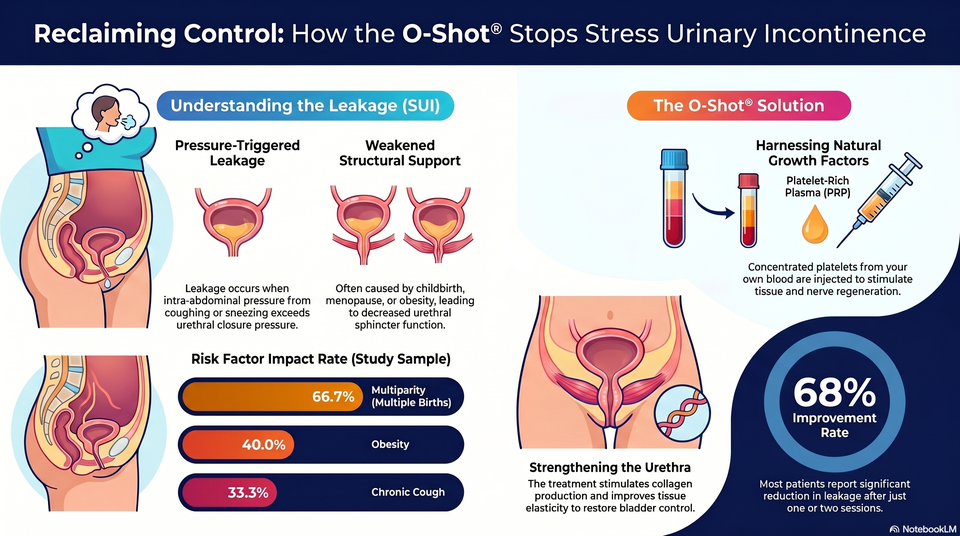
Stress urinary incontinence (SUI), which primarily affects women during physical exertion or increased intra-abdominal pressure [1, 3].
Mechanism of Action
Uses the patient's own blood (autologous PRP) to provide a regenerative cellular stimulus, promoting angiogenesis, fibroblast proliferation.
Efficacy
PRP therapy is more likely to be useful for women with mild to moderate SUI, with reported reductions in leakage episodes.
Suitability must be confirmed after consultation.
Important safety note
Safety Profile: The O-Shot has an reported safety profile due to its autologous nature (using the patient's own blood), which may reduce the risk of rejection or allergic reactions.
Suitability
Evidence
Safety
Aftercare
Detailed answer
Detailed answer
Target Population: Clinical studies demonstrate that patients with mild SUI generally show better, more predictable improvements compared to those with moderate to severe incontinence [7, 8].
Clinical context
Target Population: Clinical studies demonstrate that patients with mild SUI generally show better, more predictable improvements compared to those with moderate to severe incontinence [7, 8].
Evidence
Symptoms
Alternatives
What it means
Target Population: Clinical studies demonstrate that patients with mild SUI generally show better, more predictable improvements compared to those with moderate to severe incontinence [7, 8].
Why it happens
Alternatives: PRP therapy serves as a minimally invasive alternative to traditional surgical interventions (like mid-urethral slings) and synthetic bulking agents, avoiding surgical risks such as mesh erosion, voiding.
Evidence limits
Evidence Base: While early randomised controlled trials (RCTs) and scoping reviews demonstrate promising efficacy and safety for female SUI, larger standardised RCTs with longer follow-up are still required.
Treatment fit
Suitability depends on history, symptoms, examination where appropriate and discussion of alternatives.
What this means in practice
Preparation: Patients are advised to maintain adequate hydration prior to the procedure to optimise blood viscosity and platelet concentration [19].
Procedure Duration: The entire outpatient procedure typically takes between 30 and 45 minutes from blood draw to injection [10].
Patient safety
Why proper assessment matters
Assessment helps separate marketing claims from safe, individualised clinical decision-making.
It checks the cause
Target Population: Clinical studies demonstrate that patients with mild SUI generally show better, more predictable improvements compared to those with moderate to severe incontinence [7, 8].
It protects safety
Safety Profile: The O-Shot has an reported safety profile due to its autologous nature (using the patient's own blood), which may reduce the risk of rejection or allergic reactions.
It reviews alternatives
Preparation: Patients are advised to maintain adequate hydration prior to the procedure to optimise blood viscosity and platelet concentration [19].
It sets expectations
Procedure Duration: The entire outpatient procedure typically takes between 30 and 45 minutes from blood draw to injection [10].
A clinical decision, not a shortcut
The safest final page should explain what the intervention may do, what it cannot promise, and when another route may be better.
Treatment should be discussed with realistic goals, informed consent, clear aftercare and a plan for review.
Considerations
What to consider
Preparation: Patients are advised to maintain adequate hydration prior to the procedure to optimise blood viscosity and platelet concentration [19].
Consultation priorities
Consultation: The journey begins with a thorough medical evaluation by a trained physician to confirm the SUI diagnosis, evaluate pelvic floor health, and ensure the patient is.
Consent
Aftercare
Follow-up
Before treatment
Consultation: The journey begins with a thorough medical evaluation by a trained physician to confirm the SUI diagnosis, evaluate pelvic floor health, and ensure the patient is.
During care
Treatment Day: After the blood is processed and the local anaesthetic has taken effect, the PRP is carefully injected using a fine needle into specific sites.
Aftercare
Follow-up: Treatment response is usually monitored over several months using objective measures like 3-day bladder diaries, cough stress tests, and validated quality-of-life questionnaires (such as the ICIQ-SF) [7.
When to reassess
If expected improvement does not occur, the plan should be reviewed rather than repeated automatically.
Practical expectations
Procedure Duration: The entire outpatient procedure typically takes between 30 and 45 minutes from blood draw to injection [10].
The Blood Draw: Approximately 15 to 50 mL of blood is drawn from the patient's arm and placed in a centrifuge for about 5 minutes to isolate.
Common concerns and myths
Common misconceptions
Clear patient information should correct over-simple claims and keep expectations realistic.
Myth: Cough leakage is just part of getting older.
Reality: suitability depends on the symptom pattern, medical history, contraindications, alternatives and individual goals.
Myth: A PRP injection is the only route to improvement.
Reality: results vary, evidence may be developing, and non-response should prompt reassessment.
Myth: All leakage with coughing is mild.
Reality: injections, devices and intimate procedures can still carry risks and need proper consent and aftercare.
Evidence and advertising
Alternatives: PRP therapy serves as a minimally invasive alternative to traditional surgical interventions (like mid-urethral slings) and synthetic bulking agents, avoiding surgical risks such as mesh erosion, voiding.
Alternatives
Preparation: Patients are advised to maintain adequate hydration prior to the procedure to optimise blood viscosity and platelet concentration [19].
Safety checklist
Safety checklist
Use these questions to decide whether treatment should be discussed, delayed or redirected.
Has the cause been assessed?
Symptoms should be reviewed in context before selecting a treatment.
Are red flags absent?
Safety Profile: The O-Shot has an reported safety profile due to its autologous nature (using the patient's own blood), which may reduce the risk of rejection or allergic reactions.
Are alternatives clear?
Preparation: Patients are advised to maintain adequate hydration prior to the procedure to optimise blood viscosity and platelet concentration [19].
Is follow-up planned?
The clinic should explain aftercare, review timing and when to seek help.
Reassuring signs
Proceeding is more reasonable when goals are clear, red flags have been checked, and expectations are realistic.
No red flags
Follow-up plan
Reasons to pause
Safety Profile: The O-Shot has an reported safety profile due to its autologous nature (using the patient's own blood), which may reduce the risk of rejection or allergic reactions.
Bleeding
Infection
When to escalate
When to seek medical help
Some symptoms should be assessed before any elective intimate treatment. Use NHS 111 online
Severe or worsening pain
Safety Profile: The O-Shot has an reported safety profile due to its autologous nature (using the patient's own blood), which may reduce the risk of rejection or allergic reactions.
Bleeding or discharge
Common Side Effects: Minor, transient adverse effects may include temporary spotting, mild discomfort, or injection-site pain [14, 16, 17].
Infection signs
Contraindications (Red Flags): The procedure is not recommended for women who are currently pregnant or breastfeeding, have active urinary or sexually transmitted infections, bleeding disorders, untreated pelvic organ.
Emergency symptoms
Call 999 in a life-threatening emergency, including collapse, chest pain or breathing difficulty.
Use NHS 111 for urgent advice or call 999 in a life-threatening emergency. This page is educational and does not replace individual medical assessment.
More clinical detail
Benchmark positioning
- The best page translates the patient phrase into the clinical concept of stress leakage, then sets realistic options.
Clinical reality
- Target Population: Clinical studies demonstrate that patients with mild SUI generally show better, more predictable improvements compared to those with moderate to severe incontinence [7, 8].
- Alternatives: PRP therapy serves as a minimally invasive alternative to traditional surgical interventions (like mid-urethral slings) and synthetic bulking agents, avoiding surgical risks such as mesh erosion, voiding dysfunction, or delayed hypersensitivity [4, 21.
- Evidence Base: While early randomised controlled trials (RCTs) and scoping reviews demonstrate promising efficacy and safety for female SUI, larger standardised RCTs with longer follow-up are still required to conclusively validate long-term durability.
Timeline and expectations
- Procedure Duration: The entire outpatient procedure typically takes between 30 and 45 minutes from blood draw to injection [10].
- Onset of Results: Improvements are not immediate; they develop gradually as the tissue regenerates, with many women noticing symptom reduction within a few weeks and continued improvement up to 1 to 3 months [9-12].
- Duration of Relief: Clinical reports indicate symptom relief can be maintained for up to 2 years, though repeat injections may be necessary depending on the individual's healing response [9, 13].
Practical logistics
- Preparation: Patients are advised to maintain adequate hydration prior to the procedure to optimise blood viscosity and platelet concentration [19].
- The Blood Draw: Approximately 15 to 50 mL of blood is drawn from the patient's arm and placed in a centrifuge for about 5 minutes to isolate the platelet-rich plasma [24, 25].
- anaesthesia: A local topical anaesthetic (such as 2% lidocaine gel) is applied to the vaginal and periurethral area roughly 20 minutes before the injections to minimise discomfort [26].
- Downtime: There is usually little recovery time; patients are typically cleared to return to work, normal physical activities, and sexual intercourse on the same day [16].
Research sources
- Utama BI, et al. (2026). "Therapeutic efficacy and safety of injectable platelet-rich plasma in women with stress urinary incontinence: a systematic review and meta-analysis." Frontiers in Medicine, 13. [34, 35]
- Kochhar N, Tomar A. (2026). "A Prospective Pilot Interventional Study to Evaluate the Role of Platelet-Rich Plasma in Female Stress Urinary Incontinence." CME Journal Geriatric Medicine, 18(5): 46-51. [7, 36, 37]
- Willison N, et al. (2025). "Application of Platelet-Rich Plasma in Gynaecologic Disorders: A Scoping Review." Journal of Clinical Medicine, 14(16): 5832. [14, 38, 39]
- ClinicalTrials.gov (NCT05295420). "Platelet-Rich Plasma Injection for the Treatment of Stress Urinary Incontinence in Females: A randomised Placebo-Controlled Study." [4, 40]
Regulatory resources
Authoritative resources
These resources support assessment-led, evidence-aware patient information.
NICE guidance on vaginal laser for urogenital atrophy
NICE is a UK authority for interventional procedure governance and supports cautious language about evidence, consent and audit.
FDA safety communication on vaginal rejuvenation devices
This safety communication is a useful regulatory reference for avoiding over-claiming around sexual enhancement procedures.
RCOG patient information on menopause symptom treatment
RCOG patient information supports assessment-led discussion of vaginal dryness, discomfort and hormone-related symptoms.
Next step
Book a clinical consultation
A consultation can confirm whether this treatment may be suitable, whether another pathway should come first, and what realistic outcomes and aftercare would look like.
▶ View Research Sources (12 Sources)
These 12 source names are selected from 24 display-ready sources, with a raw audit trail of 114 imported records. Additional reviewed material included UK clinical guidance, professional society guidance, peer-reviewed clinical papers, evidence reviews; duplicate, low-relevance and non-clinical records were removed before display.
Educational only. This information is provided for educational purposes only and does not constitute professional medical advice. The FDA has not evaluated or approved stem cell or PRP therapies as a definitive cure for SUI or other specific conditions; many of these treatments are still considered investigational [41]. Individual results will vary, and no promises regarding specific outcomes or symptom relief can be made [41, 42]. Always consult with a qualified, licensed healthcare provider to determine the safest and most appropriate treatment options for your specific medical needs [41, 42]. Results vary. Not a cure.
