
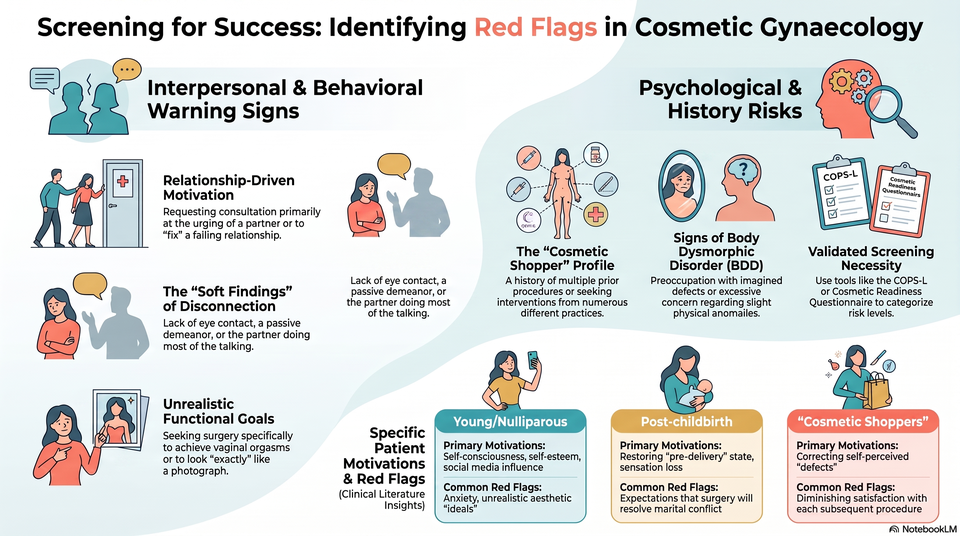


What red flags suggest a patient’s concern is mainly psychosexual or relationship-related?

What are the clinical red flags that suggest a patient is seeking elective,... | WHC Clinical FAQ

What specific psychological or psychosexual intervention frameworks are eff... | WHC Clinical FAQ
Consent
No pressure
Ethical care
Women’s Health Clinic FAQ
What are the clinical red flags that suggest a patient is seeking elective, expensive regenerative procedures for a primarily psychosexual or relationship issue?
Ethical intimate care starts by asking whether there is a real symptom, a clear indication and a pressure-free reason to treat.
Direct answer
Red flags include pressure, shame, unrealistic expectations, untreated pain, relationship conflict, trauma triggers or no clear physical indication for expensive regenerative procedures. The safest approach is to validate the concern, check for physical causes, and then explore arousal, product use, relationship context, trauma history or consent pressure where relevant. This avoids both over-medicalising normal variation and dismissing symptoms that need assessment.
A good answer should separate symptoms from cosmetic anxiety, relationship pressure, shame and unrealistic expectations before any elective treatment is discussed.
Educational only. Suitability and next steps should be confirmed after consultation. Results vary. Not a cure.

Ethical consent
At a glance
These are the main points to understand before deciding whether symptoms are physical, situational, product-related, psychosexual, trauma-related or consent-related.
At a glance
Clinical summary
Main area
Consent and ethics
Pattern
Overtreatment risk
Watch for
Pressure or shame
Next step
Pause and clarify
Important safety note
Elective or regenerative procedures should not be offered when symptoms, expectations, consent or physical indications are unclear.
Products
Consent
Tissue
Support
Detailed answer
Detailed answer
The deeper answer starts by separating tissue dryness from arousal response, friction, product irritation, relationship context, trauma triggers and normal variation.
Direct answer
The reader wants to know how ethical clinics avoid selling procedures when the issue may be asymptomatic, psychosexual, cosmetic or relationship-driven.
Cause
Safety
Support
Direct answer
Consent must be informed, voluntary and free from pressure.
Screening before treatment
Asymptomatic tissue change does not automatically need intervention.
Consent and expectation setting
Regenerative or elective procedures should not be sold as resolves for shame or relationship distress.
Red flags for overtreatment
Postmenopausal dryness often needs ongoing care rather than a single cure.
How the research shapes the answer
Both the RCOG and the American College of Obstetricians and gynaecologists (ACOG) assert that female genital cosmetic surgeries lack adequate evidence of safety and efficacy, and classify them as non-medically indicated. Recent randomised sham-controlled trials have demonstrated that while laser therapy improves.
The benchmark shaped search intent and structure, while final wording avoids shame, partner blame, procedure pressure, unsafe product advice and unsupported psychological dismissal.
Patient safety
Why this matters
Dryness concerns can affect confidence, intimacy, examinations and treatment decisions, so the answer needs both physical caution and emotional intelligence.
It protects autonomy
Consent must be informed, voluntary and free from pressure.
It prevents overtreatment
Asymptomatic tissue change does not automatically need intervention.
It checks expectations
Regenerative or elective procedures should not be sold as resolves for shame or relationship distress.
It frames maintenance honestly
Postmenopausal dryness often needs ongoing care rather than a single cure.
Balanced care prevents harm
A careful review can prevent both undertreatment of physical symptoms and overtreatment of anxiety, shame or relationship pressure.
That balance matters because products, procedures, reassurance, psychosexual support and medical treatment solve different problems.
Considerations
What to consider
A comprehensive consultation must capture demographics, medical history, psycho-social history, and a physical assessment. A mandatory reflection period of at least 48 hours (often up to a week) must be enforced between the initial consultation and the surgical intervention to ensure informed.
Consultation priorities
Useful details include symptom timing, arousal context, pain pattern, products used, relationship factors, trauma triggers, bleeding, discharge, expectations and treatment pressure.
Products
Context
Consent
Physical indication
Symptoms and examination findings should justify treatment.
Expectation realism
Promises of complete cure or transformation are warning signs.
Pressure sources
Partner pressure, cosmetic anxiety or shame should be explored gently.
Alternatives
Non-procedural support should be discussed before expensive elective care.
What not to assume
Do not assume symptoms are only psychological, only physical, or automatically suitable for an elective procedure.
Short-term improvements in vaginal dryness, burning, and dyspareunia are frequently observed between 20 to 59 days post-treatment. However, efficacy often wanes; one case series noted patient satisfaction dropping from 92% at 6 months to 25% at 24 months. For FGCS (such as.
Common concerns and myths
Common misconceptions
Dryness content often becomes too simplistic or too commercial. These corrections keep the answer safer.
Myth: Asymptomatic tissue changes always need treatment
Reality: ethical treatment needs symptoms, indication, realistic expectations and pressure-free consent.
Myth: Regenerative procedures solve psychosexual distress
Reality: ethical treatment needs symptoms, indication, realistic expectations and pressure-free consent.
Myth: Consent is just signing a form
Reality: ethical treatment needs symptoms, indication, realistic expectations and pressure-free consent.
Context matters
Arousal, products, trauma, relationship context, GSM, infection and skin disease can all affect what a patient calls dryness.
Care should be proportionate
The best plan may be reassurance, product change, physical assessment, psychosexual support, maintenance care or no treatment at all.
Safety checklist
Safety checklist
Use these checks to decide whether symptoms can be discussed routinely or need prompt clinical advice.
Are there physical red flags?
Bleeding, sores, discharge, odour, severe pain or urinary symptoms should be assessed.
Could products be irritating tissue?
Internal wipes, sprays, gels, vinegar, yoghurt or fragranced products can worsen symptoms.
Is there pressure to treat?
Cosmetic anxiety, partner pressure or unrealistic procedure expectations should be explored gently.
Is trauma or fear involved?
Exams and treatment discussions should be paced, consent-led and trauma-informed.
More reassuring signs
Symptoms are more reassuring when they are mild, situational, improving, already assessed and not linked with bleeding, sores, discharge, fever or severe pain.
Situational
Assessed
Reasons to seek advice
Patients spending more than 1 hour a day worrying about their appearance, excessive mirror gazing, seeking procedures to save a relationship, or exhibiting 'cosmetic shopping' behavior. Medical contraindications include active genital infections, pelvic organ prolapse > stage 2, undiagnosed abnormal bleeding, history.
Discharge
Severe pain
When to escalate
When to seek medical help
Some symptoms should not be managed as routine vaginal dryness or psychosexual stress.
Use NHS 111 online
Bleeding, sores or discharge
Bleeding, sores, odour, unusual discharge or a non-healing area should be assessed.
Severe pain or infection symptoms
Severe burning, pelvic pain, fever, urinary symptoms or feeling unwell needs clinical advice.
Coercion, distress or trauma triggers
Pressure to have sex, pressure to undergo treatment, flashbacks or severe distress deserve support and a pause in elective care.
Emergency symptoms
Call 999 for life-threatening symptoms such as collapse, chest pain, breathing difficulty or stroke-like symptoms.
Use NHS 111 for urgent advice or call 999 in a life-threatening emergency. This page is educational and does not replace individual medical assessment.
Additional clinical context
How to use this answer
This page is designed to separate physical dryness, arousal response, relationship context, product irritation, trauma triggers, consent pressure and normal variation.What to discuss at appointment
Useful details include symptom timing, pain pattern, arousal context, products used, bleeding, discharge, relationship pressure, trauma triggers, treatment expectations and what outcome would feel genuinely helpful.Regulatory resources
Authoritative resources
These resources support advice on vaginal dryness, medical consent, ethical practice, genital procedure caution and avoiding overtreatment.
Next step
Book a clinical consultation
A consultation can review symptoms, examination findings, expectations, costs, alternatives, consent, relationship pressure and whether treatment is actually indicated.
▶ View Research Sources (12 Sources)
These 12 source names are selected from 24 display-ready sources, with a raw audit trail of 90 imported records. Additional reviewed material included UK clinical guidance, professional society guidance, peer-reviewed clinical papers; duplicate, low-relevance and non-clinical records were removed before display.
Educational only. This information is for education only and is not a substitute for professional medical advice, diagnosis or treatment. Results vary. Not a cure.
