

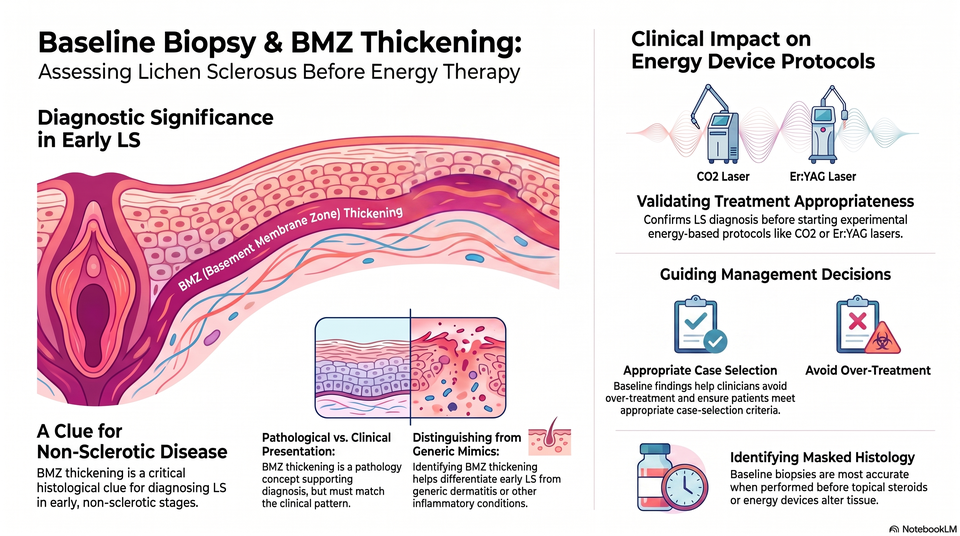


What is the clinical significance of basement membrane thickening before device therapy?

What is the role of basement membrane zone thickening in the clinical prese... | WHC Clinical FAQ

What is the clinical significance of a baseline biopsy showing basement mem... | WHC Clinical FAQ
Measure carefully
Symptoms matter
Response review
Women’s Health Clinic FAQ
What is the clinical significance of a baseline biopsy showing basement membrane zone thickening before starting an energy-device protocol?
Objective tools can add useful information, but a moisture reading, biopsy phrase or response score should not overrule symptoms and examination.
Direct answer
Basement membrane zone thickening may indicate an underlying dermatosis or tissue process that should be diagnosed before considering energy-device treatment.
The safest answer explains how measurement can support review while avoiding false certainty about treatment success or failure.
Educational only. Suitability and next steps should be confirmed after consultation. Results vary. Not a cure.

Measuring response
At a glance
These are the main points to understand before deciding whether a device-based, regenerative or measurement-led pathway is appropriate.
At a glance
Clinical summary
Main area
Response assessment
Pattern
Mixed measures
Watch for
Abnormal tissue
Next step
Reassess diagnosis
Important safety note
Biopsy abnormalities, persistent pain, bleeding, ulcers or worsening symptoms should prompt diagnostic review before continuing or escalating device treatment.
Tissue
Evidence
Safety
Review
Detailed answer
Detailed answer
The deeper answer starts by separating mechanism, device safety, tissue vulnerability, regenerative evidence, measurement limits and established dryness care.
Direct answer
The reader wants objective ways to measure hydration or response and needs help separating useful monitoring from false certainty.
Anatomy
Evidence
Safety
Direct answer
Start with the exact technology or tissue finding because laser, RF, ultrasound, shockwave, PRP, polynucleotides and biopsy questions carry different risks.
Objective measurement role
Technical parameters should be discussed as clinician-controlled safety decisions, not as settings or protocols for patients to copy.
Biopsy or tissue findings
Evidence should be tied to patient selection, outcomes measured, tissue condition and whether safer established options have been considered.
Response definitions
Post-cancer tissue, mesh, IUDs, biopsy findings, vestibular sensitivity and persistent pain all raise the threshold for specialist review.
How the research shapes the answer
• Diagnostic Uncertainty: The clinical reality is that histological findings in vulvovaginal dermatoses can be less distinctive (e.g., lacking classic sclerosis), relying on a constellation of features for a specific diagnosis. • Managing Patient Expectations: Patients.
The benchmark shaped search intent and structure, while final wording avoids device marketing, operational settings, outcome promises and unsupported regenerative claims.
Patient safety
Why this matters
Device and regenerative questions can affect safety, consent, cost, expectations and tissue health, so technical language must stay clinically grounded.
It prevents false certainty
Objective readings can support but not replace clinical judgement.
It respects tissue findings
Biopsy abnormalities should change the diagnostic pathway.
It clarifies response
Improvement should be defined before treatment starts.
It avoids premature escalation
Non-response should trigger reassessment before advanced procedures.
Evidence-aware decision-making
Good advice should be technically literate without becoming a procedural manual.
The right next step may be established GSM care, examination, biopsy interpretation, device avoidance, specialist coordination or careful consent.
Considerations
What to consider
• Instrument Selection: A 5 mm punch biopsy is recommended to obtain an adequate tissue sample. • Depth of Specimen: The punch should be pushed to the length of its hub to capture the necessary dermal.
Consultation priorities
Useful details include diagnosis, tissue appearance, cancer-treatment history, mesh or IUD status, biopsy results, previous devices, injections, adverse effects and realistic outcome goals.
Contraindications
Evidence
Follow-up
Choose meaningful endpoints
Pain, dryness, function and examination findings may tell different stories.
Repeat consistently
Measures are more useful when collected the same way over time.
Interpret biopsy context
Histology should be linked to symptoms and visible tissue findings.
Reassess before pivoting
Diagnosis, adherence, adverse effects and expectations should be revisited.
What not to assume
Do not assume a device mechanism, injection preparation, moisture reading or biopsy phrase proves benefit or suitability.
• Pre-Procedure Timeline: Patients must discontinue the use of topical steroids for at least two weeks prior to the biopsy to ensure inflammatory patterns (like those seen in LS) are not masked. • Procedure Duration: The.
Common concerns and myths
Common misconceptions
Device and regenerative marketing can sound very certain. These corrections keep the answer clinically balanced.
Myth: A moisture reading proves treatment success
Reality: measurements and biopsy findings should guide reassessment, not override symptoms and examination.
Myth: Biopsy findings can be ignored before device treatment
Reality: measurements and biopsy findings should guide reassessment, not override symptoms and examination.
Myth: Non-response means the next step must be injectables
Reality: measurements and biopsy findings should guide reassessment, not override symptoms and examination.
Technical does not mean proven
A precise-sounding mechanism still needs clinical evidence, appropriate patient selection and safety review.
Escalation should be reasoned
If symptoms persist, reassess diagnosis, tissue findings and goals before moving to more invasive or experimental options.
Safety checklist
Safety checklist
Use these checks to decide whether a device or regenerative question needs routine discussion or more urgent specialist advice.
Is the diagnosis clear?
GSM, skin disease, infection, pain, radiation change and arousal issues need different management.
Are there contraindications?
Mesh, IUDs, biopsy findings, fragile tissue or post-cancer history may change suitability.
Are expectations realistic?
Hydration, pain, sexual comfort and tissue appearance are different outcomes.
Are red flags present?
Bleeding, ulcers, severe pain, infection symptoms or suspected device injury need advice.
More reassuring signs
The situation is more reassuring when symptoms are mild, already assessed, improving and not linked with bleeding, ulcers, severe pain, infection signs or abnormal tissue findings.
Mild
Improving
Reasons to seek advice
Seek advice for bleeding, ulcers, severe pain, discharge with odour, infection symptoms, suspected device injury, post-cancer tissue change, pelvic mesh or IUD concerns, or abnormal biopsy findings.
Severe pain
Device concern
When to escalate
When to seek medical help
Some symptoms should not be attributed to device response, dryness or normal healing without assessment.
Use NHS 111 online
Bleeding, ulcers or severe pain
Bleeding, ulcers, burns, severe pain or rapidly worsening symptoms should be assessed.
Infection or discharge symptoms
Discharge with odour, fever, pelvic pain or urinary symptoms may need testing or treatment.
Complex device or cancer history
Post-radiation tissue, pelvic mesh, IUD concerns, biopsy abnormalities or suspected device injury need specialist review.
Emergency symptoms
Call 999 for life-threatening symptoms such as collapse, chest pain, breathing difficulty or stroke-like symptoms.
Use NHS 111 for urgent advice or call 999 in a life-threatening emergency. This page is educational and does not replace individual medical assessment.
Additional clinical context
How to use this answer
This page is designed to separate energy-device mechanisms, regenerative treatment claims, measurement tools, post-cancer tissue questions and contraindication checks.What to discuss at appointment
Useful details include diagnosis, tissue appearance, prior radiotherapy, mesh or IUD status, biopsy results, previous devices or injections, adverse effects, pain location, bleeding, discharge and realistic goals.Regulatory resources
Authoritative resources
These resources support measured advice on hydration tools, biopsy context, GSM review and defining response or non-response.
Next step
Book a clinical consultation
A consultation can review symptoms, examination findings, objective measures, biopsy context, adverse effects and whether treatment should continue, pause or change direction.
▶ View Research Sources (12 Sources)
These 12 source names are selected from 24 display-ready sources, with a raw audit trail of 58 imported records. Additional reviewed material included UK clinical guidance, professional society guidance, peer-reviewed clinical papers, evidence reviews; duplicate, low-relevance and non-clinical records were removed before display.
Educational only. This information is for education only and is not a substitute for professional medical advice, diagnosis or treatment. Results vary. Not a cure.

