
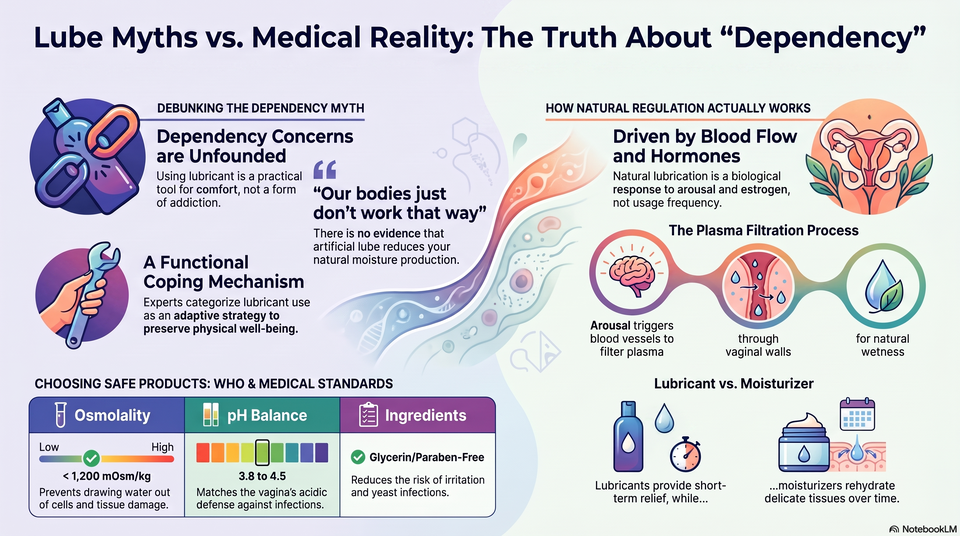


Can daily lubricant use create psychological dependency or affect natural mucosal balance?

Can a patient develop a psychological dependency on continuous, daily lubri... | WHC Clinical FAQ

How can a clinician address shame about changing natural lubrication?
Product use
Normal variation
Practical timing
Women’s Health Clinic FAQ
Can a patient develop a psychological dependency on continuous, daily lubricant applications that alters their natural mucosal self-regulation?
Lubricants and moisturisers can be helpful, but product use should reduce distress rather than increase monitoring, irritation or confusion.
Direct answer
Daily lubricant use does not usually switch off natural moisture, but anxiety-driven overuse can reinforce monitoring and may irritate tissue depending on the product. The safest approach is to validate the concern, check for physical causes, and then explore arousal, product use, relationship context, trauma history or consent pressure where relevant. This avoids both over-medicalising normal variation and dismissing symptoms that need assessment.
The answer should separate normal moisture variation, anxiety-driven checking, product irritation and practical timing with prescribed topical treatment.
Educational only. Suitability and next steps should be confirmed after consultation. Results vary. Not a cure.

Lubricant use
At a glance
These are the main points to understand before deciding whether symptoms are physical, situational, product-related, psychosexual, trauma-related or consent-related.
At a glance
Clinical summary
Main area
Lubricant habits
Pattern
Monitoring or layering
Watch for
Irritation
Next step
Product review
Important safety note
If a product causes burning, discharge, itching, soreness or worsening dryness, stop using it and seek advice.
Products
Consent
Tissue
Support
Detailed answer
Detailed answer
The deeper answer starts by separating tissue dryness from arousal response, friction, product irritation, relationship context, trauma triggers and normal variation.
Direct answer
The reader is asking how lubricant behaviour, product layering or symptom hyper-focus should be managed without shaming the patient.
Cause
Safety
Support
Direct answer
Daily lubricant use does not usually switch off natural moisture.
Product use versus dependency
Some products can irritate or worsen symptom focus.
Normal moisture variation
Layering products with topical medication may need practical spacing.
Layering with medicines
Moisture changes with arousal, cycle, hormones, stress and context.
How the research shapes the answer
Placebo vs. Active Treatment: A randomised clinical trial demonstrated that over a 12-week period, a vaginal moisturizer, a low-dose vaginal oestrogen tablet, and a dual placebo gel/tablet all provided a similar reduction in the severity of the most bothersome symptom (approx. 1.2.
The benchmark shaped search intent and structure, while final wording avoids shame, partner blame, procedure pressure, unsafe product advice and unsupported psychological dismissal.
Patient safety
Why this matters
Dryness concerns can affect confidence, intimacy, examinations and treatment decisions, so the answer needs both physical caution and emotional intelligence.
It reduces fear
Daily lubricant use does not usually switch off natural moisture.
It checks irritation
Some products can irritate or worsen symptom focus.
It improves timing
Layering products with topical medication may need practical spacing.
It normalises variation
Moisture changes with arousal, cycle, hormones, stress and context.
Balanced care prevents harm
A careful review can prevent both undertreatment of physical symptoms and overtreatment of anxiety, shame or relationship pressure.
That balance matters because products, procedures, reassurance, psychosexual support and medical treatment solve different problems.
Considerations
What to consider
Routine Application: moisturisers should be applied internally using an applicator, or externally with clean hands, every 2-3 days, completely independent of sexual activity. Activity-Specific Application: Lubricants (water-based or silicone-based) should be applied to the vulva, vagina, and/or partner directly prior to penetrative.
Consultation priorities
Useful details include symptom timing, arousal context, pain pattern, products used, relationship factors, trauma triggers, bleeding, discharge, expectations and treatment pressure.
Products
Context
Consent
Product type
Water-based, silicone-based and moisturiser products behave differently.
Frequency
Frequent use may reflect symptoms, anxiety or product irritation.
Medication instructions
Topical medicines should be used as directed without interfering layers.
Symptom monitoring
Hyper-focus may need reassurance plus a clear review plan.
What not to assume
Do not assume symptoms are only psychological, only physical, or automatically suitable for an elective procedure.
Immediate Relief: Vaginal lubricants provide immediate, temporary reduction of friction when applied just before or during sexual intercourse. Short-to-Medium Term (Days to Weeks): Vaginal moisturisers slowly release hydration and alter the fluid content of the endothelium, usually providing continuous relief for up.
Common concerns and myths
Common misconceptions
Dryness content often becomes too simplistic or too commercial. These corrections keep the answer safer.
Myth: Daily lubricant use shuts down natural moisture
Reality: product use should reduce friction and distress, while timing and irritation still matter.
Myth: More lubricant always means better care
Reality: product use should reduce friction and distress, while timing and irritation still matter.
Myth: Silicone products can be layered with every topical medicine
Reality: product use should reduce friction and distress, while timing and irritation still matter.
Context matters
Arousal, products, trauma, relationship context, GSM, infection and skin disease can all affect what a patient calls dryness.
Care should be proportionate
The best plan may be reassurance, product change, physical assessment, psychosexual support, maintenance care or no treatment at all.
Safety checklist
Safety checklist
Use these checks to decide whether symptoms can be discussed routinely or need prompt clinical advice.
Are there physical red flags?
Bleeding, sores, discharge, odour, severe pain or urinary symptoms should be assessed.
Could products be irritating tissue?
Internal wipes, sprays, gels, vinegar, yoghurt or fragranced products can worsen symptoms.
Is there pressure to treat?
Cosmetic anxiety, partner pressure or unrealistic procedure expectations should be explored gently.
Is trauma or fear involved?
Exams and treatment discussions should be paced, consent-led and trauma-informed.
More reassuring signs
Symptoms are more reassuring when they are mild, situational, improving, already assessed and not linked with bleeding, sores, discharge, fever or severe pain.
Situational
Assessed
Reasons to seek advice
Red Flag Symptoms: Postmenopausal bleeding, severe pain, recurrent urinary tract infections (UTIs), foul discharge, or visible lesions warrant immediate clinical evaluation to rule out malignancy or infection. Osmolality Limits: The World Health Organization (WHO) advises that personal lubricants should ideally not exceed.
Discharge
Severe pain
When to escalate
When to seek medical help
Some symptoms should not be managed as routine vaginal dryness or psychosexual stress.
Use NHS 111 online
Bleeding, sores or discharge
Bleeding, sores, odour, unusual discharge or a non-healing area should be assessed.
Severe pain or infection symptoms
Severe burning, pelvic pain, fever, urinary symptoms or feeling unwell needs clinical advice.
Coercion, distress or trauma triggers
Pressure to have sex, pressure to undergo treatment, flashbacks or severe distress deserve support and a pause in elective care.
Emergency symptoms
Call 999 for life-threatening symptoms such as collapse, chest pain, breathing difficulty or stroke-like symptoms.
Use NHS 111 for urgent advice or call 999 in a life-threatening emergency. This page is educational and does not replace individual medical assessment.
Additional clinical context
How to use this answer
This page is designed to separate physical dryness, arousal response, relationship context, product irritation, trauma triggers, consent pressure and normal variation.What to discuss at appointment
Useful details include symptom timing, pain pattern, arousal context, products used, bleeding, discharge, relationship pressure, trauma triggers, treatment expectations and what outcome would feel genuinely helpful.Regulatory resources
Authoritative resources
These resources support advice on vaginal dryness, menopause-related GSM, topical treatment use, vulval skin care and lubricant timing.
Next step
Book a clinical consultation
A consultation can review lubricant type, frequency, moisturiser use, topical medicines, irritation, symptom focus and whether a different product routine is safer.
▶ View Research Sources (12 Sources)
These 12 source names are selected from 24 display-ready sources, with a raw audit trail of 111 imported records. Additional reviewed material included UK clinical guidance, professional society guidance, peer-reviewed clinical papers, evidence reviews; duplicate, low-relevance and non-clinical records were removed before display.
Educational only. This information is for education only and is not a substitute for professional medical advice, diagnosis or treatment. Results vary. Not a cure.
