


What are the specific safety protocols for using clobetasol propionate on thin mucosal tissue?
Healing safety
Barrier care
Red flags
Women’s Health Clinic FAQ
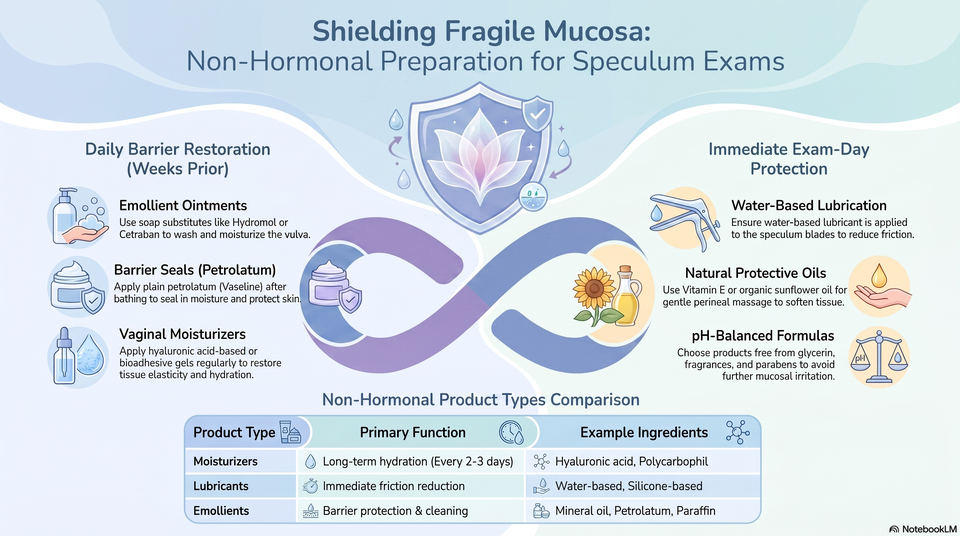
What non-hormonal barrier protectants are recommended to shield fragile, dry mucosa before an oncologist performs a routine speculum exam?
Fragile, dry or ulcerated mucosa in an oncology patient should be treated with care because infection, delayed healing and recurrence concerns can overlap.
Direct answer
Non-hormonal barrier support before speculum examination should be bland, tissue-safe and agreed with the clinician, especially in fragile post-treatment mucosa.
A strong answer explains barrier support and biopsy healing while making urgent warning signs clear and impossible to miss.
Educational only. Suitability and next steps should be confirmed after consultation. Results vary. Not a cure.

Lesion and healing safety
At a glance
These are the main points to understand before deciding whether symptoms are dryness, radiation change, active-treatment risk, healing concern or psychosexual recovery.
At a glance
Clinical summary
Main area
Fragile mucosa
Pattern
Ulcer or lesion
Watch for
Non-healing change
Next step
Prompt assessment
Important safety note
A non-healing, bleeding, enlarging, painful, smelly or discharging lesion after cancer treatment needs prompt medical assessment.
Tissue
Safety
Rehab
Review
Detailed answer
Detailed answer
The deeper answer starts by separating cancer-treatment context, tissue fragility, dryness, stenosis, infection risk, healing and psychosexual factors.
Direct answer
The reader needs to recognise fragile mucosa, ulceration, biopsy healing problems and red flags that should not be self-managed.
Tissue
Risk
Support
Direct answer
Start with the exact cancer-treatment context because breast cancer, gynaecological cancer, radiation, chemotherapy and immunotherapy change the pathway.
Fragile mucosa and barrier care
Tissue findings matter because dryness, stenosis, ulceration, scarring, discharge and wound breakdown require different responses.
Ulceration or biopsy healing
Procedures, hormones, PRP, lipofilling, dilators and barrier care should be framed through suitability, safety and specialist review.
Infection and dehiscence signs
Psychosexual support, pelvic-health adaptation and careful monitoring may be as important as local tissue treatment.
How the research shapes the answer
The clinical reality is that oncology-related dryness can overlap with treatment effects, radiation tissue change, infection risk, pain, stenosis, scarring and fear of intimacy.
The benchmark shaped search intent and structure, while final wording avoids overreassurance, procedure instructions, unsupported regenerative claims and one-size-fits-all cancer advice.
Patient safety
Why this matters
Cancer-related dryness can affect comfort, examinations, intimacy, rehabilitation and safety, so advice needs more context than routine dryness care.
It prevents delayed review
Non-healing lesions after cancer treatment should not be watched indefinitely.
It protects fragile tissue
Barrier support may reduce friction but does not replace diagnosis.
It recognises infection risk
Chemotherapy or tissue injury can alter healing and infection thresholds.
It keeps recurrence in mind
Persistent or changing lesions need proper assessment.
Safety and quality of life
Good care should protect against missed red flags while still supporting comfort, intimacy and confidence.
The right next step may involve oncology input, menopause care, examination, barrier support, dilator review, physiotherapy or psychosexual therapy.
Considerations
What to consider
Application Timing: Vaginal moisturisers should be applied at bedtime to allow better absorption and prevent the product from leaking out when standing or walking. Hygiene Practices: The vulval area should only be washed once a day.
Consultation priorities
Useful details include cancer type, treatment dates, endocrine therapy, radiation field, blood-count concerns, current medicines, biopsy results, discharge, pain, bleeding, intimacy goals and previous interventions.
Healing
Symptoms
Coordination
Look for wound change
Opening, discharge, odour, swelling or worsening pain matter.
Check systemic symptoms
Fever or feeling unwell can indicate infection.
Use bland protection
Barrier products should be simple and agreed with the clinician.
Escalate suspicious lesions
Bleeding, enlargement or persistence needs prompt review.
What not to assume
Do not assume cancer survivors all need the same plan, or that dryness, stenosis, ulceration, discharge and intimacy fear are the same problem.
Timelines vary because radiation healing, endocrine-therapy symptoms, chemotherapy risk, tissue ulceration, psychosexual recovery and rehabilitation do not follow one schedule.
Common concerns and myths
Common misconceptions
Cancer-related dryness advice can become either overcautious or overreassuring. These corrections keep it balanced.
Myth: Ulcers from dryness can be watched indefinitely
Reality: barrier care may help comfort, but ulcers or non-healing lesions need assessment.
Myth: Barrier protectants replace examination
Reality: barrier care may help comfort, but ulcers or non-healing lesions need assessment.
Myth: A non-healing lesion after cancer is only irritation
Reality: barrier care may help comfort, but ulcers or non-healing lesions need assessment.
Context changes risk
Cancer type, treatment status, radiation effects and current medicines can all change what is safe.
Support should be practical
Dryness care may include tissue protection, pain support, rehabilitation, communication and specialist coordination.
Safety checklist
Safety checklist
Use these checks to decide whether symptoms need routine support, oncology-aware review or urgent advice.
Is treatment active?
Chemotherapy, immunotherapy, targeted therapy or recent radiation can change healing and infection risk.
Is the tissue healing?
Ulcers, biopsy sites, discharge, bleeding or wound opening should be reviewed.
Is anatomy altered?
Radiation stenosis, exenteration or surgery can change symptoms and treatment choices.
Are red flags present?
Fever, severe pain, bleeding, non-healing lesions or suspected infection need advice.
More reassuring signs
The situation is more reassuring when symptoms are mild, already assessed, improving and not linked with fever, bleeding, ulcers, discharge, severe pain or wound change.
Mild
Improving
Reasons to seek advice
Seek advice for fever, neutropenia concerns, bleeding, ulcers, discharge, wound opening, non-healing lesions, severe pain, suspected infection, active chemotherapy complications or suspected recurrence.
Bleeding
Non-healing
When to escalate
When to seek medical help
Some symptoms should not be managed as routine dryness in an oncology patient.
Use NHS 111 online
Fever or infection signs
Fever, feeling unwell, discharge with odour, pelvic pain or neutropenia concerns need prompt advice.
Bleeding, ulcers or wound opening
Bleeding, ulceration, biopsy-site opening, worsening pain or delayed healing should be assessed.
Non-healing or suspicious lesion
A lesion that persists, enlarges, bleeds, smells, discharges or becomes painful needs urgent review.
Emergency symptoms
Call 999 for life-threatening symptoms such as collapse, chest pain, breathing difficulty or stroke-like symptoms.
Use NHS 111 for urgent advice or call 999 in a life-threatening emergency. This page is educational and does not replace individual medical assessment.
Additional clinical context
How to use this answer
This page is designed to separate oncology treatment effects, radiation tissue change, endocrine therapy symptoms, healing concerns, procedures, barrier care and psychosexual recovery.What to discuss at appointment
Useful details include cancer type, treatment dates, receptor status, endocrine therapy, radiation field, current medicines, blood-count concerns, biopsy sites, discharge, odour, bleeding, pain, stenosis symptoms and intimacy goals.Regulatory resources
Authoritative resources
These resources support careful advice on vaginal dryness, chemotherapy, radiotherapy effects, vulval skin assessment, mucosal ulceration and non-healing lesions.
Next step
Book a clinical consultation
A consultation can review ulceration, biopsy healing, barrier protection, discharge, bleeding, pain, treatment status and whether urgent referral is needed.
▶ View Research Sources (12 Sources)
These 12 source names are selected from 24 display-ready sources, with a raw audit trail of 74 imported records. Additional reviewed material included UK clinical guidance, professional society guidance, peer-reviewed clinical papers; duplicate, low-relevance and non-clinical records were removed before display.
Educational only. This information is for education only and is not a substitute for professional medical advice, diagnosis or treatment. Results vary. Not a cure.
