


Does vaginal tightening help with vaginal dryness?
Can menopause-related dryness mimic vaginal looseness? | WHC Clinical FAQ

Can the O-Shot help with vaginal dryness?
GSM aware
Hormone context
Adherence support
Women’s Health Clinic FAQ
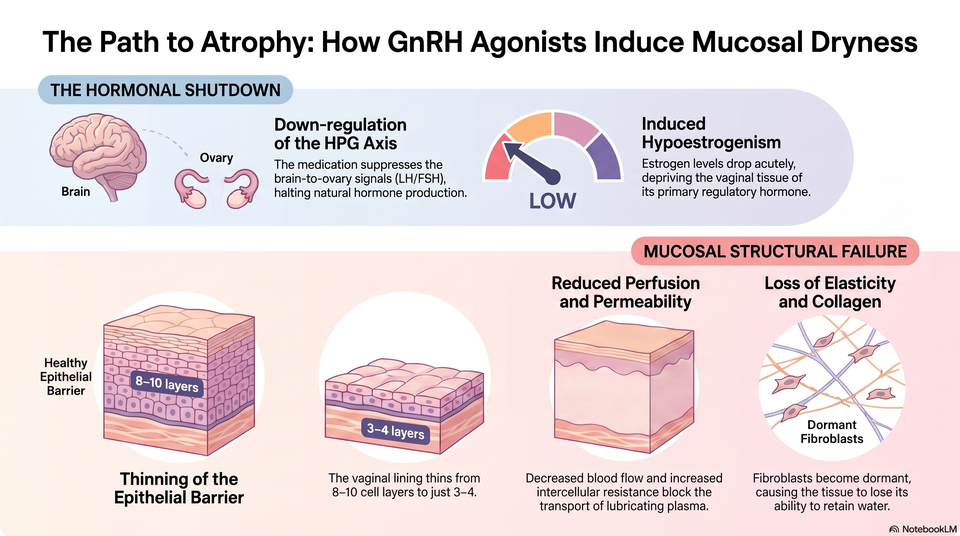
How do gonadotropin-releasing hormone (GnRH) agonists used for endometriosis treatment induce an acute, profound state of mucosal dryness?
Local hormone and hormone-related treatments may help selected patients, but persistent dryness needs diagnosis, tolerability review and realistic expectations.
Direct answer
GnRH agonists can induce a hypo-oestrogenic state, so vaginal dryness may develop quickly and should be managed as part of the treatment plan.
A strong answer explains local tissue response, formulation choice, leakage or discharge, systemic hormone context and why patients should not self-adjust prescribed treatment.
Educational only. Suitability and next steps should be confirmed after consultation. Results vary. Not a cure.

Local hormone care
At a glance
These are the main points to understand before deciding whether symptoms are medicine-related, hormonal, product-triggered, skin-related or medically complex.
At a glance
Clinical summary
Main area
Local tissue response
Pattern
Treatment review
Watch for
Bleeding or pain
Next step
Clinician-led adjustment
Important safety note
Postmenopausal bleeding, severe irritation, pelvic pain or cancer-related hormone concerns should be reviewed rather than managed by changing local treatment alone.
GSM
Products
Skin
Review
Detailed answer
Detailed answer
The deeper answer starts by separating medicine effects, local hormone response, lubricant or cream irritation, skin disease, infection and arousal physiology.
Direct answer
The reader is asking how hormone-related dryness and local treatment decisions should be managed without self-adjusting prescribed therapy.
Tissue
Products
Safety
Direct answer
Start with the exact trigger and timing because a medicine change, local treatment, lubricant switch or cream reaction points to different next steps.
Hormonal mechanism
Local tissue findings matter because burning, discharge, dryness, leakage, fissures and pain are not all the same clinical problem.
Local treatment decision points
Treatment or product changes should be framed as clinician-led or cautious trials, not proof of diagnosis or promises of symptom resolution.
Adherence and tolerability
Persistent or severe symptoms need examination, swabs, medicine review, formulation review or specialist input rather than repeated self-management.
How the research shapes the answer
The clinical reality is that vaginal dryness can overlap with medication effects, GSM, product irritation, arousal response, infection, vulval skin disease and pain.
The benchmark shaped search intent and structure, while final wording avoids product fear, medication stopping advice, supplement promises and single-cause explanations.
Patient safety
Why this matters
Dryness, burning or leakage can affect sex, confidence, medication adherence and daily comfort, but the safest plan depends on cause.
It keeps treatment individual
Local tissue response may not match serum hormone levels or product expectations.
It improves adherence
Discharge, leakage or irritation can often be addressed by technique or formulation review.
It avoids self-adjustment
Dose or frequency changes should be clinician-led.
It checks the diagnosis
Persistent dryness may involve GSM, infection, skin disease or pain.
Practical, proportionate care
Good advice should help patients discuss symptoms without shame, blame or abrupt medication changes.
The right next step may be product simplification, medicine review, local treatment adjustment, swabs, examination or a different diagnosis.
Considerations
What to consider
Prescription and Administration: Initiated by a specialist and maintained by a GP; administered via clinic visits every 28 days or 12 weeks. Monitoring: Diabetic patients require close blood glucose monitoring due to potential altered insulin resistance..
Consultation priorities
Useful details include medicine names, dose changes, treatment technique, lubricant or cream ingredients, symptom timing, discharge, odour, bleeding, pain and what has already been tried.
Ingredients
Technique
Review
Confirm the indication
GSM or hypo-oestrogenic tissue should be distinguished from other causes.
Review technique
Placement, timing and expectations can affect tolerability.
Discuss formulation
Cream, pessary, ring, moisturiser or other approaches may suit different patients.
Check safety flags
Bleeding, severe irritation or complex hormone history needs review.
What not to assume
Do not assume one medicine, supplement, lubricant, cream or hormone level explains every dryness symptom.
Timelines vary because product irritation, local hormone response, medicine effects, skin reactions and GSM do not all improve at the same pace.
Common concerns and myths
Common misconceptions
Online advice about medicines, supplements and intimate products can become overconfident. These corrections keep the answer balanced.
Myth: Systemic oestrogen levels always resolve local dryness
Reality: local tissue response, technique, formulation and diagnosis can all affect treatment success.
Myth: Local treatments should be adjusted without review
Reality: local tissue response, technique, formulation and diagnosis can all affect treatment success.
Myth: Discharge or leakage means treatment has failed
Reality: local tissue response, technique, formulation and diagnosis can all affect treatment success.
Context matters
The same symptom can come from GSM, irritation, infection, medicines, product sensitivity, arousal response or skin disease.
Changes should be safe
Medication and hormone-treatment changes should be discussed with a clinician, while product trials should stop if symptoms worsen.
Safety checklist
Safety checklist
Use these checks to decide whether symptoms are suitable for routine review, cautious product change or more urgent advice.
Did timing change?
Link symptoms to new medicines, dose changes, local treatment, lubricant or cream use where possible.
Are symptoms localised?
Separate vulval burning, vaginal dryness, discharge, leakage, vestibular pain and urinary symptoms.
Could ingredients matter?
Preservatives, pH, osmolality, fragrances and active ingredients can affect sensitive tissue.
Are red flags present?
Bleeding, ulcers, swelling, severe pain or discharge with odour need advice.
More reassuring signs
The situation is more reassuring when symptoms are mild, improving after removing a likely trigger and not linked with bleeding, sores, swelling, odour or severe pain.
Improving
Clear timing
Reasons to seek advice
Seek advice for bleeding, ulcers, fissures, severe burning, swelling, discharge with odour, pelvic pain, urinary symptoms, suspected allergy, suspected infection or symptoms during complex hormone care.
Sores
Severe pain
When to escalate
When to seek medical help
Some symptoms should not be managed by changing products or medicines alone.
Use NHS 111 online
Bleeding, sores or swelling
Bleeding, ulcers, fissures, swelling, peeling or rapidly worsening pain should be assessed.
Discharge, odour or infection symptoms
New discharge, odour, pelvic pain, fever or urinary symptoms may need testing or treatment.
Treatment or medicine concerns
Severe irritation with local treatment, complex hormone history or suspected medicine side effects should be reviewed.
Emergency symptoms
Call 999 for life-threatening symptoms such as collapse, chest pain, breathing difficulty or stroke-like symptoms.
Use NHS 111 for urgent advice or call 999 in a life-threatening emergency. This page is educational and does not replace individual medical assessment.
Additional clinical context
How to use this answer
This page is designed to separate medication side effects, GSM, lubricant or moisturiser irritation, cream sensitivity, supplements, local treatment adherence and other causes of vulvovaginal dryness.What to discuss at appointment
Useful details include medicines, dose changes, local treatment technique, products used, supplement names, discharge, odour, bleeding, pain location, visible irritation and what improved or worsened symptoms.Regulatory resources
Authoritative resources
These resources support evidence-aware advice on GSM, local oestrogen, prasterone, GnRH agonists, HRT context and treatment adherence.
Next step
Book a clinical consultation
A consultation can review diagnosis, treatment technique, formulation, leakage, irritation, contraindications, response and whether another local or non-hormonal option is safer.
▶ View Research Sources (12 Sources)
These 12 source names are selected from 24 display-ready sources, with a raw audit trail of 47 imported records. Additional reviewed material included UK clinical guidance, professional society guidance, peer-reviewed clinical papers, evidence reviews; duplicate, low-relevance and non-clinical records were removed before display.
Educational only. This information is for education only and is not a substitute for professional medical advice, diagnosis or treatment. Results vary. Not a cure.
