
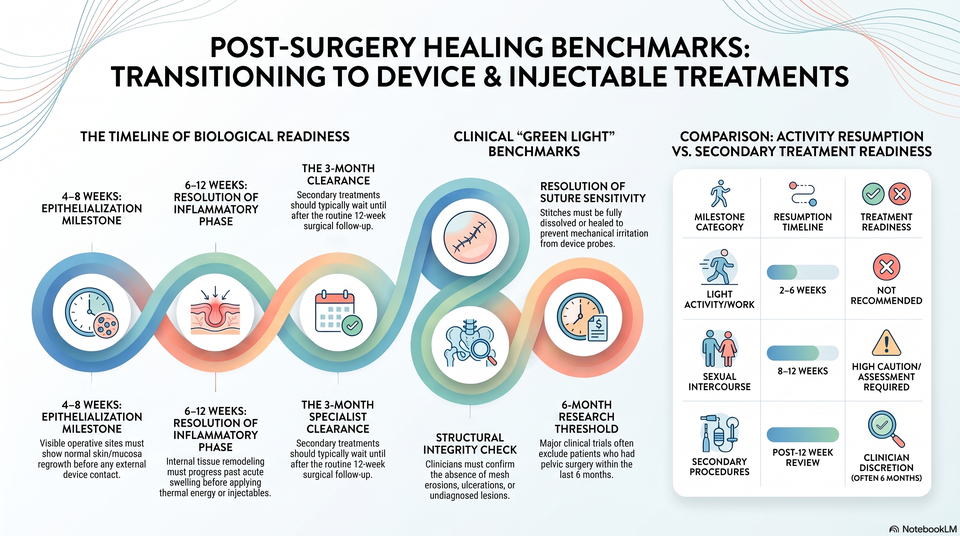


What Healing Is Required Before Device or Injectable Treatment After Vaginal Reconstructive Surgery

What are the specific healing benchmarks required before starting localised... | WHC Clinical FAQ

🛑 STOP or GO? Dilators & Physio After Vaginal Rejuvenation: The Healing Timeline Explained
Healing first
Procedure safety
Surgical clearance
Women’s Health Clinic FAQ
What are the specific healing benchmarks required before starting localised device or injectable treatments after major vaginal reconstructive surgery?
After major vaginal reconstructive surgery, the key question is not simply time elapsed but whether tissue has healed enough for any additional treatment.
Direct answer
Before device or injectable treatments after major vaginal reconstruction, clinicians should confirm intact healing, no infection, no bleeding, stable pain, tissue maturity and explicit surgical clearance. The key is to separate true low-moisture tissue change from friction, burning, scarring, arousal response, cervical mucus, prolapse exposure or infection. Assessment is worthwhile if symptoms are persistent, focal, painful, linked with bleeding or difficult to explain.
A safe answer should explain healing benchmarks, reasons to delay, device or injectable boundaries and the need for explicit surgical clearance.
Educational only. Suitability and next steps should be confirmed after consultation. Results vary. Not a cure.

Healing benchmarks
At a glance
These are the main points to understand before deciding whether symptoms are hormone-related, anatomy-related, mechanical, inflammatory or part of healing.
At a glance
Clinical summary
Main area
Post-surgical healing
Pattern
Readiness check
Watch for
Wound change
Next step
Surgeon clearance
Important safety note
Do not start elective local device or injectable treatment after major reconstruction without confirmation of intact healing and surgical clearance.
Hormones
Tissue
Symptoms
Review
Detailed answer
Detailed answer
The deeper answer starts by separating moisture production from friction, burning, exposure, scar sensitivity, arousal response and infection.
Direct answer
The reader wants a safety checklist for when vaginal tissue is healed enough before elective device or injectable treatment.
Anatomy
Assessment
Care
Direct answer
A calendar date alone cannot prove tissue readiness.
Healing benchmarks
Intact epithelium, no infection and stable pain matter.
What should delay procedures
The operating team may set specific restrictions.
Device and injectable boundaries
Devices and injectables can add trauma to recently repaired tissue.
How the research shapes the answer
A high-quality 2021 randomised sham-controlled trial (JAMA) demonstrated that fractional CO2 laser therapy was no more effective than sham procedures in improving postmenopausal vaginal symptoms [32-34]. PRP has demonstrated consistent short-term superiority over pelvic floor muscle training (PFMT) in reducing symptom bother.
The benchmark shaped search intent and structure, while final wording avoids overclaiming, treatment promises, unsupported mechanisms and copied generic dryness text.
Patient safety
Why this matters
Dryness-like symptoms can affect comfort, sex, examinations, confidence and recovery, but the safest plan depends on the underlying mechanism.
It prevents early treatment
A calendar date alone cannot prove tissue readiness.
It checks healing quality
Intact epithelium, no infection and stable pain matter.
It respects surgical plans
The operating team may set specific restrictions.
It avoids stacking risk
Devices and injectables can add trauma to recently repaired tissue.
Assessment prevents guesswork
A careful review can identify whether symptoms are mainly hormonal, mechanical, inflammatory, scar-related, arousal-related or healing-related.
That distinction matters because moisturisers, lubricants, pelvic-health support, endocrine review, pessary review or surgical clearance solve different problems.
Considerations
What to consider
localised regenerative procedures are performed in an outpatient clinical setting and typically last between 10 to 30 minutes [38-40]. Topical anaesthetics (such as EMLA cream or lidocaine jelly) are applied prior to the procedure to manage discomfort; general anaesthesia is rarely required.
Consultation priorities
Useful details include symptom location, cycle or feeding context, surgery history, products used, pain triggers, bleeding, discharge, prolapse, pessary or mesh history and treatment goals.
Location
Triggers
Safety
Wound integrity
No opening, bleeding, discharge or infection should be present.
Pain and swelling
Symptoms should be stable or improving, not escalating.
Tissue maturity
Fragile new tissue may need longer before elective treatment.
Surgical clearance
Written or explicit clearance is safer after major reconstruction.
What not to assume
Do not assume every dry, burning or friction symptom has the same cause, or that unusual anatomy automatically proves the mechanism.
Energy-based treatments (CO2/Er:YAG lasers) typically require a primary course of 3 sessions spaced 4 to 6 weeks apart [11, 12]. PRP protocols often utilize 1 to 3 sessions administered at 4 to 6-month intervals, which have shown progressive and cumulative improvements for.
Common concerns and myths
Common misconceptions
Dryness content often becomes too simple. These corrections keep the page clinically useful.
Myth: A calendar date is enough to clear treatment
Reality: tissue readiness depends on healing quality, symptoms and clinical clearance, not only time.
Myth: No pain means complete tissue maturity
Reality: tissue readiness depends on healing quality, symptoms and clinical clearance, not only time.
Myth: Devices and injectables are routine after reconstruction
Reality: tissue readiness depends on healing quality, symptoms and clinical clearance, not only time.
Mechanism matters
Hormones, tissue exposure, surgery, scar sensitivity, arousal response and infection can all produce symptoms that patients call dryness.
Support should be targeted
The best plan starts with the cause, then chooses proportionate comfort measures, review, tests or referral.
Safety checklist
Safety checklist
Use these checks to decide whether symptoms can be discussed routinely or need prompt clinical advice.
Is there bleeding or ulceration?
Bleeding, sores, wound opening or exposed tissue should be assessed.
Is pain focal or worsening?
Entry pain, scar pain, severe burning or worsening symptoms may need examination.
Is there prolapse, pessary or mesh history?
Mechanical irritation, erosion or inflammation can mimic dryness.
Is there a hormone or healing context?
Breastfeeding, amenorrhoea, perimenopause, testosterone therapy, adrenal surgery or recent reconstruction changes the assessment.
More reassuring signs
Symptoms are more reassuring when they are mild, improving, already assessed and not linked with bleeding, ulcers, discharge, fever, wound change or severe pain.
Improving
Assessed
Reasons to seek advice
Red Flags: Treatments are strictly contraindicated in the presence of undiagnosed vaginal bleeding, active genital or urinary tract infections, suspicion of malignancy, and severe pelvic organ prolapse (greater than Stage 2) [22-25]. Contraindications: A history of pelvic radiation, recent pelvic reconstructive surgery.
Ulcer
Severe pain
When to escalate
When to seek medical help
Some symptoms should not be managed as routine vaginal dryness.
Use NHS 111 online
Bleeding, ulceration or wound change
Bleeding, sores, wound opening, exposed mesh or a non-healing focal area should be assessed.
Infection symptoms
Fever, odour, new discharge, pelvic pain or feeling unwell needs clinical advice.
Severe or worsening pain
Severe burning, entry pain, urinary symptoms or worsening scar pain should not be ignored.
Emergency symptoms
Call 999 for life-threatening symptoms such as collapse, chest pain, breathing difficulty or stroke-like symptoms.
Use NHS 111 for urgent advice or call 999 in a life-threatening emergency. This page is educational and does not replace individual medical assessment.
Additional clinical context
How to use this answer
This page is designed to separate hormones, anatomy, arousal response, friction, scarring, prolapse, pessary or mesh effects, and post-surgical healing.What to discuss at appointment
Useful details include timing, symptom location, feeding or cycle context, hormone therapy, surgery history, pain triggers, bleeding, discharge, products used, prolapse symptoms and treatment goals.Regulatory resources
Authoritative resources
These resources support advice on vaginal dryness, prolapse surgery, reconstructive healing, genital procedure caution and post-surgical safety.
Next step
Book a clinical consultation
A consultation can review operation details, wound healing, pain, bleeding, infection history, tissue maturity and whether the original surgical team has cleared treatment.
▶ View Research Sources (12 Sources)
These 12 source names are selected from 24 display-ready sources, with a raw audit trail of 121 imported records. Additional reviewed material included UK clinical guidance, professional society guidance, peer-reviewed clinical papers, evidence reviews; duplicate, low-relevance and non-clinical records were removed before display.
Educational only. This information is for education only and is not a substitute for professional medical advice, diagnosis or treatment. Results vary. Not a cure.
