
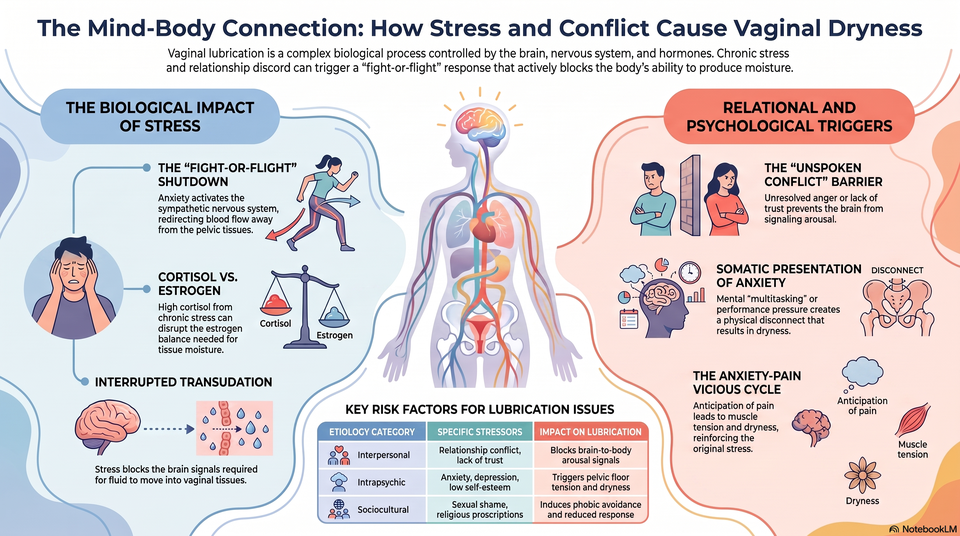

Can relationship stress or intimacy conflict contribute to vaginal dryness?

Can mismatched sexual desire in a couple cause situational vaginal dryness?

Can chronic relationship stress or unspoken intimacy conflicts cause a soma... | WHC Clinical FAQ
Situational
Couple context
No blame
Women’s Health Clinic FAQ
Can chronic relationship stress or unspoken intimacy conflicts cause a somatic presentation of severe, unyielding vaginal dryness?
Sometimes dryness is situational: arousal time, relationship stress, desire mismatch or partner difficulties can change friction and comfort.
Direct answer
Relationship stress may reduce arousal, increase tension and make dryness feel severe, but persistent symptoms should still be assessed physically. The safest approach is to validate the concern, check for physical causes, and then explore arousal, product use, relationship context, trauma history or consent pressure where relevant. This avoids both over-medicalising normal variation and dismissing symptoms that need assessment.
The answer should make room for couple context without blaming either person or ignoring possible physical causes.
Educational only. Suitability and next steps should be confirmed after consultation. Results vary. Not a cure.

Relationship context
At a glance
These are the main points to understand before deciding whether symptoms are physical, situational, product-related, psychosexual, trauma-related or consent-related.
At a glance
Clinical summary
Main area
Situational friction
Pattern
Context-dependent
Watch for
Persistent pain
Next step
Open assessment
Important safety note
Relationship or partner factors may contribute, but symptoms that are persistent, painful, bleeding-related or linked with discharge should still be assessed.
Products
Consent
Tissue
Support
Detailed answer
Detailed answer
The deeper answer starts by separating tissue dryness from arousal response, friction, product irritation, relationship context, trauma triggers and normal variation.
Direct answer
The reader is asking whether couple dynamics, partner sexual difficulties or desire mismatch can create situational friction mistaken for dryness.
Cause
Safety
Support
Direct answer
Couple factors can affect arousal without making either partner the problem.
Situational arousal context
Shortened foreplay or mismatched desire can create friction before lubrication builds.
Partner and couple factors
Situational symptoms can coexist with GSM, infection, skin disease or pain.
Friction versus structural dryness
Care may involve practical changes, medical review and psychosexual support.
How the research shapes the answer
The clinical reality is that vaginal dryness can overlap with arousal, pain memory, product irritation, relationship context, trauma, GSM, infection, skin disease and normal variation.
The benchmark shaped search intent and structure, while final wording avoids shame, partner blame, procedure pressure, unsafe product advice and unsupported psychological dismissal.
Patient safety
Why this matters
Dryness concerns can affect confidence, intimacy, examinations and treatment decisions, so the answer needs both physical caution and emotional intelligence.
It removes blame
Couple factors can affect arousal without making either partner the problem.
It explains timing
Shortened foreplay or mismatched desire can create friction before lubrication builds.
It keeps physical causes visible
Situational symptoms can coexist with GSM, infection, skin disease or pain.
It supports communication
Care may involve practical changes, medical review and psychosexual support.
Balanced care prevents harm
A careful review can prevent both undertreatment of physical symptoms and overtreatment of anxiety, shame or relationship pressure.
That balance matters because products, procedures, reassurance, psychosexual support and medical treatment solve different problems.
Considerations
What to consider
Effective management requires a detailed biopsychosocial history, medication review, and potentially a gentle pelvic exam. First-line GSM treatment utilizes minimally absorbed topical vaginal estrogens. Care is optimally delivered through a multidisciplinary network of gynaecologists, pelvic floor physical therapists, and accredited psychosexual therapists.
Consultation priorities
Useful details include symptom timing, arousal context, pain pattern, products used, relationship factors, trauma triggers, bleeding, discharge, expectations and treatment pressure.
Products
Context
Consent
When it happens
Situational symptoms differ from constant dryness.
Foreplay and pace
Arousal may need more time when stress or partner difficulties are present.
Desire mismatch
Different readiness levels can feel like unmanaged dryness.
Referral options
Psychosexual support may help when communication or anxiety is central.
What not to assume
Do not assume symptoms are only psychological, only physical, or automatically suitable for an elective procedure.
Timelines vary because psychosexual recovery, product irritation, tissue healing, maintenance treatment and relationship communication do not follow one resolved schedule.
Common concerns and myths
Common misconceptions
Dryness content often becomes too simplistic or too commercial. These corrections keep the answer safer.
Myth: Situational dryness means one partner is to blame
Reality: situational dryness can involve timing, desire and communication without blaming either partner.
Myth: Short foreplay proves structural dryness
Reality: situational dryness can involve timing, desire and communication without blaming either partner.
Myth: Desire mismatch is not a clinical factor
Reality: situational dryness can involve timing, desire and communication without blaming either partner.
Context matters
Arousal, products, trauma, relationship context, GSM, infection and skin disease can all affect what a patient calls dryness.
Care should be proportionate
The best plan may be reassurance, product change, physical assessment, psychosexual support, maintenance care or no treatment at all.
Safety checklist
Safety checklist
Use these checks to decide whether symptoms can be discussed routinely or need prompt clinical advice.
Are there physical red flags?
Bleeding, sores, discharge, odour, severe pain or urinary symptoms should be assessed.
Could products be irritating tissue?
Internal wipes, sprays, gels, vinegar, yoghurt or fragranced products can worsen symptoms.
Is there pressure to treat?
Cosmetic anxiety, partner pressure or unrealistic procedure expectations should be explored gently.
Is trauma or fear involved?
Exams and treatment discussions should be paced, consent-led and trauma-informed.
More reassuring signs
Symptoms are more reassuring when they are mild, situational, improving, already assessed and not linked with bleeding, sores, discharge, fever or severe pain.
Situational
Assessed
Reasons to seek advice
Absolute contraindications for vaginal oestrogen include active breast cancer and undiagnosed vaginal bleeding. Flibanserin carries risks of severe hypotension and syncope, especially with alcohol. Off-label testosterone therapy requires close monitoring to avoid acne, hirsutism, and adverse lipid profiles. Deep trauma histories require.
Discharge
Severe pain
When to escalate
When to seek medical help
Some symptoms should not be managed as routine vaginal dryness or psychosexual stress.
Use NHS 111 online
Bleeding, sores or discharge
Bleeding, sores, odour, unusual discharge or a non-healing area should be assessed.
Severe pain or infection symptoms
Severe burning, pelvic pain, fever, urinary symptoms or feeling unwell needs clinical advice.
Coercion, distress or trauma triggers
Pressure to have sex, pressure to undergo treatment, flashbacks or severe distress deserve support and a pause in elective care.
Emergency symptoms
Call 999 for life-threatening symptoms such as collapse, chest pain, breathing difficulty or stroke-like symptoms.
Use NHS 111 for urgent advice or call 999 in a life-threatening emergency. This page is educational and does not replace individual medical assessment.
Additional clinical context
How to use this answer
This page is designed to separate physical dryness, arousal response, relationship context, product irritation, trauma triggers, consent pressure and normal variation.What to discuss at appointment
Useful details include symptom timing, pain pattern, arousal context, products used, bleeding, discharge, relationship pressure, trauma triggers, treatment expectations and what outcome would feel genuinely helpful.Regulatory resources
Authoritative resources
These resources support advice on vaginal dryness, sexual wellbeing, erectile difficulties, psychosexual therapy and relationship-related arousal context.
Next step
Book a clinical consultation
A consultation can review symptom timing, foreplay, desire mismatch, partner factors, pain, tissue symptoms and whether psychosexual or clinical support is appropriate.
▶ View Research Sources (12 Sources)
These 12 source names are selected from 24 display-ready sources, with a raw audit trail of 127 imported records. Additional reviewed material included UK clinical guidance, professional society guidance, peer-reviewed clinical papers, evidence reviews; duplicate, low-relevance and non-clinical records were removed before display.
Educational only. This information is for education only and is not a substitute for professional medical advice, diagnosis or treatment. Results vary. Not a cure.
