



Which bio-impedance tools measure mucosal hydration changes post-treatment?

How does mucosal tissue water content affect fractional CO2 laser ablation depth?

How does tissue hydration influence laser thermal delivery when treating su... | WHC Clinical FAQ
Device caution
Thin tissue
Specialist settings
Women’s Health Clinic FAQ
How does progressive mucosal re-hydration across a laser treatment series alter real-time tissue bio-impedance measurements?
Energy-based treatment in atrophic vaginal tissue is mainly a safety and suitability question because heat, dryness and mucosal thickness interact.
Direct answer
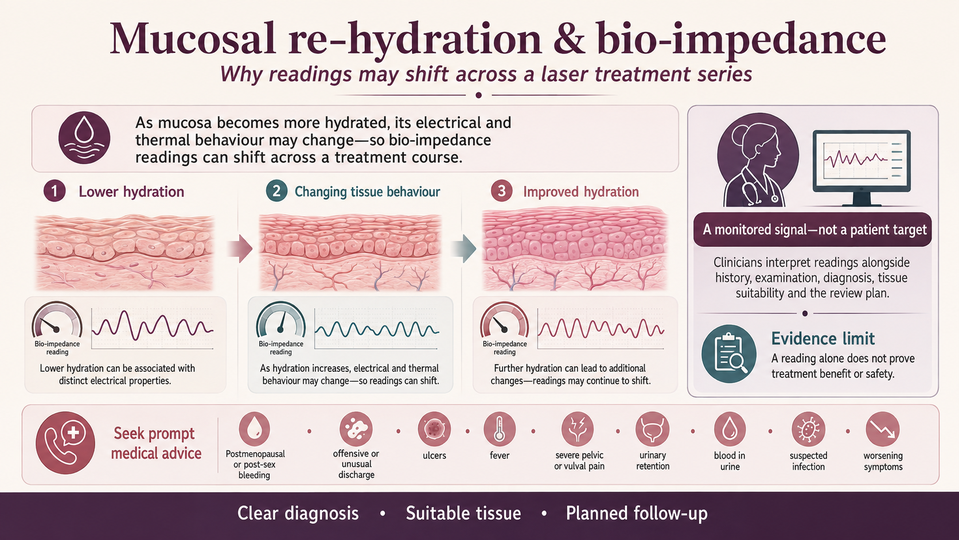
As mucosa becomes more hydrated, electrical and thermal behaviour may change, so bio-impedance readings can shift across a treatment course. The page should explain why this is monitored by clinicians rather than used as a patient-facing target.
The safest explanation combines the biological rationale with examination findings, contraindications, red flags and the limits of current intimate-health evidence.
Educational only. Use this as general education before discussing your own symptoms with a clinician. Results vary. Not a cure.

Atrophy treatment review
At a glance
These points frame the question before discussing treatment suitability.
At a glance
Clinical summary
Settings
Laser and radiofrequency settings must be chosen by a trained clinician after examination.
Heat handling
Dry, thin tissue may tolerate heat differently from healthier mucosa.
Deferral
Severe atrophy, infection, bleeding or ulceration may make postponement safer.
Evidence
Device-based GSM evidence is evolving and should be discussed without overclaiming.
Important safety note
Seek medical advice promptly for postmenopausal bleeding, bleeding after sex, offensive or unusual discharge, ulcers, fever, severe pelvic or vulval pain, urinary retention, blood in urine, suspected infection or symptoms that worsen after treatment.
Atrophic mucosa
Suitability
Evidence
Review
Detailed answer
Detailed answer
Energy-based treatment in severe vaginal atrophy is a safety question first, because thin mucosa has less reserve if heat, friction or dryness is misjudged.
Mechanism in context
Hydrated tissue can conduct electrical signals differently from dry atrophic mucosa, so readings may shift across a treatment series.
Tissue reserve
Evidence limit
Safety
What matters first
Energy-based treatment in severe vaginal atrophy is a safety question first, because thin mucosa has less reserve if heat, friction or dryness is misjudged.
Biological logic
Hydrated tissue can conduct electrical signals differently from dry atrophic mucosa, so readings may shift across a treatment series.
Evidence boundary
Clinicians consider tissue hydration, epithelial thickness, symptoms, infection, bleeding risk, prior response and whether local medical care is more appropriate first.
Safety boundary
A reassuring measurement should not override pain, bleeding, discharge, ulceration or a poor clinical appearance.
What this means in practice
Clinicians should interpret bio-impedance trends in context rather than treating a device reading as proof of repair.
The page should not give procedural settings, injection maps, product volumes, resolved intervals, prices or outcome percentages.
Patient safety
Why this matters
Severe atrophy can affect comfort, intimacy, examinations and confidence, but treatment decisions also involve tissue resilience and clinical safety.
It protects fragile tissue
Thin mucosa can react differently to heat, injection, friction or product placement.
It avoids overclaiming
Cellular pathways are not the same as proven symptom improvement.
It checks the diagnosis
Bleeding, infection, vulval skin disease or pelvic-floor pain may need a different pathway.
It supports consent
Patients should understand uncertainty, discomfort, bruising, thermal risk and follow-up before choosing treatment.
A careful treatment conversation
The clinical question is not only whether a mechanism is plausible, but whether the mucosa is safe to treat.
That is why examination, history and review should come before any procedural escalation.
Considerations
What to consider
Consider symptom severity, bleeding, discharge, pain, cancer history, current medicines, tissue thickness, hydration, infection risk, previous GSM treatment and patient priorities.
Consultation priorities
Assessment looks for active infection, ulcers, bleeding, severe fissuring, pelvic pain, cancer history and medication factors that may affect healing.
Examination
Contraindications
Follow-up
Assessment
Assessment looks for active infection, ulcers, bleeding, severe fissuring, pelvic pain, cancer history and medication factors that may affect healing.
Differential diagnosis
The clinician decides whether the mucosa is suitable for treatment, needs pre-conditioning, requires another diagnosis, or should avoid energy-based therapy.
Treatment fit
During treatment, comfort, tissue appearance and device feedback may guide whether to continue, reduce intensity, pause or stop.
Review
Review should check pain, discharge, bleeding, delayed irritation, hydration, examination comfort and whether the next session remains appropriate.
Practical expectations
Response varies and may be slow, partial or absent, especially where severe tissue fragility, cancer treatment or chronic inflammation is involved.
Treatment costs, exact products, settings, intervals and aftercare should be confirmed with the clinic before booking.
Common concerns and myths
Common misconceptions
These myths can make technical atrophy treatments sound simpler than they are.
Myth: higher energy gives better repair
Reality: more heat is not automatically safer or more effective in thin atrophic tissue.
Myth: settings can be copied between patients
Reality: tissue hydration, thickness and symptoms can change the safety margin.
Myth: no downtime means no risk
Reality: mild recovery does not remove the need for screening, consent and follow-up.
Evidence and context
Mechanism helps explain why a treatment is being considered, but it does not replace clinical evidence or suitability checks.
Treatment routes
Options may include moisturisers, lubricants, local prescription care, pelvic-floor support, regenerative injectables, energy devices or referral, depending on the assessment.
Safety checklist
Safety checklist
Use these checks before assuming a technical treatment is suitable for severe atrophy.
Has the diagnosis been confirmed?
Atrophy can overlap with infection, dermatoses, fissures, pelvic-floor pain, vulvodynia and unexplained bleeding.
Is the tissue ready?
Very thin, dry, ulcerated or bleeding tissue may need stabilising or a different treatment pathway.
Are red flags absent?
Pause and seek clinical review if there is new bleeding, worsening pain, offensive discharge, fever, ulceration, spreading swelling, urinary retention or any concern about infection.
Is uncertainty documented?
Novel or procedural options should include consent around limited evidence, variable results and possible adverse effects.
Reassuring signs
Proceeding is more reasonable when symptoms fit GSM, red flags are absent, the tissue is suitable and the treatment goal is realistic.
Suitable tissue
Review plan
Reasons to pause
New bleeding, infection symptoms, ulcers, severe pain, poor healing, cancer-treatment uncertainty or very friable mucosa should prompt review before treatment.
Infection
Severe pain
When to escalate
When to seek medical help
Some symptoms during or after atrophy treatment need prompt assessment.
Use NHS 111 online
Bleeding
Postmenopausal bleeding, bleeding after sex or unexplained bleeding should be assessed by a clinician.
Infection symptoms
Offensive discharge, fever, worsening burning, ulcers or pelvic pain may need swabs, urine testing or review.
Treatment reaction
Worsening swelling, increasing pain, blistering, tissue colour change or delayed healing should be reviewed.
Emergency symptoms
Call 999 in a life-threatening emergency, including collapse, chest pain, breathing difficulty or sudden neurological symptoms.
Use NHS 111 for urgent advice or call 999 in a life-threatening emergency. This page is educational and does not replace individual medical assessment.
More clinical detail
Bio-impedance in plain English
Bio-impedance reflects how tissue resists or conducts a small electrical signal. Hydration, thickness and structure can all influence the reading.Why readings need context
A trend may be useful, but symptoms, examination findings and adverse effects remain central when deciding whether to continue treatment.Regulatory resources
Authoritative resources
These resources support evidence-aware, assessment-led care for GSM, atrophy and emerging procedural options.
NICE HTG582 energy-based therapies for GSM
NICE provides UK evidence and governance context for energy-based therapies in genitourinary syndrome of menopause.
NICE NG23 menopause recommendations
NICE supports assessment-led GSM care and review before procedural escalation.
Genitourinary syndrome of menopause clinical review
This review helps explain atrophic mucosal fragility and why energy-based evidence must be handled cautiously.
Next step
Book a menopause or vaginal health consultation
A consultation can clarify whether symptoms fit vaginal atrophy, whether another cause needs excluding, and which treatment options are suitable.
▶ View Research Sources (12 Sources)
These 12 source names are selected from 432 curated sources. Additional reviewed material included peer-reviewed clinical papers, evidence reviews; duplicate and low-relevance records were removed before display.
Educational only. This information is for education only and is not a substitute for professional medical advice, diagnosis or treatment. Results vary. Not a cure.
