
Why does tacrolimus ointment often cause an intense burning sensation durin... | WHC Clinical FAQ

Can cytolytic vaginosis cause a cyclical, acidic burning sensation during i... | WHC Clinical FAQ

Can switching between water-based lubricant brands alter mucosal pH and trigger burning feelings?
Assessment first
Evidence-aware
Safety focused
Women’s Health Clinic FAQ
How does mucosal thinning affect sub-epithelial nerve ending exposure and localised burning sensations?
Microscopic tissue changes help explain why atrophic tissue can feel dry, tight, fragile or burning, but they should not be turned into routine-test promises.
Direct answer
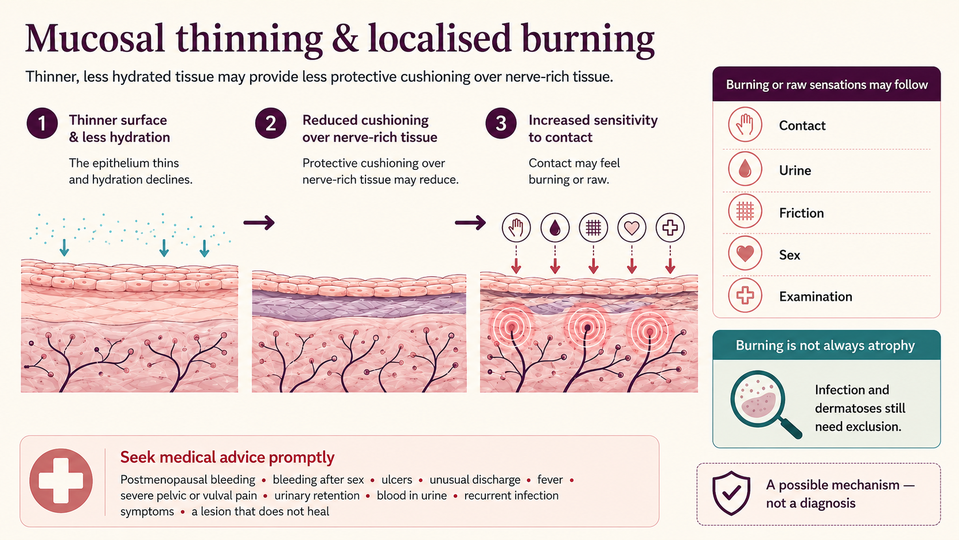
When the epithelium thins and hydration declines, protective cushioning over nerve-rich tissue may reduce. That can make contact, urine, friction, sex or examination feel burning or raw. The benchmark should explain this without implying burning is always atrophy; infection and dermatoses still need exclusion.
The safest answer separates genitourinary syndrome of menopause from infection, inflammatory skin disease, ulcers, bleeding, urinary red flags and other causes before choosing treatment.
Educational only. This page is educational and does not replace individual assessment. Results vary. Not a cure.

Atrophy assessment
At a glance
These points help place the finding in clinical context.
At a glance
Clinical summary
Depth
Atrophy affects epithelium and supporting tissue.
Matrix
Collagen, hydration and vascularity all influence resilience.
Symptoms
Thin tissue may burn, split or bleed more easily.
Limit
Microscopic markers are not routine patient tests.
Important safety note
Seek medical advice promptly for postmenopausal bleeding, bleeding after sex, ulcers, unusual discharge, fever, severe pelvic or vulval pain, urinary retention, blood in urine, recurrent infection symptoms or a lesion that does not heal.
Oestrogen
Tissue signs
Differential diagnosis
Review
Detailed answer
Detailed answer
Beneath the surface, atrophy can involve epithelial thinning, altered hydration, reduced vascular support and changes in the lamina propria.
Clinical context
Collagen organisation, extracellular-matrix turnover and inflammatory activity help explain why tissue may feel less elastic or more fragile.
pH
Vascularity
Safety
What changes
Beneath the surface, atrophy can involve epithelial thinning, altered hydration, reduced vascular support and changes in the lamina propria.
Why it happens
Collagen organisation, extracellular-matrix turnover and inflammatory activity help explain why tissue may feel less elastic or more fragile.
What it does not prove
Mucosal thinning may reduce the protective barrier over nerve-rich tissue, contributing to burning or rawness with friction, urine contact or examination.
What keeps it safe
Histology concepts should be explained as mechanisms, not as routine measurements or proof of one diagnosis.
What this means in practice
A responsible page explains the tissue mechanism without making one sign or test sound diagnostic on its own.
Symptoms such as bleeding, ulcers, severe pain, discharge or urinary red flags should be routed to medical review.
Patient safety
Why this matters
Atrophy can be uncomfortable and intimate, but the clinical priority is to explain the sign clearly without missing other causes.
It explains symptoms
Epithelial thinning, lower moisture, pH change and tissue fragility can make contact, sex or examination uncomfortable.
It avoids over-testing
Objective measures may support assessment, but they are not required for every patient.
It protects safety
Bleeding, ulcers, infection symptoms and atypical lesions need review rather than simple reassurance.
It supports treatment choice
Local tissue treatment, moisturisers, lubricants or referral depend on symptoms, risk factors and preferences.
A whole-context assessment
The useful question is not just whether tissue looks atrophic, but whether the finding explains the patient's symptoms safely.
That is why examination, symptom pattern, menopause history, medication, infection risk and red flags all matter.
Considerations
What to consider
Before deciding what the finding means, consider symptoms, menopause or treatment history, pH or cytology if used, urinary symptoms, bleeding, discharge, pain, skin changes and response to previous treatment.
Consultation priorities
Assessment links microscopic concepts to visible signs such as pallor, friability, erosion, elasticity and pain response.
Examination
Tests
Review
History
Assessment links microscopic concepts to visible signs such as pallor, friability, erosion, elasticity and pain response.
Examination or tests
If the appearance is atypical, clinicians may consider swabs, urine testing, dermatology, gynaecology referral or biopsy.
Treatment choice
Treatment focuses on restoring comfort and tissue resilience while excluding inflammatory or infectious causes.
Follow-up
Persistent erosions, ulcers, bleeding or severe burning should be reviewed rather than assumed to be atrophy alone.
Practical expectations
Response varies; symptom relief, tissue comfort, examination findings and red flags should be reviewed over time.
Costs, prescription options and treatment suitability should be confirmed directly with the clinic or prescribing clinician before booking.
Common concerns and myths
Common misconceptions
These myths can make vaginal atrophy sound either too simple or unnecessarily frightening.
Myth: collagen ratios are checked routinely
Reality: collagen and MMPs are usually research or histology concepts, not everyday clinic tests.
Myth: burning always means atrophy
Reality: infection, dermatoses, pelvic-floor pain and neuropathic pain can also burn.
Myth: one enzyme explains the matrix
Reality: extracellular-matrix health reflects collagen, hydration, vascularity, inflammation and hormone signalling.
Evidence and context
The finding only becomes clinically meaningful when it fits the symptoms, examination and differential diagnosis.
Treatment routes
Options may include non-hormonal moisturisers or lubricants, local vaginal oestrogen, review of medicines, infection testing or specialist referral.
Safety checklist
Safety checklist
Use these checks before assuming a tissue sign is simply atrophy.
Is the symptom pattern clear?
Dryness, burning, entry pain, urinary symptoms, discharge and bleeding should be separated.
Has infection or skin disease been considered?
Viral lesions, thrush, bacterial vaginosis, dermatitis, lichen conditions and trauma can overlap with atrophy signs.
Are red flags absent?
Seek medical advice promptly for postmenopausal bleeding, bleeding after sex, ulcers, unusual discharge, fever, severe pelvic or vulval pain, urinary retention, blood in urine, recurrent infection symptoms or a lesion that does not heal.
Is review planned?
A plan should explain what improvement would look like and when persistent signs need reassessment.
Reassuring signs
Proceeding is more reasonable when symptoms, examination and safety checks all fit a clear GSM pattern.
No red flags
Review plan
Reasons to pause
Seek medical advice promptly for postmenopausal bleeding, bleeding after sex, ulcers, unusual discharge, fever, severe pelvic or vulval pain, urinary retention, blood in urine, recurrent infection symptoms or a lesion that does not heal.
Ulcers
Infection
When to escalate
When to seek medical help
Some vaginal, vulval or urinary symptoms should be assessed promptly.
Use NHS 111 online
Bleeding
Postmenopausal bleeding, bleeding after sex or unexplained bleeding should be assessed by a clinician.
Ulcers or unusual lesions
Ulcers, blisters, a persistent sore area or a lesion that does not heal should not be assumed to be atrophy.
Infection or urinary symptoms
Fever, unusual discharge, blood in urine, urinary retention or recurrent infection symptoms need medical advice.
Emergency symptoms
Call 999 in a life-threatening emergency, including collapse, chest pain, breathing difficulty or sudden neurological symptoms.
Use NHS 111 for urgent advice or call 999 in a life-threatening emergency. This page is educational and does not replace individual medical assessment.
More clinical detail
How microscopic change becomes a symptom
Thinner epithelium, altered collagen support, lower hydration and reduced vascularity can make tissue feel dry, raw, tight, fragile or more easily irritated by contact.Why this is not usually a routine test
Collagen ratios, matrix metalloproteinases and lamina propria changes are useful explanatory concepts, but most patients are assessed through symptoms, examination and selected tests only when needed.Regulatory resources
Authoritative resources
These resources support assessment-led, evidence-aware vaginal atrophy information.
NICE HTG582 urogenital atrophy background
NICE describes urogenital atrophy tissue thinning, trauma vulnerability and collagen-remodelling claims.
StatPearls GSM pathophysiology
This reference explains vascularity, collagen, elasticity, hydration and epithelial structural change in GSM.
Vaginal health in menopausal women
This review discusses VHI, VMI, collagen ratio change and connective-tissue strength in menopausal vaginal health.
Next step
Book a menopause or vaginal health consultation
A consultation can clarify whether symptoms fit vaginal atrophy, whether another cause needs excluding, and which treatment options are suitable.
▶ View Research Sources (12 Sources)
These 12 source names are selected from 321 curated sources. Additional reviewed material included professional society guidance, peer-reviewed clinical papers, evidence reviews, clinical trial records; duplicate and low-relevance records were removed before display.
Educational only. This information is for education only and is not a substitute for professional medical advice, diagnosis or treatment. Results vary. Not a cure.
