


Does vulvar vestibulodynia hypersensitize nerves after dryness treatment
Does vulvar vestibulodynia hypersensitize nerves after dryness treatment | WHC Clinical FAQ

Differentiating vulvar lichen sclerosus tightness and mucosal dryness
Pain-informed
Arousal physiology
Pelvic floor
Women’s Health Clinic FAQ
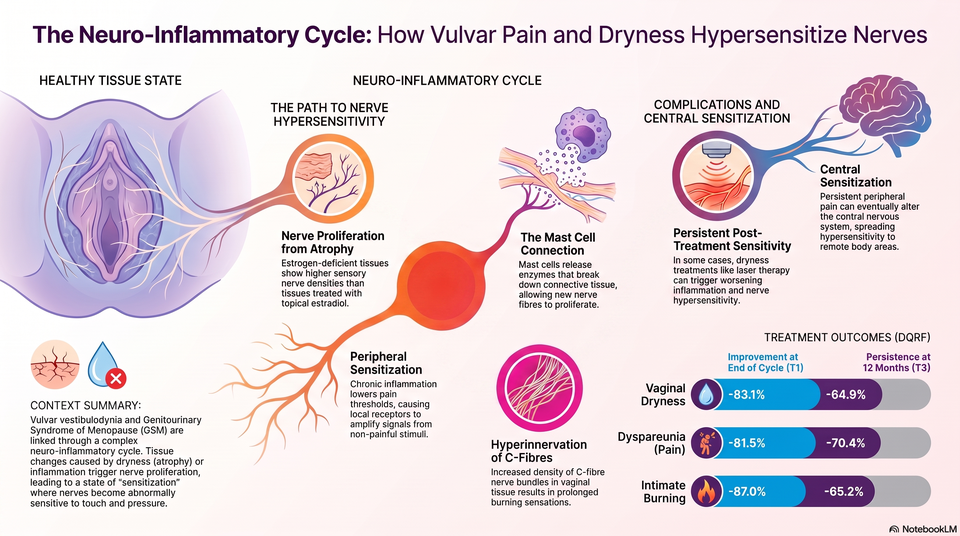
Does vulval vestibulodynia hypersensitize nerves after dryness treatment
Lubrication is influenced by tissue health, arousal, pain, pelvic-floor tone and gland function, so persistent dryness-like symptoms need a wider assessment.
Direct answer
Vestibulodynia can keep pain pathways sensitised after tissue dryness improves, so ongoing pain may need pain-informed and pelvic-floor assessment rather than more dryness treatment.
The page should separate mucosal dryness from pain sensitisation, arousal difficulty, vestibular pain, gland blockage and pelvic-floor guarding.
Educational only. Suitability and next steps should be confirmed after consultation. Results vary. Not a cure.

Lubrication and pain
At a glance
These are the main points to understand before deciding whether dryness is likely to be hormonal, inflammatory, pain-related, structural or medically complex.
At a glance
Clinical summary
Main area
Arousal and pain
Pattern
Multifactorial
Watch for
Persistent pain
Next step
Pelvic review
Important safety note
Persistent pain after dryness improves may reflect vestibulodynia, pelvic-floor guarding or another pain pathway rather than untreated dryness alone.
Tissue
Pain
Risk
Review
Detailed answer
Detailed answer
The deeper answer starts by separating mucosal dryness from arousal, vulval skin disease, vestibular pain, gland symptoms, medicine effects, surgical history and complex tissue injury.
Direct answer
The reader is trying to understand why lubrication or pain symptoms persist when tissue treatment alone may not explain the full picture.
Context
Options
Review
Direct answer
Start with the exact symptom and the anatomy involved, because vulval, vestibular, vaginal, pelvic-floor, gland and urinary symptoms need different thinking.
Arousal, pain and pelvic-floor tone
Dryness should be interpreted alongside age, menopause status, medicines, cancer history, autoimmune symptoms, pain pattern and any prior surgery or radiation.
Gland function and local anatomy
Treatment choices should match the likely cause rather than escalating automatically from moisturisers to medicines, hormones or procedures.
When dryness treatment is not enough
Follow-up matters when symptoms persist, affect sex or urination, occur after complex treatment, or do not match the expected pattern.
How the research shapes the answer
The clinical reality is that vaginal dryness can overlap with GSM, medicines, arousal, pain, vulval skin disease, autoimmune sicca, surgery or oncology-related tissue change.
The benchmark shaped search intent and structure, while final wording avoids treatment ranking, oncology over-reassurance, device hype and regeneration promises.
Patient safety
Why this matters
Vaginal dryness can affect sex, comfort, confidence, urination and daily life, but the safest treatment depends on the cause rather than the symptom label alone.
It avoids one-cause thinking
Lubrication is not only a moisture problem.
It validates pain pathways
Vestibular pain can persist after tissue dryness improves.
It protects anatomy
Gland symptoms, vestibular pain and vaginal dryness are different.
It guides referral
Pelvic-health or sexual-medicine support may be more useful than repeating dryness treatment.
Cause-led care
Good dryness advice should validate symptoms without assuming every case is menopause or that every treatment is suitable.
The right next step may be simple moisturiser advice, examination, swabs, pelvic-health support, local medicine, oncology discussion or specialist referral.
Considerations
What to consider
Prior to initiating any energy-based dryness treatment, clinicians must perform a comprehensive vulvovaginal exam, including a Q-tip test, to rule out pre-existing localised provoked vestibulodynia. If treatment-induced hypersensitization occurs, a multidisciplinary approach is required. Management should.
Consultation priorities
Useful details include symptom location, onset, medicines, menopause status, cancer history, autoimmune symptoms, pain, discharge, urinary symptoms and prior surgery or radiation.
Anatomy
Risk
Follow-up
Locate the symptom
Vaginal dryness, vestibular pain and gland swelling should not be blurred.
Assess arousal and pain
Pain anticipation and pelvic-floor guarding can affect lubrication.
Check focal swelling
Bartholin's or Skene's gland issues may need examination.
Use paced treatment
Pain-informed care should avoid forcing penetration or escalating procedures too quickly.
What not to assume
Do not assume every dryness symptom is hormonal, every painful symptom is dryness, or every cancer survivor has the same treatment pathway.
Laser or radiofrequency treatments for dryness are typically administered over 3 to 4 sessions, spaced 4 to 6 weeks apart. Complications such as progressive dyspareunia, burning, and strictures can manifest after completing the treatment cycle, sometimes.
Common concerns and myths
Common misconceptions
Online advice about vaginal dryness can become over-simple or promotional. These corrections keep the answer clinically useful.
Myth: Lubrication is only a moisture problem
Reality: lubrication and comfort involve tissue health, arousal, pain pathways and pelvic-floor tone, not moisture alone.
Myth: Pelvic-floor tension cannot affect sex comfort
Reality: lubrication and comfort involve tissue health, arousal, pain pathways and pelvic-floor tone, not moisture alone.
Myth: Persistent vestibular pain means dryness treatment failed
Reality: lubrication and comfort involve tissue health, arousal, pain pathways and pelvic-floor tone, not moisture alone.
One symptom, many causes
Dryness-like discomfort can reflect GSM, irritation, vulval dermatoses, pelvic-floor guarding, vestibulodynia, medicine effects, gland issues or structural tissue problems.
Treatment should stay proportionate
Moisturisers, lubricants, local medicines, pelvic-health care and procedures have different roles and should not be blurred together.
Safety checklist
Safety checklist
Use these checks to decide whether symptoms are more suitable for routine review, specialist assessment or urgent advice.
Is the location clear?
Vulval, vestibular, vaginal, pelvic-floor, gland and urinary symptoms should be described separately.
Is there a complex history?
Breast-cancer treatment, ovary removal, transplant, pelvic radiation or mesh surgery changes the risk discussion.
Is pain persisting?
Ongoing burning, vestibular pain or pelvic-floor guarding may need pain-informed review rather than more dryness treatment.
Are red flags present?
Bleeding, ulceration, unusual discharge, leakage, severe pain or suspected mesh exposure needs prompt assessment.
More reassuring signs
The situation is more reassuring when symptoms are mild, improving, clearly linked to a known trigger, and not associated with bleeding, sores, discharge, leakage or severe pain.
Improving
No red flags
Reasons to seek advice
Seek advice for postmenopausal bleeding, pelvic pain, new discharge, ulceration, suspected mesh exposure, urine or faecal leakage, post-radiation symptoms, post-transplant genital symptoms or rapidly worsening pain.
Leakage
Severe pain
When to escalate
When to seek medical help
Some symptoms should not be managed with moisturisers, lubricants or online advice alone.
Use NHS 111 online
Bleeding, ulceration or new discharge
Postmenopausal bleeding, sores, unusual discharge, odour, a new lump or tissue breakdown should be assessed.
Complex treatment history
Symptoms after pelvic radiation, transplant, mesh surgery or cancer treatment should be reviewed in the context of that history.
Severe pain or leakage
Severe pelvic pain, urinary or faecal leakage, suspected fistula symptoms or urinary retention needs prompt advice.
Emergency symptoms
Call 999 for life-threatening symptoms such as collapse, chest pain, breathing difficulty or stroke-like symptoms.
Use NHS 111 for urgent advice or call 999 in a life-threatening emergency. This page is educational and does not replace individual medical assessment.
Additional clinical context
How to use this answer
This page is designed to separate vaginal dryness from arousal, vulval skin disease, vestibular pain, medicines, surgery, oncology treatment and complex tissue injury.What to discuss at appointment
Useful details include symptom location, onset, menopause status, medicines, cancer or transplant history, prior pelvic surgery or radiation, discharge, bleeding, urinary symptoms, pain during sex and what has already been tried.Regulatory resources
Authoritative resources
These resources support careful advice on painful sex, pelvic-floor function, gland symptoms, arousal physiology and vestibular pain.
Next step
Book a clinical consultation
A consultation can review tissue comfort, arousal, pain location, pelvic-floor symptoms, gland swelling and whether pelvic-health or sexual-medicine support is needed.
▶ View Research Sources (12 Sources)
These 12 source names are selected from 24 display-ready sources, with a raw audit trail of 66 imported records. Additional reviewed material included UK clinical guidance, peer-reviewed clinical papers; duplicate, low-relevance and non-clinical records were removed before display.
Educational only. This information is for education only and is not a substitute for professional medical advice, diagnosis or treatment. Results vary. Not a cure.
