
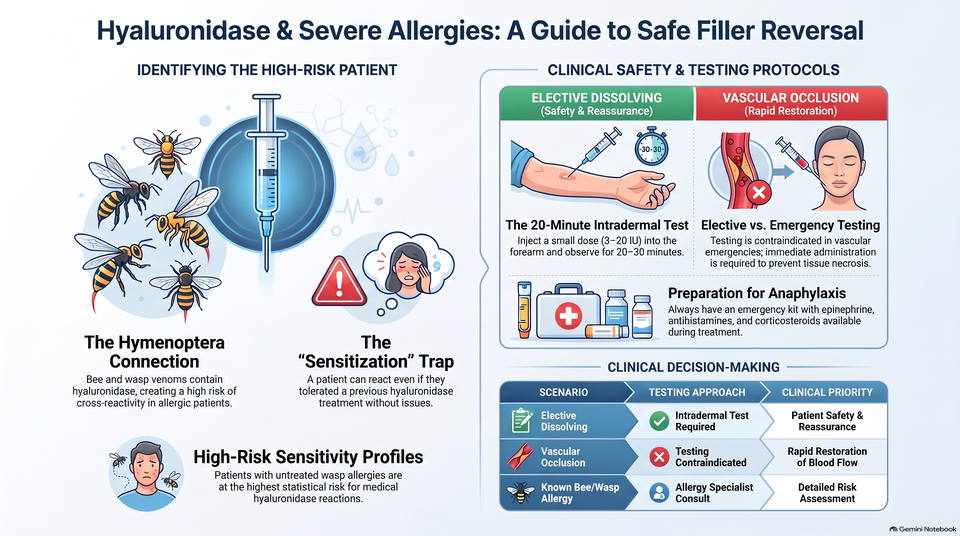


What is the safety planning for administering hyaluronidase in patients with a known history of...

What is the safety planning for administering hyaluronidase in patients wit... | WHC Clinical FAQ

What is the emergency hyaluronidase dosing instructions (area-based amounts... | WHC Clinical FAQ
Assessment first
Safety focused
Clinician led
Women’s Health Clinic FAQ
What if I have severe allergy history and may need hyaluronidase after filler?
A severe allergy history changes the safety conversation around both HA filler and possible reversal treatment.
Direct answer
A history of severe allergy or anaphylaxis should be discussed before intimate HA filler treatment and before any possible hyaluronidase reversal. This does not mean every patient with bee-sting allergy can or cannot have treatment, but it does mean risk assessment and emergency preparedness matter. Hyaluronidase decisions are medical decisions, especially in urgent situations, and should not be reduced to a public safety recipe.
The patient-facing answer is deliberately safer than a technical clinical manual: it explains what to notice, when to seek review, and why treatment planning belongs in a clinical setting.
Educational only. Suitability and complication management must be confirmed by a qualified clinician. Results vary. Not a cure.

Labial Puff safety
At a glance
These points help separate expected recovery from symptoms that should be reviewed quickly.
At a glance
Safety summary
Treatment area
External labia majora
Main issue
Allergy and reversal safety
Do not self-treat
Seek clinical review
Urgent signs
Pain or colour change
Important safety note
Severe pain, blanching, dusky or mottled skin, blistering, rapidly increasing swelling, spreading redness, pus, fever, heavy bleeding or allergic symptoms should be reviewed urgently.
Anaphylaxis
Hyaluronidase
Consent
Safety
Detailed answer
Detailed answer
The key is to understand allergy and reversal safety in plain English without turning patient information into a clinical instruction sheet.
The clinical boundary
Patients should know the warning signs and the right escalation route. They should not be given injection planning, medicine schedules, product-volume rules or home correction methods.
Timing
Symptoms
Review
Allergy history
Labia majora filler involves delicate vulval tissue, so symptoms after treatment need to be interpreted by timing, severity, appearance and the patient's medical context.
Anaphylaxis context
The safest answer separates normal settling, expected tenderness and bruising from symptoms that need prompt review.
Emergency preparedness
Useful questions include who provides urgent review, what symptoms should be reported, how complications are managed, and whether another diagnosis should be considered first.
Shared decision-making
Rapid change, severe pain, skin colour change, fever, pus, spreading redness, heavy bleeding or allergic symptoms should move the conversation from reassurance to assessment.
What this means in practice
The page should reassure without minimising risk: mild tenderness or bruising can occur, but worsening pain or visible skin change should not be dismissed.
Filler treatment, reversal decisions, infection care and late-nodule management should be handled by clinicians with appropriate follow-up and escalation plans.
Patient safety
Why this matters
Complication questions can make patients anxious, but precise, calm information helps them act at the right time.
It protects patients
Consent is stronger when patients understand that intimate filler has benefits, limits and uncommon but important risks.
It improves consent
Over-reassurance can delay help; over-alarm can create panic. The page should sit in the responsible middle.
It avoids simple answers
Clear red-flag wording helps patients know when the clinic, urgent care or emergency services are more appropriate than waiting.
It supports planned care
Technical decisions belong to clinicians because anatomy, tissue quality, infection risk, allergy history and timing all change management.
A patient-safe answer
The best public content answers the worry behind the question without teaching a procedure or a medicine plan.
This protects patients while still showing that the clinic understands the clinical complexity behind Labial Puff treatment.
Considerations
What to consider
Before treatment, ask how suitability, risks, aftercare, emergency contact and follow-up are handled.
Consultation priorities
Assessment should review symptoms, timing, examination findings, medical history, allergy history and the patient's concerns.
Consent
Aftercare
Urgent review
Before treatment
Mention previous filler reactions, allergy history, immune problems, blood-thinning medicines, active infection, vulval skin disease, pain disorders and recent procedures.
After treatment
The clinic should explain aftercare, follow-up, alternatives and exactly who to contact if symptoms change.
If a lump appears
Do not squeeze, puncture or repeatedly rub a lump. The clinician needs to decide whether it looks inflammatory, infection-related, product-related or cystic.
If symptoms escalate
Escalating pain, mottling, blanching, blistering, spreading redness, pus, fever, heavy bleeding or allergic symptoms should be acted on promptly.
What not to assume
Do not assume that swelling is always routine, that a lump is always filler, or that dissolving treatment is always simple.
Do not use online instructions to dose medicines, manipulate filler, delay care or decide that symptoms are harmless.
Common concerns and myths
Common misconceptions
These myths are common because complication advice online is often either too vague or too technical.
Myth: Bee-sting allergy is irrelevant
Reality: the safer answer depends on clinical assessment, timing, symptoms and the reason the concern has appeared.
Myth: Patch testing answers everything
Reality: intimate filler complications need individual review; reassuring language should not delay urgent care.
Myth: Reversal is always straightforward
Reality: patient education can explain warning signs and next steps without teaching clinician-only technique.
Recovery is not diagnosis
Normal settling, bruising, swelling, infection, vascular concern and delayed inflammation can overlap, so worrying symptoms deserve review.
Public education has limits
A good FAQ tells patients when to seek help; it does not teach injection technique, prescribing decisions or emergency reversal instructions.
Safety checklist
Safety checklist
Use these checks before assuming symptoms are routine or deciding on further treatment.
Is pain severe or worsening?
Escalating pain, pain spreading beyond the treated area or pain with skin colour change should be reviewed urgently.
Has skin colour changed?
Blanching, dusky skin, mottling, coolness, blistering or blue-grey visible filler should not be ignored.
Are infection signs present?
Spreading redness, heat, pus, fever, tenderness that worsens or feeling unwell needs prompt medical advice.
Is follow-up clear?
Before leaving the clinic, patients should know expected recovery, urgent signs and how to contact the team out of hours.
More reassuring signs
Mild bruising or tenderness that is improving, no skin colour change, no fever and a clear review route are more reassuring.
No colour change
Review planned
Reasons to pause
Pause further filler and seek advice for severe pain, mottling, infection signs, allergic symptoms, undiagnosed lumps, delayed nodules or persistent firmness.
Mottling
Infection
When to escalate
When to seek medical help
After intimate filler, urgent symptoms should be assessed rather than watched for several days.
Use NHS 111 online
Severe pain or colour change
Severe or escalating pain, blanching, dusky or mottled skin, coolness, blistering or rapidly increasing swelling should be assessed urgently.
Infection symptoms
Fever, pus, spreading redness, heat, worsening tenderness, foul discharge or feeling unwell needs prompt medical advice.
Bleeding or pressure
Heavy bleeding, expanding bruising, firm swelling, pressure that feels obstructive or new urinary difficulty should not be ignored.
Emergency symptoms
Call 999 for life-threatening symptoms such as collapse, chest pain, breathing difficulty or severe allergic reaction.
Use NHS 111 for urgent advice or call 999 in a life-threatening emergency. This page is educational and does not replace individual medical assessment.
More clinical detail
Why this question is sensitive
This topic involves allergy and reversal safety, where public information should support safe decisions without giving procedural instructions.What patients can safely ask
Ask who provides urgent review, what symptoms should trigger contact, how complications are escalated, and whether the concern should be assessed by a gynaecology, dermatology or emergency-care route.What should stay clinician-led
Medicine amounts, product placement, blood-supply mapping, prescribing decisions, reversal planning and correction methods should not be followed from public web content.Regulatory resources
Authoritative resources
These resources support cautious discussion of anatomy, consent, filler complications and assessment-led care.
JCCP dermal filler complications guidance
UK aesthetic-medicine guidance supporting careful complication recognition, escalation and follow-up.
Hyaluronidase use in aesthetic medicine
Clinical review material supporting cautious explanation of HA filler reversal without public dosing instructions.
GMC decision making and consent
UK consent guidance supporting discussion of material risks, alternatives and uncertainty.
Next step
Book an intimate health consultation
A consultation can confirm whether Labial Puff filler is suitable, what risks and alternatives apply, and what aftercare or urgent review pathway would be in place.
▶ View Research Sources (12 Sources)
These 12 source names are selected from 76 curated sources. Additional reviewed material included peer-reviewed clinical papers, evidence reviews; duplicate and low-relevance records were removed before display.
Educational only. This information is for education only and is not a substitute for professional medical advice, diagnosis or treatment. Results vary. Not a cure.
