



How Is Local Oestrogen Therapy Assessed for Testosterone-Related Vaginal Atrophy in Trans Men?

What is the role of psychosexual therapy in addressing menopausal sexual difficulties?

How does the decline of estrogen impact the clinical management and symptom severity of Pelvic Co...
Gender-affirming
Testosterone aware
Local treatment
Women’s Health Clinic FAQ
How do specialists evaluate the safety and efficacy of localised oestrogen therapy in a transgender man experiencing testosterone-induced mucosal atrophy?
Testosterone-related genital tissue symptoms deserve precise, respectful care that does not force standard menopause language onto transmasculine patients.
Direct answer
Specialists evaluate local oestrogen for testosterone-induced mucosal atrophy by balancing symptom relief, dysphoria, systemic absorption, goals of care and gender-affirming follow-up. The key is to separate true low-moisture tissue change from friction, burning, scarring, arousal response, cervical mucus, prolapse exposure or infection. Assessment is worthwhile if symptoms are persistent, focal, painful, linked with bleeding or difficult to explain.
A good answer should explain mucosal atrophy, local oestrogen considerations, systemic absorption, dysphoria, sexual comfort and individual goals.
Educational only. Suitability and next steps should be confirmed after consultation. Results vary. Not a cure.

Gender-affirming tissue care
At a glance
These are the main points to understand before deciding whether symptoms are hormone-related, anatomy-related, mechanical, inflammatory or part of healing.
At a glance
Clinical summary
Main area
Transmasculine care
Pattern
Testosterone atrophy
Watch for
Pain or bleeding
Next step
Specialist review
Important safety note
Local oestrogen decisions in a transgender man should be individualised, gender-affirming and clinician-led rather than assumed suitable or unsuitable.
Hormones
Tissue
Symptoms
Review
Detailed answer
Detailed answer
The deeper answer starts by separating moisture production from friction, burning, exposure, scar sensitivity, arousal response and infection.
Direct answer
The reader needs respectful, gender-affirming information about testosterone-related mucosal atrophy and local oestrogen decisions.
Anatomy
Assessment
Care
Direct answer
Care should use language and anatomy terms that fit the patient.
Testosterone-related mucosal atrophy
Testosterone can cause genital mucosal atrophy in some trans men.
Local oestrogen safety considerations
Local oestrogen is not automatically incompatible with testosterone therapy.
Gender-affirming language and dysphoria
Dysphoria, goals and comfort should shape treatment choices.
How the research shapes the answer
The clinical reality is that vaginal dryness can overlap with hormone change, friction, scarring, tissue exposure, arousal response, infection, skin disease and pelvic-floor pain.
The benchmark shaped search intent and structure, while final wording avoids overclaiming, treatment promises, unsupported mechanisms and copied generic dryness text.
Patient safety
Why this matters
Dryness-like symptoms can affect comfort, sex, examinations, confidence and recovery, but the safest plan depends on the underlying mechanism.
It respects identity
Care should use language and anatomy terms that fit the patient.
It explains testosterone effects
Testosterone can cause genital mucosal atrophy in some trans men.
It avoids false conflict
Local oestrogen is not automatically incompatible with testosterone therapy.
It supports consent
Dysphoria, goals and comfort should shape treatment choices.
Assessment prevents guesswork
A careful review can identify whether symptoms are mainly hormonal, mechanical, inflammatory, scar-related, arousal-related or healing-related.
That distinction matters because moisturisers, lubricants, pelvic-health support, endocrine review, pessary review or surgical clearance solve different problems.
Considerations
What to consider
A consultation should clarify symptom location, timing, relevant surgery, hormone context, products used, pain pattern, discharge, bleeding and whether examination is needed.
Consultation priorities
Useful details include symptom location, cycle or feeding context, surgery history, products used, pain triggers, bleeding, discharge, prolapse, pessary or mesh history and treatment goals.
Location
Triggers
Safety
Preferred language
Ask what words the patient uses for their anatomy.
Hormone regimen
Testosterone dose, route and duration may be relevant.
Symptoms and goals
Pain, bleeding, sex, smear tests and dysphoria may all matter.
Local treatment concerns
Discuss absorption, acceptability and follow-up clearly.
What not to assume
Do not assume every dry, burning or friction symptom has the same cause, or that unusual anatomy automatically proves the mechanism.
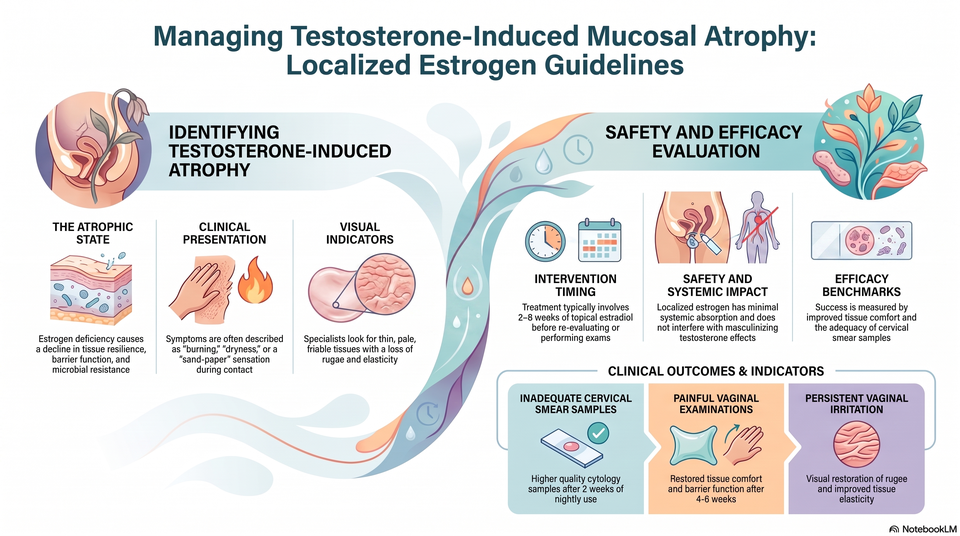
Initial symptom relief (e.g., improved lubrication and reduced burning) often begins within a few weeks of consistent use. Full physiological restoration of the vaginal epithelium and tissue elasticity may take several months, particularly for patients with severe atrophy. Treatment must be continued.
Common concerns and myths
Common misconceptions
Dryness content often becomes too simple. These corrections keep the page clinically useful.
Myth: Local oestrogen always conflicts with testosterone therapy
Reality: gender-affirming care can discuss local treatment without assuming it conflicts with testosterone goals.
Myth: Atrophy symptoms should be ignored to avoid dysphoria
Reality: gender-affirming care can discuss local treatment without assuming it conflicts with testosterone goals.
Myth: Standard menopause language is enough for transmasculine patients
Reality: gender-affirming care can discuss local treatment without assuming it conflicts with testosterone goals.
Mechanism matters
Hormones, tissue exposure, surgery, scar sensitivity, arousal response and infection can all produce symptoms that patients call dryness.
Support should be targeted
The best plan starts with the cause, then chooses proportionate comfort measures, review, tests or referral.
Safety checklist
Safety checklist
Use these checks to decide whether symptoms can be discussed routinely or need prompt clinical advice.
Is there bleeding or ulceration?
Bleeding, sores, wound opening or exposed tissue should be assessed.
Is pain focal or worsening?
Entry pain, scar pain, severe burning or worsening symptoms may need examination.
Is there prolapse, pessary or mesh history?
Mechanical irritation, erosion or inflammation can mimic dryness.
Is there a hormone or healing context?
Breastfeeding, amenorrhoea, perimenopause, testosterone therapy, adrenal surgery or recent reconstruction changes the assessment.
More reassuring signs
Symptoms are more reassuring when they are mild, improving, already assessed and not linked with bleeding, ulcers, discharge, fever, wound change or severe pain.
Improving
Assessed
Reasons to seek advice
Red Flag: Any unexplained vaginal bleeding must be investigated promptly (via ultrasound or biopsy) to rule out endometrial hyperplasia or cancer, even though local oestrogen rarely causes this. Safety Profile: Due to ultra-low systemic absorption, localised oestrogen avoids the cardiovascular and thromboembolic.
Ulcer
Severe pain
When to escalate
When to seek medical help
Some symptoms should not be managed as routine vaginal dryness.
Use NHS 111 online
Bleeding, ulceration or wound change
Bleeding, sores, wound opening, exposed mesh or a non-healing focal area should be assessed.
Infection symptoms
Fever, odour, new discharge, pelvic pain or feeling unwell needs clinical advice.
Severe or worsening pain
Severe burning, entry pain, urinary symptoms or worsening scar pain should not be ignored.
Emergency symptoms
Call 999 for life-threatening symptoms such as collapse, chest pain, breathing difficulty or stroke-like symptoms.
Use NHS 111 for urgent advice or call 999 in a life-threatening emergency. This page is educational and does not replace individual medical assessment.
Additional clinical context
How to use this answer
This page is designed to separate hormones, anatomy, arousal response, friction, scarring, prolapse, pessary or mesh effects, and post-surgical healing.What to discuss at appointment
Useful details include timing, symptom location, feeding or cycle context, hormone therapy, surgery history, pain triggers, bleeding, discharge, products used, prolapse symptoms and treatment goals.Regulatory resources
Authoritative resources
These resources support advice on vaginal dryness, gender-affirming healthcare, testosterone-related atrophy and local oestrogen decision-making.
Next step
Book a clinical consultation
A consultation can review testosterone therapy, anatomy, symptoms, dysphoria concerns, sexual comfort, bleeding, infection risk and whether local treatment may be suitable.
▶ View Research Sources (12 Sources)
These 12 source names are selected from 24 display-ready sources, with a raw audit trail of 92 imported records. Additional reviewed material included UK clinical guidance, professional society guidance, peer-reviewed clinical papers; duplicate, low-relevance and non-clinical records were removed before display.
Educational only. This information is for education only and is not a substitute for professional medical advice, diagnosis or treatment. Results vary. Not a cure.
