



How does anatomy guide treatment choice for laxity?

How does anatomy guide treatment choice for laxity? | WHC Clinical FAQ

Can nerve recovery improve perceived laxity? | WHC Clinical FAQ
PROM aware
Bias conscious
Context matters
Women’s Health Clinic FAQ
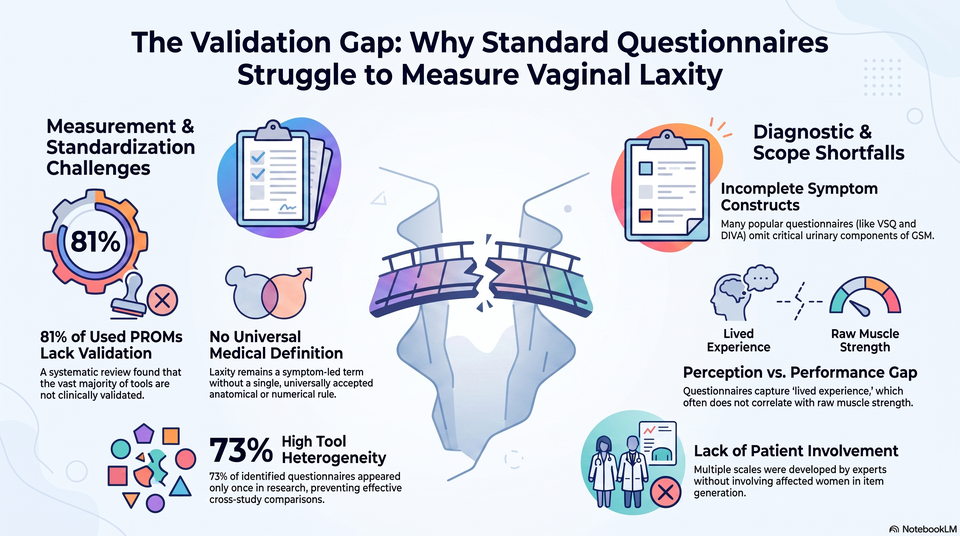
What are the limitations of using standard laxity questionnaires for validation?
Questionnaires can capture what a patient feels, but they cannot prove every anatomical or treatment claim on their own.
Direct answer
Standard questionnaires are useful but limited because they are subjective, context-sensitive and may not correlate neatly with anatomy. The safest interpretation treats scores as one part of assessment, not proof on their own.
A careful answer explains recall bias, wording, expectations and the gap between subjective scores and internal anatomy.
Educational only. Suitability and next steps should be confirmed after consultation. Results vary. Not a cure.

Score limits
At a glance
These are the main points to understand before judging a treatment claim, study result or patient-reported outcome.
At a glance
Evidence-aware summary
Main area
Patient-reported scores
Pattern
Useful but limited
Watch for
Overclaimed validation
Next step
Check context
Important safety note
Questionnaire results should be interpreted with symptom history, examination, safety outcomes and follow-up, especially before elective treatment.
Recall
Validity
Context
Consent
Detailed answer
Detailed answer
The deeper answer starts by separating patient experience, internal anatomy, pelvic-floor function, study design, safety outcomes and durability.
Subjective scores
The reader wants to understand what counts as credible evidence, how outcomes are measured, what uncertainty remains and how to avoid confusing marketing claims with patient-relevant benefit.
Compare
Follow up
Decide
Subjective scores
Start with the outcome that matters to the patient: support, friction, sexual comfort, confidence, urinary symptoms, pain or safety.
Recall bias
Look at how the outcome was measured and whether the measure was suitable for the claim being made.
Anatomy correlation
Check whether improvement was compared with a credible control, assessed after enough follow-up and interpreted alongside adverse events.
Validation limits
Use the evidence to guide a proportionate conversation, not to promise a resolved result from one treatment route.
How the research shapes the answer
The research supports treating this as a patient-reported scores question rather than a generic vaginal-tightening claim.
The research synthesis shaped the structure, while final wording avoids device hype, treatment ranking, legal advice, procedure technique, score overclaiming and overconfident benefit claims.
Patient safety
Why this matters
Patients are often shown confident treatment claims, but vaginal laxity outcomes are affected by measurement choice, expectations, anatomy, pelvic-floor function and follow-up.
It protects interpretation
Subjective scores are useful, but they are influenced by memory, wording and expectations.
It avoids false precision
A number can look exact while still reflecting a complex personal experience.
It checks anatomy separately
Patient-reported improvement may not match internal support or tissue findings.
It supports better trials
Good studies define whether a score is valid, reliable and responsive.
Evidence protects choice
A cautious evidence discussion does not dismiss symptoms; it helps match treatment to the right goal.
The strongest decision is one where benefits, limits, risks, alternatives and follow-up are all visible before treatment.
Considerations
What to consider
A consultation should connect symptoms, goals, examination findings, evidence quality, uncertainty, alternatives and follow-up.
Consultation priorities
Bring your main symptom, treatment goal, childbirth and menopause history, pelvic-floor symptoms, pain, urinary or bowel symptoms, previous treatments and what outcome would feel meaningful.
Evidence
Safety
Follow-up
Check the question wording
A questionnaire should ask about the outcome being claimed.
Look for validation
Reliable tools should be tested in the population being studied.
Match score to examination
Symptoms, support and pelvic-floor findings should be considered together.
Interpret change cautiously
A score may improve for reasons beyond tightening.
What not to assume
Do not assume that a higher score, better satisfaction or early tightness proves durable structural change.
Initial management via supervised pelvic floor muscle training typically involves a 3- to 4-month program before assessing the need for further intervention. If EBDs (lasers or radiofrequency) are used, treatments generally consist of 3 sessions spaced 4 to 6 weeks apart. Symptomatic.
Common concerns and myths
Common misconceptions
These corrections keep the answer clinically cautious and useful rather than sales-led.
Myth: Questionnaires are objective proof
Reality: scores can be useful, but they need context, validation, examination findings, safety outcomes and follow-up.
Myth: A score means the same thing for every patient
Reality: scores can be useful, but they need context, validation, examination findings, safety outcomes and follow-up.
Myth: Recall bias does not affect intimate-health research
Reality: the answer depends on the outcome measured, study design, patient goals, safety and follow-up.
Improvement still matters
Patient experience is important, but the reason for improvement should be interpreted carefully.
Uncertainty is not failure
Clear uncertainty helps patients make informed choices and compare conservative, non-surgical and surgical pathways fairly.
Safety checklist
Safety checklist
Use these checks before accepting a treatment claim or deciding whether symptoms can wait for routine review.
Is the outcome clear?
Know whether the claim is about symptoms, support, sexual comfort, satisfaction, anatomy, safety or durability.
Was there proper follow-up?
Short follow-up may not capture durability, later pain, narrowing, retreatment or other adverse effects.
Were alternatives discussed?
Pelvic-health assessment, symptom treatment, conservative care, non-surgical procedures and surgery may have different roles.
Are red flags present?
Bleeding, severe pain, fever, discharge, urinary retention, faecal incontinence or a new bulge should change the pathway.
More reassuring signs
The situation is more reassuring when symptoms are stable, there are no red flags, goals are realistic, alternatives have been discussed and follow-up is planned.
Explained
Reviewed
Reasons to seek advice
Questionnaire results should be interpreted with symptom history, examination, safety outcomes and follow-up, especially before elective treatment.
Severe pain
New bulge
When to escalate
When to seek medical help
These symptoms should not be managed with general vaginal-tightening advice or evidence interpretation alone.
Use NHS 111 online
Bleeding that needs review
Postmenopausal bleeding, bleeding after sex or unexplained bleeding should be assessed promptly.
Severe or worsening pain
Severe pelvic, vulval or vaginal pain, rapidly worsening symptoms or pain after treatment needs medical advice.
Infection or support symptoms
Fever, offensive discharge, urinary retention, faecal incontinence, a new bulge or marked pelvic pressure should be checked.
Emergency symptoms
Call 999 for life-threatening symptoms such as collapse, severe bleeding, chest pain, breathing difficulty or stroke-like symptoms.
Use NHS 111 for urgent advice or call 999 in a life-threatening emergency. This page is educational and does not replace individual medical assessment.
Additional clinical context
How to use this answer
Use this page to prepare a focused discussion about evidence, symptoms, treatment goals and uncertainty. The aim is not to memorise research terminology, but to ask whether the outcome being promised is the outcome that matters to you.What to bring to consultation
Useful details include childbirth history, menopause status, urinary or bowel symptoms, prolapse sensations, pain, dryness, sexual comfort, previous procedures, what changed over time and what improvement would feel meaningful enough to justify treatment.Regulatory resources
Authoritative resources
These resources support explanation of patient-reported measures, outcome validation, clinical trial design and vaginal-laxity evidence limits.
COSMIN - Outcome measurement instruments
Methodology source for validity, reliability and responsiveness of measurement tools.
COMET Initiative - Core outcome sets
Source for outcome selection and patient-relevant endpoints.
NICE - Evidence standards framework
UK evidence framework useful for judging outcome quality and claims.
Next step
Book a clinical consultation
A consultation can review symptom scores alongside anatomy, pelvic-floor function, sexual comfort, expectations and safety.
▶ View Research Sources (12 Sources)
These 12 source names are selected from 12 display-ready sources, with a raw audit trail of 68 imported records. Additional reviewed material included UK clinical guidance, professional society guidance, peer-reviewed clinical papers, evidence reviews; duplicate, low-relevance and non-clinical records were removed before display.
Educational only. This information is for education only and is not a substitute for professional medical advice, diagnosis or treatment. Results vary. Not a cure.

