



Can repeated heavy lifting contribute to vaginal laxity? | WHC Clinical FAQ

Should urinary symptoms be investigated before treating vaginal laxity? | WHC Clinical FAQ

Can weightlifting technique affect vaginal laxity symptoms? | WHC Clinical FAQ
Connective tissue
Pelvic support
Assessment first
Women’s Health Clinic FAQ
Can hypermobility spectrum disorder cause vaginal laxity?
Hypermobility and Ehlers-Danlos syndrome can affect more than joints; connective tissue also contributes to pelvic and vaginal support.
Direct answer
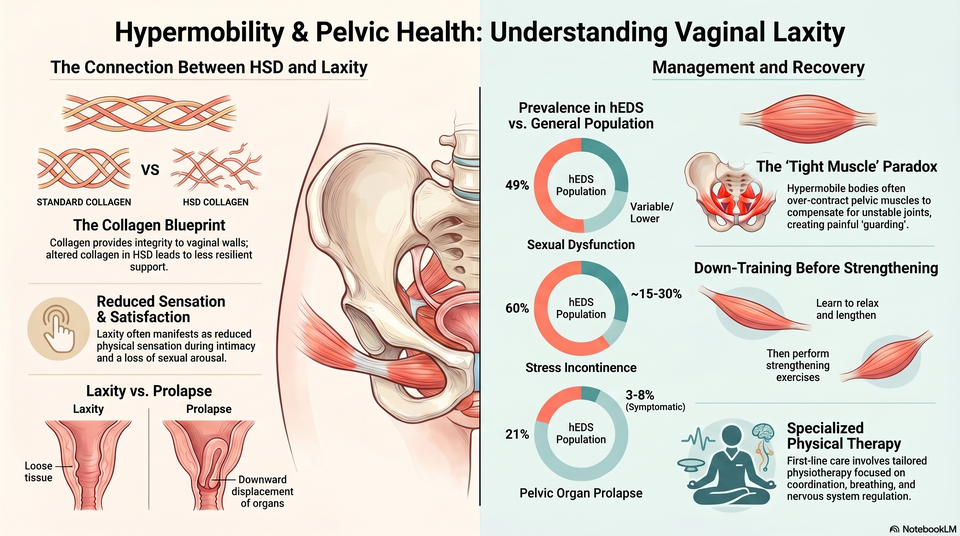
Hypermobility spectrum disorder can contribute to vaginal laxity symptoms because connective tissues may be more stretchy and pelvic support may fatigue more easily. Treatment planning should start with pelvic-floor and prolapse assessment rather than assuming a device procedure will correct the underlying tissue tendency. The safest sequence is pelvic-health assessment first, then treatment discussion only if the goal and risk profile are realistic.
A useful answer explains the tissue logic without making every symptom sound inevitable or every treatment sound unsuitable.
Educational only. Suitability and next steps should be confirmed after consultation. Results vary. Not a cure.

Connective-tissue care
At a glance
These are the main points to understand before deciding whether symptoms are likely to need pelvic-health support, specialist review or cautious treatment discussion.
At a glance
Connective-tissue context
Main area
Connective-tissue support
Pattern
Variable tissue stretch
Watch for
Bulge, pain or leakage
Next step
Pelvic-health assessment
Important safety note
New bulge symptoms, urinary retention, bowel dysfunction, severe pelvic pain, unexplained bleeding, tissue tearing or worsening symptoms should be assessed before elective vaginal treatment.
Pelvic floor
Prolapse
Treatment goals
Safety
Detailed answer
Detailed answer
The deeper answer starts by separating connective-tissue tendency, pelvic-floor function, prolapse symptoms, pain and treatment goals.
Connective-tissue stretch
The reader wants to know whether HSD can explain symptoms and what safe next steps look like.
Support
Assessment
Goals
Connective-tissue stretch
Start with the exact diagnosis and symptom pattern because HSD, EDS, prolapse, pain, leakage and sexual discomfort can point to different pathways.
Pelvic support symptoms
Pelvic support depends on fascia, ligaments, muscle coordination and tissue behaviour, not on tightness alone.
Assessment before treatment
Laser, RF, fillers or surgery should not be used to bypass pelvic-floor assessment, prolapse review or realistic consent.
Physiotherapy role
When treatment is considered, goals should be specific: comfort, support, function, symptom control or confidence rather than promised restoration.
How the research shapes the answer
Co-morbidities are the Rule: Pelvic floor issues in EDS/HSD rarely exist in isolation. They are frequently accompanied by Postural Orthostatic Tachycardia Syndrome (POTS), Mast Cell Activation Syndrome (MCAS), and gastrointestinal dysmotility (like severe constipation). Missed Diagnoses: Adults are frequently under-diagnosed because hypermobility.
The benchmark shaped search intent and structure, but final wording avoids procedure hype, outcome promises, device settings and simplistic assumptions about connective tissue.
Patient safety
Why this matters
Hypermobility and EDS can make vaginal laxity questions more complex because tissue support, healing, pain sensitivity and pelvic-floor coordination may all be involved.
It explains the tissue context
Connective tissue helps support the vaginal walls, pelvic organs, fascia and ligaments, so hypermobility can change symptom patterns.
It prevents oversimplified treatment
Vaginal laxity, prolapse, leakage, pain and sensation changes can overlap but need different care pathways.
It protects consent
People with EDS or HSD need honest discussion about uncertainty, healing, recurrence and what treatment cannot promise.
It keeps conservative care visible
Pelvic-health physiotherapy and specialist review may improve control, comfort and treatment selection.
Assessment protects choice
A cautious assessment does not mean treatment is impossible; it means the plan should match the tissue context and symptoms.
The best decision is often the one that recognises limits early and chooses support, review or treatment in the right order.
Considerations
What to consider
First-Line Treatment: specialised pelvic floor physiotherapy is the cornerstone of management. Treatment must be trauma-informed and focus on releasing tension before building strength. Mechanical Support: Vaginal pessaries are an effective first-line, non-surgical option to support prolapsed organs, though fragile tissues may require.
Consultation priorities
Bring details about hypermobility or EDS diagnosis, tissue fragility, healing history, pelvic pain, leakage, bulge symptoms, bowel symptoms, previous surgery and what outcome would feel meaningful.
Symptoms
Healing
Goals
Clarify the diagnosis
Note whether the concern is HSD, EDS, joint hypermobility, collagen disorder, tissue fragility or an unconfirmed pattern of symptoms.
Map the symptoms
Describe looseness, bulge, heaviness, leakage, bowel symptoms, pain, sexual discomfort and what triggers or relieves them.
Review healing history
Easy bruising, poor wound healing, tearing, prolonged discomfort or previous surgery can change procedure suitability.
Set realistic goals
The aim may be better support, comfort, function or confidence, not a certain restoration of tissue behaviour.
What not to assume
Do not assume looseness is only cosmetic, or that a connective-tissue diagnosis makes every option unsuitable.
Early Presentation: Pelvic floor dysfunction and POP tend to present at much younger ages in women with hypermobility compared to the general population. Pregnancy and Postpartum: Pregnancy exacerbates laxity due to hormones like relaxin. Delivery can cause rapid labour and severe tissue.
Common concerns and myths
Common misconceptions
These corrections keep the answer practical, specific and clinically cautious.
Myth: Hypermobility only affects joints
Reality: connective tissue also contributes to pelvic support, fascia, ligaments, healing and symptom behaviour.
Myth: Vaginal laxity in HSD is always cosmetic
Reality: prolapse and laxity can feel similar, but they are assessed and managed differently.
Myth: A tightening procedure corrects the connective-tissue tendency
Reality: procedure suitability depends on tissue fragility, symptoms, goals, healing history and specialist assessment.
Specificity matters
The right answer depends on whether the main issue is tissue stretch, prolapse, pain, leakage, healing risk or sexual comfort.
Treatment has limits
Vaginal tightening cannot treat the underlying connective-tissue disorder or promise stable collagen behaviour, sensation or recurrence prevention.
Safety checklist
Safety checklist
Use these checks to decide whether treatment can be discussed routinely or should wait for specialist-aware assessment.
Is there a connective-tissue diagnosis?
HSD, EDS, collagen disorder, tissue fragility or poor healing history should be made clear before any procedure discussion.
Could symptoms be prolapse or pelvic-floor dysfunction?
Bulge, heaviness, leakage, bowel symptoms, pain or difficulty emptying bladder or bowel should not be treated as simple laxity.
Is there pain, tearing or healing concern?
Pain sensitivity, fragile mucosa, bruising, tearing, scarring or slow healing can change procedure suitability.
Are goals realistic?
The plan should define whether the goal is comfort, support, function, confidence or symptom control, and avoid promised outcomes.
More reassuring signs
The situation is more reassuring when symptoms are stable, there is no bulge or severe pain, healing history is uncomplicated and expectations are specific.
Assessed
Specific goals
Reasons to seek advice
Avoid Standard Kegels: Strengthening or 'Kegel' exercises can actively worsen a hypertonic, guarding pelvic floor. 'Down-training' and relaxation must precede any strengthening. Surgical Complications: Surgery for POP in hypermobile patients should be a last resort. Due to tissue fragility, there are higher.
Pain
Bleeding
When to escalate
When to seek medical help
These symptoms or situations should not be managed with general vaginal-tightening advice alone.
Use NHS 111 online
Bulge or emptying problems
New or worsening prolapse symptoms, urinary retention or bowel dysfunction should be assessed.
Pain, bleeding or tissue injury
Severe pelvic pain, unexplained bleeding, tissue tearing, bruising or non-healing areas need medical advice.
Post-treatment concerns
Fever, increasing pain, offensive discharge, heavy bleeding or worsening symptoms after treatment should be discussed promptly.
Emergency symptoms
Call 999 for life-threatening symptoms such as collapse, severe bleeding, chest pain, breathing difficulty or stroke-like symptoms.
Use NHS 111 for urgent advice or call 999 in a life-threatening emergency. This page is educational and does not replace individual medical assessment.
Additional clinical context
How to use this answer
Use this page to prepare a focused discussion about connective tissue, pelvic support and treatment expectations. The aim is to understand whether the concern is laxity, prolapse, pelvic-floor dysfunction, pain, tissue fragility or a goal that needs reframing.What to bring to consultation
Helpful details include HSD or EDS diagnosis, Beighton score if known, prolapse symptoms, leakage, bowel symptoms, pain, sexual comfort, previous surgery, healing history, bruising or tearing tendency and the outcome you hope treatment would change.Regulatory resources
Authoritative resources
These resources support UK-facing information on hypermobility, Ehlers-Danlos syndrome, pelvic-floor symptoms and prolapse assessment.
NHS - Joint hypermobility syndrome
UK patient baseline for hypermobility symptoms, support and when to seek help.
NHS - Ehlers-Danlos syndromes
UK patient source for EDS types, tissue fragility and symptom patterns.
The Ehlers-Danlos Society - What is EDS?
International authority for EDS classification and connective-tissue context.
Next step
Book a clinical consultation
A consultation can review hypermobility or EDS diagnosis, pelvic symptoms, tissue fragility, pain, leakage, prolapse signs and whether pelvic-health or specialist review should come first.
▶ View Research Sources (12 Sources)
These 12 source names are selected from 12 display-ready sources, with a raw audit trail of 42 imported records. Additional reviewed material included UK clinical guidance, professional society guidance, peer-reviewed clinical papers; duplicate, low-relevance and non-clinical records were removed before display.
Educational only. This information is for education only and is not a substitute for professional medical advice, diagnosis or treatment. Results vary. Not a cure.
