



Should active urinary tract infections be cleared before vaginal tightening... | WHC Clinical FAQ

How does non surgical vaginal tightening treatment work?

What pre-treatment checks should be done before vaginal tightening? | WHC Clinical FAQ
Infection first
Temporary delay
Reassess after treatment
Women’s Health Clinic FAQ
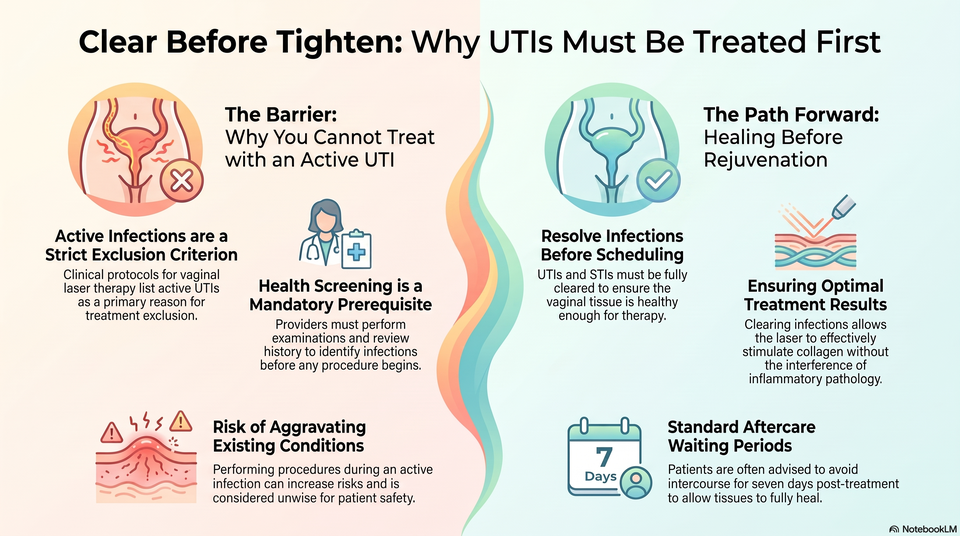
Should active urinary tract infections be cleared before vaginal tightening?
Active vaginal, urinary or genital infection symptoms should be dealt with before vaginal tightening because inflamed tissue can heal poorly and symptoms can be confused with procedure effects.
Direct answer
An active UTI should be treated and symptoms should settle before vaginal tightening. Burning, urgency, pelvic discomfort or infection signs can worsen with irritation and may be confused with procedure side effects. The safest next step is to treat active symptoms first and reassess once the tissue has settled.
The key message is simple but important: infection usually means postpone, treat, allow symptoms to settle, then reassess suitability.
Educational only. Suitability and next steps should be confirmed after consultation. Results vary. Not a cure.

Infection timing
At a glance
These are the main points to understand before deciding whether treatment can proceed, should wait or needs another pathway first.
At a glance
Practical suitability summary
Main area
Infection and inflammation
Pattern
Treat before device care
Watch for
Discharge, lesions or UTI
Next step
Treat and reassess
Important safety note
Fever, pelvic pain, offensive discharge, active herpes lesions, UTI symptoms, blood in urine or feeling unwell should be assessed before elective treatment.
Screening
Symptoms
Timing
Referral
Detailed answer
Detailed answer
The deeper answer starts by separating vaginal laxity from conditions that need assessment, treatment or referral before elective laser or RF care.
UTI symptoms
The reader wants to know if a UTI delays treatment.
Contraindications
Referral
Follow-up
UTI symptoms
Start with the exact symptom or history because the safe answer changes when screening, infection, urinary symptoms, pregnancy, prolapse, coil use, mesh or surgery is involved.
Why delay matters
Clarify what is active, unresolved, recurrent or new before deciding whether treatment is appropriate.
Resolution before treatment
Laser or RF treatment should not be used to bypass diagnosis, infection treatment, cervical follow-up or pelvic-floor assessment.
Recurrent UTI review
When treatment is delayed, the plan should explain what needs to settle or be reviewed before reassessment.
How the research shapes the answer
The research supports treating infection and inflammation as an assessment-first question rather than a device-choice question.
The benchmark shaped search intent and structure, but final wording avoids device hype, energy settings, cure claims, price claims and false reassurance.
Patient safety
Why this matters
These questions matter because vaginal tightening is elective, and elective treatment should not obscure symptoms that need another clinical pathway.
It prevents missed causes
Symptoms described as laxity may actually involve infection, prolapse, GSM, pelvic-floor dysfunction, pain, pregnancy, coil issues or surgical complications.
Delay can be protective
Postponing treatment while screening, infection or specialist review is completed can prevent confusion and reduce avoidable risk.
Device treatment has limits
Laser or RF cannot replace diagnosis, cervical screening, infection treatment, pelvic-floor rehabilitation or prolapse care.
Consent needs context
Patients need to know what treatment can reasonably address and what should be investigated or treated first.
Assessment protects choice
A delay is not a rejection; it is often the step that makes later treatment safer and more accurately targeted.
The best page helps a patient understand what needs checking before treatment rather than pushing them towards a procedure.
Considerations
What to consider
A consultation should connect symptoms with screening status, infection signs, pelvic-floor findings, pregnancy or postpartum context, device history and surgical history.
Consultation priorities
Bring screening results, infection tests, symptom timing, pregnancy possibility, coil details, prolapse symptoms, prior surgery details and what decision you need help making.
Symptoms
History
Next step
Bring results and dates
Useful details include cervical screening status, HPV or colposcopy results, infection tests, pregnancy possibility, coil dates and previous surgery details.
Describe the symptom pattern
Clarify discharge, odour, itching, lesions, urinary symptoms, bleeding, bulge symptoms, pain, dryness and when symptoms started.
Check what treatment cannot do
Vaginal tightening should not be used to treat infection, cervical cell changes, prolapse, mesh symptoms or unexplained pelvic pain.
Plan review after delay
If treatment is postponed, agree what needs to happen before reassessment, such as symptom resolution, test results or specialist advice.
What not to assume
Do not assume every sensation of looseness is vaginal laxity or that every intimate symptom should be treated with a device.
Timing matters because treatment may be appropriate later after infection clears, screening follow-up is complete, postpartum healing progresses or specialist review clarifies risk.
Common concerns and myths
Common misconceptions
These corrections keep the answer clear, practical and clinically cautious.
Myth: A UTI is separate from vaginal treatment
Reality: active infection or inflammation is usually a reason to pause, treat and reassess rather than proceed.
Myth: Antibiotics mean treatment can happen immediately
Reality: active infection or inflammation is usually a reason to pause, treat and reassess rather than proceed.
Myth: Post-treatment burning is always normal
Reality: suitability depends on symptoms, examination findings, screening status, infection status, pelvic-floor findings and medical history.
Suitability is specific
The same treatment question can have a different answer depending on screening, infection, prolapse, pregnancy, coil, mesh or surgical history.
Treatment has limits
Vaginal tightening cannot replace screening, infection treatment, pelvic-floor rehabilitation, prolapse care or specialist review.
Safety checklist
Safety checklist
Use these checks to decide whether treatment can be discussed routinely or should wait for assessment first.
Is anything unresolved?
Overdue screening, abnormal results, active infection, pregnancy possibility, unexplained bleeding or unresolved pelvic pain should be addressed first.
Are symptoms active today?
Discharge, odour, itching, lesions, urinary burning, fever, pelvic pain or new bleeding can change timing.
Could this be prolapse or pelvic-floor dysfunction?
Bulge, pressure, leakage, urgency, bowel symptoms or pain may need pelvic-health assessment before device treatment.
Is there device or surgery history?
A coil, mesh implant, previous prolapse repair, scar pain or altered anatomy should be reviewed before treatment.
More reassuring signs
The situation is more reassuring when symptoms are mild, stable, already assessed, infection-free and not linked with bleeding, pregnancy, prolapse or surgical complications.
Stable
No red flags
Reasons to seek advice
Fever, pelvic pain, offensive discharge, active herpes lesions, UTI symptoms, blood in urine or feeling unwell should be assessed before elective treatment.
Infection
Pain
When to escalate
When to seek medical help
These symptoms or situations should not be managed with general vaginal-tightening advice alone.
Use NHS 111 online
Bleeding or suspicious change
Postmenopausal bleeding, bleeding after sex, unexplained bleeding, non-healing lesions or new lumps should be assessed.
Infection or systemic symptoms
Fever, pelvic pain, offensive discharge, active genital lesions, UTI symptoms with feeling unwell or blood in urine need medical advice.
Pelvic-floor or prolapse red flags
Urinary retention, bowel symptoms, worsening bulge, severe pelvic pressure or advanced prolapse symptoms should be reviewed.
Pregnancy or surgical complexity
Possible pregnancy, unhealed postpartum injury, mesh symptoms or previous reconstructive surgery should be discussed before treatment.
Use NHS 111 for urgent advice or call 999 in a life-threatening emergency. This page is educational and does not replace individual medical assessment.
Additional clinical context
How to use this answer
Use this page to prepare a precise suitability review. The aim is to understand whether treatment can be considered now, should wait, or needs another clinical pathway first.What to bring to consultation
Helpful details include cervical screening dates, HPV or colposcopy results, infection symptoms or tests, urinary symptoms, pregnancy possibility, birth history, coil details, prolapse symptoms, mesh or surgery history and current medicines.Regulatory resources
Authoritative resources
These resources support UK-facing information on thrush, BV, UTI, genital herpes, vaginal discharge and sexual-health pathways.
Next step
Book a clinical consultation
A consultation can review symptoms, discharge, pain, urinary symptoms, lesion history, recurrence pattern, test results and when treatment can safely be reconsidered.
▶ View Research Sources (12 Sources)
These 12 source names are selected from 12 display-ready sources, with a raw audit trail of 52 imported records. Additional reviewed material included UK clinical guidance, professional society guidance, peer-reviewed clinical papers, clinical trial records; duplicate, low-relevance and non-clinical records were removed before display.
Educational only. This information is for education only and is not a substitute for professional medical advice, diagnosis or treatment. Results vary. Not a cure.
