

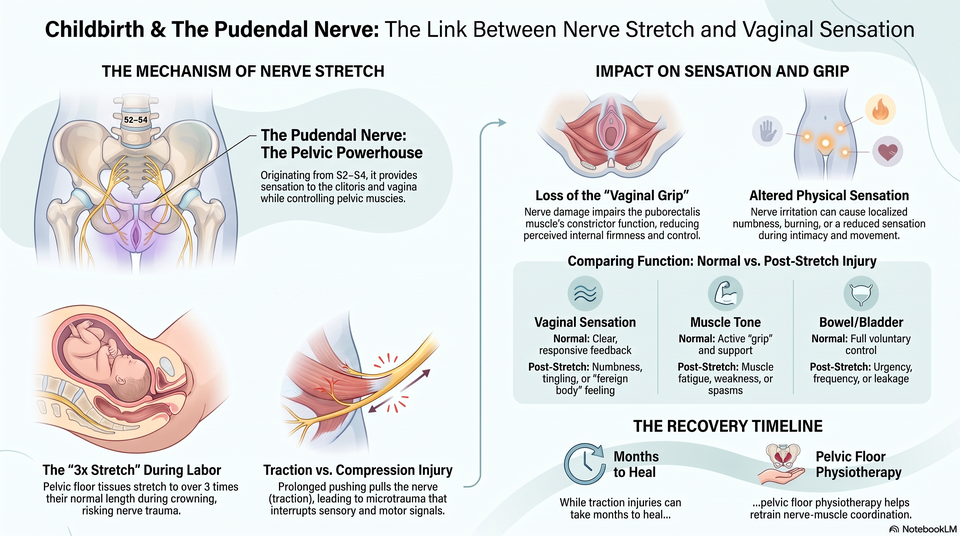


Can childbirth nerve stretch affect vaginal grip sensation? | WHC Clinical FAQ

Can childbirth nerve stretch mimic vaginal laxity?

Can childbirth nerve stretch mimic vaginal laxity? | WHC Clinical FAQ
Postnatal nerves
Recovery context
Support check
Women’s Health Clinic FAQ
Can childbirth nerve stretch affect vaginal grip sensation?
After childbirth, nerve stretch, tissue healing, breastfeeding-related dryness and pelvic-floor recovery can all change how vaginal grip feels.
Direct answer
Childbirth-related nerve stretch can temporarily affect vaginal grip sensation by reducing sensory feedback and pelvic-floor coordination during recovery. The safest next step is postnatal pelvic-health review if symptoms persist, worsen or come with pain or support symptoms.
A useful answer explains temporary sensory change while still checking for prolapse, pain, scar symptoms and persistent support concerns.
Educational only. Suitability and next steps should be confirmed after consultation. Results vary. Not a cure.

Postnatal sensation
At a glance
These are the main points to understand before deciding whether symptoms need sensory mapping, pelvic-health review, medical review or structural assessment.
At a glance
Sensation-aware summary
Main area
Postnatal sensory recovery
Pattern
Grip feels reduced
Watch for
Persistent numbness
Next step
Postnatal review
Important safety note
Persistent or worsening numbness, severe pain, wound concerns, urinary retention, new bulge, heavy bleeding, fever or offensive discharge should be assessed.
Nerves
Support
Safety
Context
Detailed answer
Detailed answer
The deeper answer starts by separating reduced sensation, nerve feedback, arousal, medicines, tissue comfort, pelvic-floor coordination and true structural laxity.
Childbirth nerve stretch
The reader wants to know whether symptoms reflect structural laxity, reduced sensation, altered nerve feedback, low arousal, medication effects, clitoral response or a neurological red flag.
Cause
Assessment
Plan
Childbirth nerve stretch
Start by identifying whether the main issue is numbness, tingling, arousal, medication effect, pain, pelvic-floor coordination or structural support.
Temporary sensory change
Reduced feedback can feel like less friction, but that does not automatically prove the vagina is wider or unsupported.
Pelvic-floor recovery
Support symptoms, prolapse signs, pain, dryness, clitoral response and medical history should be reviewed together.
Structural check
Treatment decisions should define whether the aim is sensory clarity, pain relief, tissue comfort, support, sexual function or urgent medical assessment.
How the research shapes the answer
Underdiagnosed Condition: Pudendal neuralgia and nerve stretch injuries are frequently misdiagnosed or entirely missed by healthcare providers. Dismissal of Symptoms: Many postpartum individuals are incorrectly told that their sharp nerve pain or loss of sensation is just "normal postpartum healing," which delays.
The research synthesis shaped the structure, while final wording avoids device hype, self-diagnosis, medication-change advice, procedure ranking and overconfident treatment claims.
Patient safety
Why this matters
Sensation and laxity symptoms can overlap, and the wrong assumption can lead to unnecessary treatment or missed neurological clues.
Recovery is layered
Nerve stretch, tissue healing, breastfeeding dryness and pelvic-floor function can all influence grip sensation.
It avoids rushing
Early sensory change after birth does not automatically mean a resolved structural problem.
It still checks support
Birth-related nerve recovery and support injury can coexist.
It supports rehabilitation
Pelvic-health physiotherapy can assess strength, coordination, relaxation and symptoms over time.
Assessment protects choice
A careful review does not mean treatment is impossible; it means sensation, support, pain and safety should be understood first.
The safest page helps patients understand when symptoms are structural and when nerve, arousal, medicine or medical factors need priority.
Considerations
What to consider
A consultation should connect sensation, arousal, medicines, nerve symptoms, pelvic-floor support, pain, red flags and treatment goals.
Consultation priorities
Bring details about numbness, tingling, burning, arousal, orgasm, dryness, medicines, diabetes, back symptoms, birth history, treatment history, support symptoms and red flags.
History
Support
Safety
Review birth history
Assisted birth, prolonged pushing, tears, episiotomy, pain and breastfeeding all matter.
Track recovery
Ask whether sensation is improving, static, worsening or linked to pain or dryness.
Check support symptoms
Bulge, heaviness, urinary symptoms or bowel symptoms may need pelvic-floor review.
Sequence care
Rehabilitation and tissue comfort may need to come before procedural decisions.
What not to assume
Do not assume less sensation always means structural laxity, or that a procedure can restore nerve feedback, arousal or orgasm.
Short-term: Discomfort and swelling are common in the first 2-4 weeks postpartum, with perineal stitches typically dissolving within 10-14 days. Spontaneous Recovery: Most birth-related pudendal nerve stretch injuries are transient, and normal function is typically regained without intervention within a few weeks.
Common concerns and myths
Common misconceptions
These corrections keep the answer sensory-aware, specific and clinically cautious.
Myth: Reduced grip after birth is always structural laxity
Reality: the answer depends on sensory pattern, pain, arousal, medicines, pelvic support and red flags.
Myth: Nerve recovery cannot change perceived looseness
Reality: the answer depends on sensory pattern, pain, arousal, medicines, pelvic support and red flags.
Myth: Postnatal symptoms follow one resolved timeline
Reality: the answer depends on sensory pattern, pain, arousal, medicines, pelvic support and red flags.
Symptoms can mimic each other
Numbness, arousal, dryness, clitoral response, pain, prolapse and pelvic-floor coordination can all change perceived tightness.
Treatment has limits
No device, procedure, exercise, test or medicine can promise restored sensation, orgasm, support or lasting results.
Safety checklist
Safety checklist
Use these checks to decide whether symptoms can be discussed routinely or need earlier medical advice.
Is sensation changed?
Numbness, tingling, burning, reduced orgasm or altered friction should be mapped before assuming structural laxity.
Are nerve red flags present?
Saddle numbness, weakness, radiating pain or bladder and bowel change should be assessed urgently.
Are support symptoms present?
Bulge, heaviness, urinary retention, leakage or bowel symptoms should change timing and pathway.
Are medicines or arousal relevant?
Medication changes, low arousal, dryness or delayed orgasm can alter sensation without proving laxity.
More reassuring signs
The situation is more reassuring when symptoms are stable or improving, there is no saddle numbness, weakness, bladder or bowel change, severe pain, unusual bleeding, discharge or new bulge, and goals are realistic.
Mapped
No red flags
Reasons to seek advice
Neuropathic Pain Symptoms: Persistent sharp, shooting, burning, or stabbing pain in the genitals, perineum, or rectum that worsens upon sitting is a major red flag for pudendal neuralgia. Persistent Incontinence: Unexplained difficulty initiating urination, chronic urinary retention, or fecal incontinence that does.
Weakness
Bladder change
When to escalate
When to seek medical help
These symptoms or situations should not be managed with general vaginal-tightening advice alone.
Use NHS 111 online
Persistent numbness
Persistent or worsening numbness after birth should be assessed.
Urinary retention or new bulge
Retention, new bulge or severe pelvic pressure should be checked.
Infection or wound concern
Fever, offensive discharge, wound breakdown or feeling unwell needs medical advice.
Emergency symptoms
Call 999 for life-threatening symptoms such as collapse, severe bleeding, chest pain, breathing difficulty or stroke-like symptoms.
Use NHS 111 for urgent advice or call 999 in a life-threatening emergency. This page is educational and does not replace individual medical assessment.
Additional clinical context
How to use this answer
Use this page to prepare a focused discussion about sensation, nerve symptoms, arousal, medicines, tissue comfort, pelvic-floor support and whether tightening should wait. The aim is to understand whether the concern is structural laxity, reduced sensory feedback, medication effect, sexual-response change, postnatal recovery or a neurological warning sign.What to bring to consultation
Helpful details include when sensation changed, whether symptoms are numb, burning, tingling or radiating, any back symptoms, diabetes, childbirth history, treatment history, medicines, arousal, orgasm, dryness, pain, urinary or bowel symptoms, bulge or heaviness and what outcome would feel meaningful.Regulatory resources
Authoritative resources
These resources support postnatal care, childbirth recovery, pelvic-floor health, painful sex and childbirth-related nerve stretch.
Next step
Book a clinical consultation
A consultation can review birth history, sensory change, breastfeeding dryness, pain, scar symptoms, pelvic-floor function and treatment timing.
▶ View Research Sources (12 Sources)
These 12 source names are selected from 12 display-ready sources, with a raw audit trail of 66 imported records. Additional reviewed material included UK clinical guidance, professional society guidance, peer-reviewed clinical papers, evidence reviews; duplicate, low-relevance and non-clinical records were removed before display.
Educational only. This information is for education only and is not a substitute for professional medical advice, diagnosis or treatment. Results vary. Not a cure.
