

Women’s Health Clinic FAQ
What positions or pacing can make intimacy more comfortable?
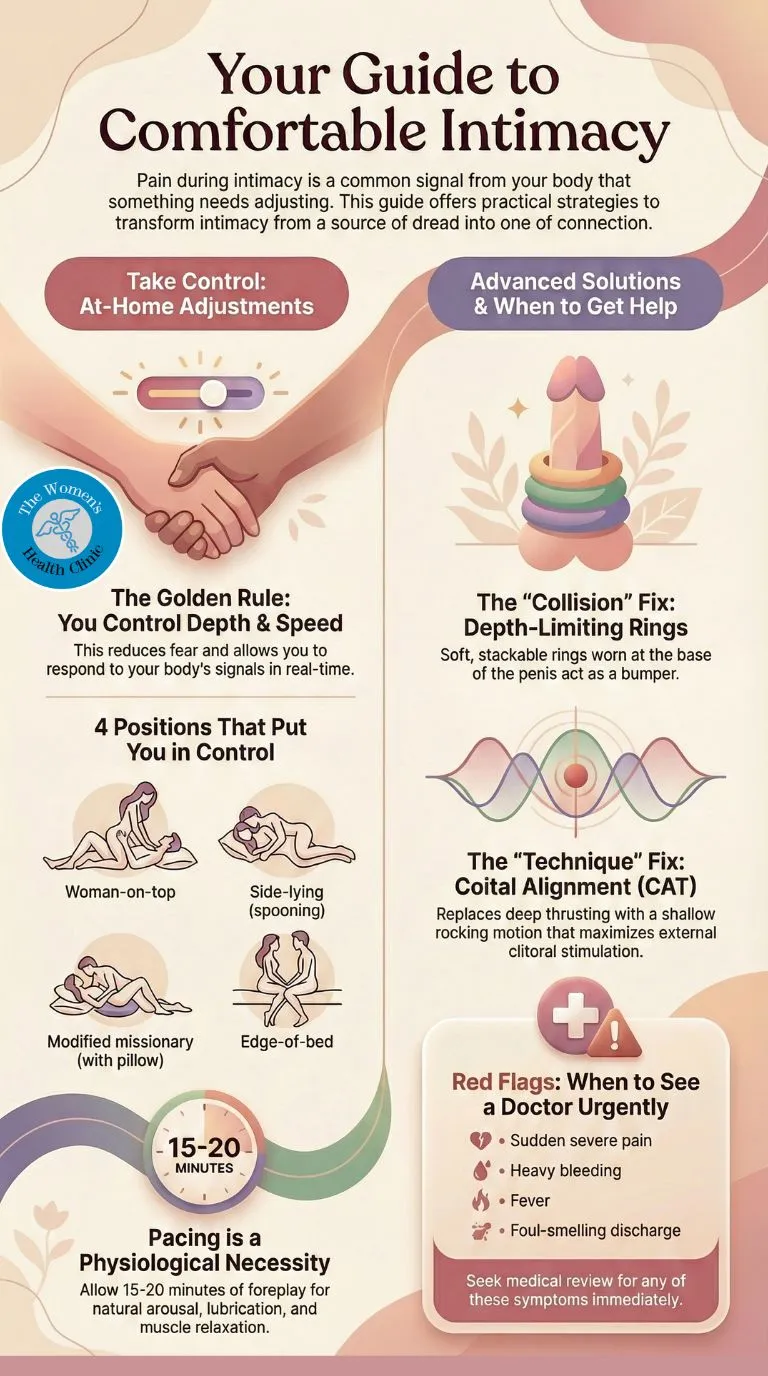
Comfort during intimacy is often improved by changing depth, angle, pace and pressure rather than trying to tolerate pain. The aim is to make penetration feel controlled, gradual and responsive, while also recognising when repeated discomfort may point to an underlying vaginal, pelvic floor, hormonal or gynaecological cause.
Direct answer
The most comfortable positions are usually those that let you control depth, angle and speed. Woman-on-top, side-lying and modified missionary with pillow support can reduce sudden deep penetration and pressure on sensitive areas. Slower pacing, longer arousal time, generous lubrication and clear communication also help tissues relax and reduce friction. If pain continues despite these changes, especially with dryness, burning, pelvic pain, bleeding or avoidance of intimacy, it is sensible to arrange a clinical assessment rather than repeatedly trying to push through.
Positions and pacing are a useful first step, but persistent pain is not something you should have to manage alone. At WHC, vaginal wellness assessment can help clarify whether symptoms are mainly mechanical, hormonal, pelvic floor related, skin related, infection related, or linked to deeper pelvic conditions.
Educational only. Clinical suitability must be confirmed following an appropriate consultation and assessment by a qualified healthcare professional. Results vary. Not a cure.
At a glance
Pain with intimacy is often affected by more than one factor. A position may help because it changes depth and angle, but tissue dryness, pelvic floor guarding and deeper pelvic pain can still need assessment.
Comfort Differentiators
What usually changes comfort during penetration
Best control
Woman-on-top, side-lying and supported missionary
Best pacing
Slow entry, shallow movement and regular pauses
Common triggers
Dryness, friction, anxiety, deep pressure or muscle tension
When to review
Persistent, worsening, new, bleeding-related or infection-like symptoms
Important comfort signal
If intimacy repeatedly becomes something you avoid because of pain, the next step is not more pressure or endurance. It is a calm, confidential clinical review to understand the cause.
Comfort is usually about control, not endurance
Pain during intimacy can happen at the entrance, deeper inside the pelvis, after sex, or only in certain positions. The right adjustment depends on where the pain is felt, whether dryness or burning is present, and whether the pelvic floor is tightening in anticipation.
Key Overlapping Symptom Triggers
The same position can feel comfortable one day and painful another if arousal, lubrication, inflammation, oestrogen levels, pelvic floor tone or pelvic pain conditions have changed. This is why a practical approach and a clinical approach often need to work together.
Woman-on-top
This gives the receiving partner the most control over depth, angle and rhythm. Leaning forward or back can change where pressure lands, and pausing is easier if discomfort starts.
Side-lying
Spooning or side-by-side positions naturally limit depth and can feel gentler when there is fatigue, pelvic floor tension, dryness or fear of sudden thrusting.
Supported missionary
A pillow or wedge under the hips can alter pelvic tilt. This may reduce pressure on a tender cervix or anterior wall, but the angle needs to be adjusted gently rather than forced.
Slow, shallow pacing
Comfort is often improved by slow entry, shallow movement, circular rocking and regular pauses. Repetitive deep thrusting is a common trigger for deep dyspareunia.
When simple adjustments are not enough
If changing position, using lubricant and slowing down makes a clear difference, that is useful information. It suggests mechanical pressure, friction, arousal timing or pelvic floor tension may be part of the picture. However, repeated pain can also be linked with menopause-related tissue changes, vulval skin conditions, infection, endometriosis, scarring, vestibular pain or pelvic floor overactivity.
If discomfort is recurring, worsening, or affecting confidence and relationships, it may be time to move from trial-and-error to a structured assessment. You can read more about the broader WHC pathway for intimate tissue comfort and symptom assessment on our vaginal rejuvenation and intimate wellness page.
Pain is a signal worth listening to
Painful intimacy is common, but it should not be dismissed as normal, inevitable, or simply part of ageing, childbirth, menopause or a relationship. The pattern of pain can guide the next step.
Entry pain
Burning, tearing or pain at the opening may relate to dryness, vestibular sensitivity, skin irritation, infection, scarring or pelvic floor guarding.
Deep pain
Pain with deep thrusting may involve cervical contact, uterine position, endometriosis, adenomyosis, ovarian tenderness, pelvic inflammation or pelvic floor tension.
Dryness and friction
Low oestrogen states, menopause, breastfeeding, some medicines, stress and irritation can reduce comfort even when the position itself is reasonable.
Avoidance cycle
When pain creates anxiety, the pelvic floor can tighten protectively. This can make the next attempt more painful unless the cycle is addressed.
The conversion point: persistent pain deserves a proper explanation
It is helpful to experiment with positions and pacing, but repeated pain should not be treated as a performance problem. It can be a symptom of tissue sensitivity, hormonal change, inflammation, pelvic floor overactivity, vulval skin disease or deeper pelvic pathology.
A confidential vaginal wellness consultation can help identify whether conservative steps, medical treatment, pelvic health physiotherapy, psychosexual support, or selected clinic-based intimate wellness treatments may be appropriate. The right pathway depends on assessment.
How to decide what to try next
The safest next step depends on whether discomfort is occasional and clearly mechanical, or persistent and linked with dryness, burning, bleeding, pelvic pain, menopause symptoms, infection symptoms or emotional avoidance.
A practical benchmark
If a few weeks of careful position changes, longer arousal time, better lubrication and slower pacing do not improve comfort, it is reasonable to stop guessing and arrange a clinical review.
Lubricant and moisturisers
Lubricants help during sex by reducing friction. Vaginal moisturisers are used more regularly to support day-to-day dryness. They are not the same, and some women need both.
Local oestrogen review
Where dryness, soreness, recurrent urinary symptoms or menopause-related vaginal changes are present, a clinician may discuss local vaginal oestrogen or other suitable medical options.
Pelvic floor support
If the muscles tighten, spasm or create a sense of a block, pelvic health physiotherapy may help with breathing, relaxation, graded touch, dilators or manual therapy where appropriate.
Vaginal wellness assessment
For ongoing discomfort, assessment can help decide whether medical, conservative or clinic-based intimate wellness treatments should be considered, and what should be avoided.
A simple comfort check before booking
Consider three questions: how long has this been happening, is it changing your willingness to be intimate, and have you had a proper assessment? If the answer points to repeated discomfort, avoidance, distress, dryness, burning or deep pelvic pain, it is reasonable to seek help.
If you are ready to discuss symptoms in a confidential setting, you can book a vaginal wellness consultation and explore whether vaginal rejuvenation or another care pathway may be suitable after assessment.
What many women worry about privately
Pain during intimacy is often surrounded by embarrassment, silence and self-blame. These myths can delay women from getting simple, effective support.
“I just need to push through.”
Pushing through pain can increase guarding and anxiety. Comfort usually improves when pain is respected, the pace is slowed and underlying causes are considered.
“Needing control ruins spontaneity.”
Communication, pausing and choosing a gentler position do not make intimacy less meaningful. For many couples, they make it safer, more connected and less fearful.
“A glass of wine will fix it.”
Alcohol may lower inhibition, but it does not treat dryness, inflammation, pelvic floor tension or deeper pelvic causes. It can also worsen lubrication for some women.
Partner communication matters
Clear words such as “slower”, “shallower”, “pause” or “that angle is better” are not criticism. They are practical guidance. A caring partner should want comfort, not endurance.
Pain can change desire
When sex becomes associated with pain, desire can reduce because the body begins to anticipate discomfort. Treating the pain pattern can be an important part of rebuilding confidence.
When self-help is reasonable and when to pause
Some discomfort improves with simple changes. Other patterns need medical review before continuing, especially if symptoms are new, severe, worsening or associated with bleeding or infection symptoms.
Occasional discomfort
If symptoms are mild, occasional and clearly improved by lubrication, arousal time or position changes, self-care may be a reasonable first step.
Recurring dryness
Dryness, soreness, burning or tissue sensitivity that keeps returning deserves review, particularly around perimenopause, menopause or breastfeeding.
Avoidance or distress
If pain is affecting your relationship, confidence, sleep, mood or willingness to be intimate, support is appropriate even if symptoms are not dangerous.
New severe symptoms
Sudden severe pain, fever, heavy bleeding, foul-smelling discharge or rapidly worsening pain should be reviewed urgently.
Reassuring Signs Matrix (Green Flags)
These signs suggest it may be reasonable to start with practical comfort strategies while monitoring symptoms.
Indicators to Pause and Re-Evaluate (Red Flags)
These patterns mean you should pause penetrative sex and seek clinical advice rather than continuing to experiment.
Signs Demanding Immediate Clinical Evaluation
Most discomfort during intimacy is not an emergency, but certain symptoms should not be managed with position changes alone. These may indicate infection, significant inflammation, acute pelvic pathology or another condition needing prompt assessment.
Access NHS 111 SupportSudden severe pelvic pain
Do not try to continue intimacy or self-treat. Seek urgent medical advice, especially if pain is one-sided, worsening or associated with collapse, nausea or fever.
Bleeding after sex
Occasional spotting can have simple causes, but new, recurrent, heavy or unexplained bleeding should be assessed by a GP or appropriate clinician.
Discharge, odour or fever
These may indicate infection or inflammation and should be reviewed before continuing penetrative sex or considering intimate treatments.
New progressive pain
Pain that is new, worsening, or increasingly limiting activity should be assessed rather than managed only with positioning changes.
This safety and escalation advice is purely educational and does not replace emergency medical care. If you are experiencing severe, worsening pain, heavy active bleeding, signs of systemic infection, acute urinary retention, or sudden incontinence, please contact NHS 111, your local GP, or an urgent care centre immediately.
Deep Clinical Context & Common Patient Inquiries
Why arousal time changes comfort
During arousal, vaginal tissues become more elastic and the upper vagina can lengthen and expand. If penetration happens before the body is physically ready, friction and pressure are more likely. This is why “mental readiness” and “tissue readiness” are not always the same thing.
Why deep pain can feel positional
Deep thrusting may create pressure around the cervix, uterus, ovaries or deeper pelvic structures. If symptoms are worse around periods, associated with bowel symptoms, or consistently triggered by deep penetration, assessment for conditions such as endometriosis, adenomyosis, pelvic inflammation or ovarian tenderness may be appropriate.
The role of buffer-style depth control
Some couples use soft depth-limiting rings or external buffers to reduce penetration depth. These can help if the main issue is “collision” pain, but they should not be used to mask severe, worsening or unexplained symptoms. They are a practical aid, not a diagnosis.
Coital alignment and shallow rocking
Some women find comfort improves when the movement changes from deep in-and-out thrusting to shallow rocking or grinding. This can reduce deeper impact while maintaining closeness and external stimulation. The principle is to reduce pressure while keeping communication open.
Reverse Kegel and pelvic floor release
When the pelvic floor tightens in anticipation of pain, penetration can feel blocked, sharp or burning. Some women are taught to breathe, soften the abdomen and gently release the pelvic floor downwards rather than clenching. A pelvic health physiotherapist can guide this safely, especially if symptoms are persistent.
Sensate focus and rebuilding confidence
If pain has created fear around sex, graded non-penetrative touch can help rebuild safety. Sensate focus approaches usually begin with touch that has no goal of intercourse, then gradually reintroduce genital touch and penetration only when the body feels ready. This can be especially helpful where anxiety, avoidance or relationship strain has developed.
How vaginal rejuvenation fits into the pathway
Vaginal rejuvenation should not be presented as a universal answer to painful sex. In a responsible clinical setting, it sits within a wider assessment pathway that considers conservative measures, moisturisers, lubricants, local hormonal options where appropriate, pelvic floor support, psychosexual care and selected treatment options only when suitable.
Questions worth bringing to a consultation
- Is the pain at the entrance, deep inside, or both?
- Is there dryness, burning, itching, discharge, bleeding or urinary discomfort?
- Is the pain worse around periods or after menopause?
- Do you tense or brace before penetration?
- Have lubricants, moisturisers, position changes or longer arousal time helped?
Authoritative UK Clinical Resources
Access recognised healthcare guidance to support your understanding of painful sex, menopause-related vaginal symptoms and pelvic pain assessment.
NHS: painful sex
NHS information on painful sex, possible causes and when to seek medical help.
Open resourceNICE: menopause guidance
NICE guidance covering menopause assessment and management, including genitourinary symptoms.
Open resourceRCOG: chronic pelvic pain
RCOG guidance on initial assessment and management of chronic pelvic pain, which may overlap with deep pain during sex.
Open resourceNext step
Explore Vaginal Rejuvenation and Intimate Wellness Support
If positions, pacing and lubrication help only partly, or if discomfort is affecting confidence, relationships or quality of life, a confidential vaginal wellness consultation can help identify the cause and explain suitable next steps. This may include conservative care, medical options, pelvic floor support, psychosexual input, or selected vaginal rejuvenation treatments where appropriate after assessment.
Clinical Reference Materials Compiled From: NHS, NICE, RCOG, BMS and other recognised UK clinical resources where relevant to the topic.
Educational only. Individual treatment suitability can only be determined by a qualified professional after a thorough consultation and assessment. Results vary. Not a cure.
