
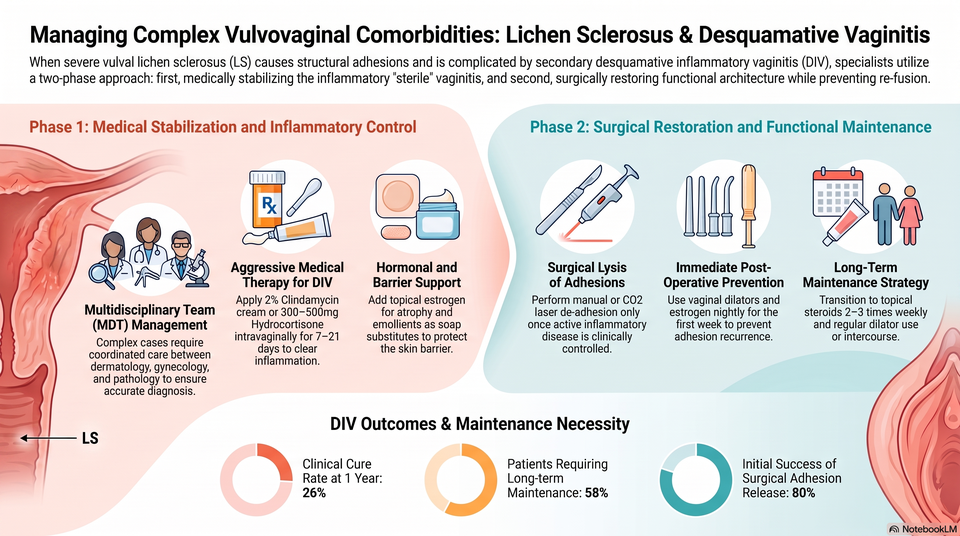


How do specialists manage the co-existence of severe vulval lichen sclerosu... | WHC Clinical FAQ

How is dermoscopy utilized by specialists in the clinical evaluation of vulvar lichen sclerosus?

Can lichen sclerosus cause chronic vulvar pruritus without presenting visib... | WHC Clinical FAQ
Autoimmune
Scarring
Specialist care
Women’s Health Clinic FAQ
How do specialists manage the co-existence of severe vulval lichen sclerosus adhesions and secondary desquamative vaginitis?
Autoimmune vulval disease can create erosions, adhesions, narrowing and secondary inflammation, so painful sex may reflect both active disease and altered anatomy.
Direct answer
Coexisting severe lichen sclerosus adhesions and secondary desquamative vaginitis needs specialist sequencing: control inflammation, protect tissue, treat vaginitis and monitor scarring or suspicious change. The safest approach is to localise the pain, examine the skin and mucosa, check discharge or infection where relevant, and decide whether swabs, microscopy, pH testing, biopsy or specialist vulval review are needed. This avoids reducing persistent dyspareunia to thrush, dryness or friction alone.
The safest answer keeps scarring, inflammatory control, vaginal overlap and cancer vigilance visible without implying that narrowing is only mechanical.
Educational only. Suitability and next steps should be confirmed after consultation. Results vary. Not a cure.

Scarring and pain
At a glance
These are the main points to understand before deciding whether painful sex is linked to skin, discharge, infection, allergy, scarring, mechanics or a focal lesion.
At a glance
Clinical summary
Main area
Scarring disease
Pattern
Narrowing or adhesions
Watch for
Rapid change
Next step
Specialist review
Important safety note
Rapid narrowing, new adhesions, ulcers, bleeding, a persistent lesion or worsening pain should prompt specialist assessment.
Skin
Swabs
Biopsy
Review
Detailed answer
Detailed answer
The deeper answer starts by separating entrance pain, deep pain, vestibular pain, discharge, dermatoses, fissures, scarring, allergy and focal lesions.
Direct answer
The reader needs a clear explanation of how autoimmune disease can scar, narrow or inflame vulvovaginal tissue and why specialist care matters.
Cause
Testing
Safety
Direct answer
Active inflammation can continue even when pain feels mechanical.
Inflammation and scarring
Control of the underlying disease matters before assuming anatomy alone is responsible.
Introital narrowing or adhesions
Scarring disease and secondary vaginitis may need different parts of the plan.
Vaginitis overlap
Chronic vulval inflammatory disease still needs attention to new or persistent lesions.
How the research shapes the answer
Treatment Non-compliance: Treatment failure is frequently caused by poor adherence due to "steroid-phobia", mixed messaging from healthcare providers, or incorrect application techniques. Relapse Rates: Without continuous maintenance therapy, approximately 84% of women will experience a clinical relapse within four years. Refractory Disease.
The benchmark shaped search intent and section order, while final wording keeps anatomy precise, avoids self-treatment instructions and preserves biopsy vigilance.
Patient safety
Why this matters
Painful sex is not a single diagnosis. It can affect intimacy and confidence, but the clinical priority is to identify the cause without shame or false reassurance.
It prevents scarring progression
Active inflammation can continue even when pain feels mechanical.
It treats active inflammation
Control of the underlying disease matters before assuming anatomy alone is responsible.
It sequences overlap
Scarring disease and secondary vaginitis may need different parts of the plan.
It keeps cancer vigilance
Chronic vulval inflammatory disease still needs attention to new or persistent lesions.
Cause-led care prevents harm
Repeatedly treating pain as thrush, dryness, friction or anxiety can delay the right diagnosis.
A better approach connects history, examination, tests, skin findings and follow-up so treatment matches the actual driver.
Considerations
What to consider
Formulation Selection: Ointments are strongly preferred over creams because they lack irritating preservatives (like alcohol), provide a superior barrier effect, and offer better absorption. Application Technique: Patients must be instructed to use a hand mirror to apply a very small amount (a.
Consultation priorities
Useful details include pain location, discharge, odour, bleeding, visible lesions, itching, products, condoms, prior surgery, cycle timing, recurrent infections and vulval skin history.
Discharge
Triggers
Lesions
Anatomy change
Narrowing, adhesions or loss of elasticity should be assessed directly.
Inflammation activity
Redness, erosions, soreness and discharge may suggest ongoing disease.
Vaginitis overlap
Secondary discharge or burning may need separate assessment.
Biopsy threshold
A new, changing or non-healing lesion should not be ignored.
What not to assume
Do not assume persistent dyspareunia is only dryness, only thrush, only friction or only anxiety.
Induction Phase: Standard therapy begins with daily application of an ultrapotent TCS for 4 weeks, tapering to alternate days for 4 weeks, and then twice weekly for a final 4 weeks. Maintenance Phase: Long-term maintenance therapy (1 to 3 times weekly) is.
Common concerns and myths
Common misconceptions
Painful sex content can become too vague. These corrections keep the answer clinically safer.
Myth: Scarring pain is only mechanical
Reality: scarring can coexist with active inflammation, and suspicious lesions still need review.
Myth: Adhesions mean inflammation is no longer active
Reality: scarring can coexist with active inflammation, and suspicious lesions still need review.
Myth: Specialist biopsy is only needed for obvious cancer
Reality: scarring can coexist with active inflammation, and suspicious lesions still need review.
Precision matters
The vulva, vestibule, vagina, introitus, perineal folds and Bartholin gland area can produce different pain patterns.
Persistence changes the threshold
When symptoms persist, recur or do not respond as expected, reassessment is safer than repeating the same explanation.
Safety checklist
Safety checklist
Use these checks to decide whether symptoms can be discussed routinely or need prompt clinical advice.
Is there a visible lesion?
A plaque, fissure, ulcer, lump, colour change, thickened area or non-healing spot should be assessed.
Is discharge present?
Purulent discharge, odour, recurrent thrush-like symptoms or new irritation may need swabs, microscopy or clinician review.
Is pain focal or recurrent?
Vestibular pain, one-sided entry pain, scar pain, fissuring or deep pain can point to different causes.
Has treatment failed?
Repeated antifungals, steroids, lubricants or antibiotics without improvement should prompt reassessment.
More reassuring signs
Symptoms are more reassuring when they are mild, short-lived, improving, already assessed and not linked with bleeding, sores, swelling, fever, discharge or a persistent lesion.
Improving
Reviewed
Reasons to seek advice
Malignancy Red Flags: Any persistent, non-healing ulcerations, new lumps, or areas of induration that do not respond to topical therapy require an urgent biopsy to rule out SCC or differentiated vulval intraepithelial neoplasia (dVIN). Steroid Safety: vulval tissue is remarkably resistant to.
Bleeding
Discharge
When to escalate
When to seek medical help
Some symptoms should not be managed as routine painful sex, dryness or recurrent thrush.
Use NHS 111 online
Persistent or changing lesion
A painful, thickened, pigmented, ulcerated, bleeding or non-healing lesion should be assessed promptly.
Bleeding, ulceration or swelling
Bleeding after sex, visible ulceration, new swelling or a lump should not be ignored.
Severe discharge, fever or pelvic pain
Purulent discharge, foul odour, fever, pelvic pain, urinary symptoms or feeling unwell needs clinical advice.
Emergency symptoms
Call 999 for life-threatening symptoms such as collapse, chest pain, breathing difficulty or stroke-like symptoms.
Use NHS 111 for urgent advice or call 999 in a life-threatening emergency. This page is educational and does not replace individual medical assessment.
Additional clinical context
How to use this answer
This page is designed to separate vulval skin disease, inflammatory vaginitis, infection, allergy, scarring, fissuring, post-surgical anatomy, focal lesions and pain sensitisation.What to discuss at appointment
Useful details include the exact pain point, visible changes, discharge, odour, bleeding, itch, swelling, products used, condom exposure, cycle timing, prior surgery, previous treatments and whether symptoms are changing.Regulatory resources
Authoritative resources
These resources support advice on painful sex, vulval skin disease, lichen sclerosus, autoimmune scarring and specialist vulval review.
NHS - Pain during or after sex
UK patient baseline for dyspareunia and clinical assessment.
RCOG - Skin conditions of the vulva
Gynaecology source for vulval scarring, symptoms and review.
British Association of Dermatologists - Lichen sclerosus
Specialist dermatology source for lichen sclerosus and scarring.
Next step
Book a clinical consultation
A consultation can review scarring, adhesions, current inflammation, vaginal discharge, pain location, previous treatments and whether biopsy or specialist sequencing is needed.
▶ View Research Sources (12 Sources)
These 12 source names are selected from 24 display-ready sources, with a raw audit trail of 90 imported records. Additional reviewed material included UK clinical guidance, professional society guidance, peer-reviewed clinical papers; duplicate, low-relevance and non-clinical records were removed before display.
Educational only. This information is for education only and is not a substitute for professional medical advice, diagnosis or treatment. Results vary. Not a cure.
