

How does a longitudinal or transverse vaginal septum physically obstruct pe... | WHC Clinical FAQ

How do clinicians manage deep dyspareunia caused by a retroverted uterus co... | WHC Clinical FAQ

How do you navigate painful intercourse (dyspareunia) and its impact on cou... | WHC Clinical FAQ
Structural anatomy
Primary pain
Consent-led
Women’s Health Clinic FAQ
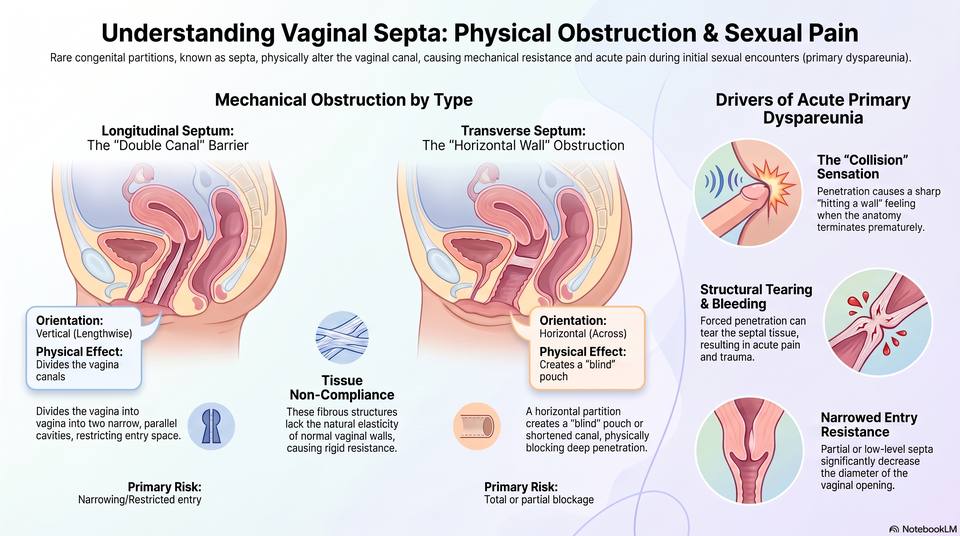
How does a longitudinal or transverse vaginal septum physically obstruct penetration and cause acute primary dyspareunia?
Primary penetration pain can sometimes reflect a structural barrier, such as a septum, hymenal variant, short vagina or congenital uterine or cervical anomaly.
Direct answer
A longitudinal or transverse vaginal septum can physically obstruct penetration by narrowing or partitioning the canal, causing acute primary dyspareunia when tissue is stretched or pressed. The safest approach is to define the anatomy, locate the pain, check for bleeding, infection or post-surgical red flags, and decide whether examination, imaging, supervised dilation discussion or specialist gynaecology review is needed. This avoids treating structural dyspareunia as anxiety, friction or a problem to force through.
A useful answer explains how anatomy can limit entry or depth while keeping examination, imaging and treatment planning clinician-led and consent-led.
Educational only. Suitability and next steps should be confirmed after consultation. Results vary. Not a cure.

Structural entry pain
At a glance
These are the main points to understand before deciding whether painful sex is linked to entry obstruction, deep pelvic pathology, scarring, stenosis, mesh, pessary pressure or infection.
At a glance
Clinical summary
Main area
Congenital structure
Pattern
Entry or depth limit
Watch for
Tearing or bleeding
Next step
Gynaecology review
Important safety note
Severe primary penetration pain, tearing, bleeding, inability to insert tampons, obstructed periods or suspected structural anomaly should be assessed.
Depth
Scarring
Bleeding
Review
Detailed answer
Detailed answer
The deeper answer starts by separating primary entry obstruction, deep collision pain, post-surgical scarring, stenosis, mesh or pessary friction, infection and endometriosis.
Direct answer
The reader needs to understand how congenital anatomy can physically obstruct entry or limit depth, and why examination, imaging and consent-led planning matter.
Mechanism
Imaging
Safety
Direct answer
Pain from the first attempts at penetration can be structural rather than psychological.
Structural anatomy
A septum, hymenal variant or short vagina can change entry, depth and direction of pressure.
Primary entry pain pattern
Repeated attempts can worsen tearing, fear and tissue pain.
Assessment and imaging
Examination, imaging and any procedure should be planned with consent and diagnosis.
How the research shapes the answer
The clinical reality is that structural dyspareunia can involve congenital anatomy, deep pelvic disease, adhesions, post-surgical scarring, mesh, pessary pressure, stenosis or infection.
The benchmark shaped search intent and section order, while final wording avoids procedural instructions and keeps bleeding, infection, mesh and post-surgical red flags visible.
Patient safety
Why this matters
Structural painful sex is easy to mislabel as anxiety, friction or normal healing. The safer approach is to describe the mechanism and check what needs assessment.
It validates primary pain
Pain from the first attempts at penetration can be structural rather than psychological.
It explains the barrier
A septum, hymenal variant or short vagina can change entry, depth and direction of pressure.
It avoids forced penetration
Repeated attempts can worsen tearing, fear and tissue pain.
It keeps treatment bounded
Examination, imaging and any procedure should be planned with consent and diagnosis.
Assessment prevents avoidable harm
Forcing penetration, ignoring bleeding or following generic dilation advice can worsen pain or delay the right diagnosis.
A better plan connects anatomy, symptoms, examination tolerance, imaging, prior surgery and follow-up.
Considerations
What to consider
Preoperative Imaging: A high-quality MRI or 3D ultrasound is strictly required before surgery to map the exact location/thickness of the septum and check the kidneys and uterus. Menstrual Suppression: For transverse septa causing obstruction, physicians may prescribe continuous hormonal medications to pause.
Consultation priorities
Useful details include entry versus deep pain, tearing, bleeding, fever, discharge, tampon history, period symptoms, previous surgery, mesh or pessary use, imaging and examination preferences.
Depth
Surgery
Safety
Entry history
Tampon insertion, period flow, first penetration and tearing history all matter.
Pain location
Pain at the opening differs from pain at depth or one side.
Imaging or examination
A clinician may need careful examination or imaging to define anatomy.
Treatment goals
The aim is function, comfort and consent, not forcing one type of sexual activity.
What not to assume
Do not assume structural dyspareunia is only anxiety, only friction, normal healing or something to push through.
Diagnosis Timing: Often remains undiagnosed until puberty (when menstrual blockage causes pain) or sexual debut (when penetration is difficult). Occasionally diagnosed incidentally during labor. Surgery Duration: Resection surgery typically takes 1 to 2 hours under general anaesthesia. Hospital Stay: Many patients go.
Common concerns and myths
Common misconceptions
Structural dyspareunia advice can be too dismissive or too technical. These corrections keep the answer safer.
Myth: Primary dyspareunia is always anxiety
Reality: primary or depth-limited pain can reflect anatomy and should be assessed without shame or pressure.
Myth: A hymenal or septal variant is always obvious earlier
Reality: primary or depth-limited pain can reflect anatomy and should be assessed without shame or pressure.
Myth: Depth and angle problems are just preference
Reality: primary or depth-limited pain can reflect anatomy and should be assessed without shame or pressure.
Anatomy matters
The hymen, introitus, vestibule, vaginal canal, apex, cervix, uterus, mesh and pessary can create different pain patterns.
Instructions have limits
Surgery, dilation, pessary adjustment and mesh management need individual examination, consent and supervision.
Safety checklist
Safety checklist
Use these checks to decide whether symptoms can be discussed routinely or need prompt clinical advice.
Is there bleeding or discharge?
Bleeding during sex, discharge, odour or suspected mesh exposure should be assessed.
Is deep pain severe or new?
Severe deep pain, fever, feeling unwell or suspected abscess needs prompt advice.
Is there a structural barrier?
Repeated failed entry, tearing, tampon difficulty or obstructed periods can point to anatomy that needs review.
Is there post-surgical narrowing?
Narrowing after hysterectomy, prolapse repair, perineoplasty or cancer treatment should be managed with specialist guidance.
More reassuring signs
Symptoms are more reassuring when they are mild, improving, already assessed and not linked with bleeding, fever, discharge, a mass, mesh exposure, severe pain or post-surgical worsening.
Improving
Reviewed
Reasons to seek advice
Surgical Risks: Resection carries a small but serious risk of injury to adjacent organs such as the urethra, bladder, and bowel, which could lead to incontinence or fistulae. Post-Operative Infection: Symptoms like high fever, chills, worsening pain, heavy bleeding, or foul-smelling discharge.
Fever
Severe pain
When to escalate
When to seek medical help
Some symptoms should not be managed as routine painful sex, friction or normal healing.
Use NHS 111 online
Bleeding, mass or mesh concern
Bleeding with sex, a new lump, partner scratchiness or suspected mesh exposure should be assessed.
Fever or severe pelvic pain
Fever, severe deep pain, discharge, feeling unwell or possible abscess needs prompt medical advice.
Failed entry or obstructed symptoms
Inability to tolerate entry, repeated tearing, tampon difficulty or obstructed periods should be reviewed.
Emergency symptoms
Call 999 for life-threatening symptoms such as collapse, chest pain, breathing difficulty or stroke-like symptoms.
Use NHS 111 for urgent advice or call 999 in a life-threatening emergency. This page is educational and does not replace individual medical assessment.
Additional clinical context
How to use this answer
This page is designed to separate congenital anatomy, primary entry obstruction, deep pelvic pathology, adhesions, post-surgical scarring, stenosis, mesh exposure, pessary pressure and infection-related pain.What to discuss at appointment
Useful details include entry versus deep pain, tearing, bleeding, fever, discharge, tampon history, period symptoms, prior surgery, prolapse or pessary use, mesh history, imaging, cancer-treatment history and examination preferences.Regulatory resources
Authoritative resources
These resources support careful advice on painful sex, vaginal symptoms, hymenal variants, septa, congenital anatomy and gynaecological assessment.
Next step
Book a clinical consultation
A consultation can review the exact point of obstruction, bleeding, tampon history, period symptoms, examination preferences, imaging needs and treatment options.
▶ View Research Sources (12 Sources)
These 12 source names are selected from 24 display-ready sources, with a raw audit trail of 69 imported records. Additional reviewed material included UK clinical guidance, professional society guidance, peer-reviewed clinical papers, evidence reviews; duplicate, low-relevance and non-clinical records were removed before display.
Educational only. This information is for education only and is not a substitute for professional medical advice, diagnosis or treatment. Results vary. Not a cure.
