


Can vaginal atrophy cause chronic pelvic pain?

Can vaginal dryness cause pelvic pain?

A dynamic pelvic vascular congestion syndrome alter regional
Deep pain
Pelvic pathology
Do not dismiss
Women’s Health Clinic FAQ
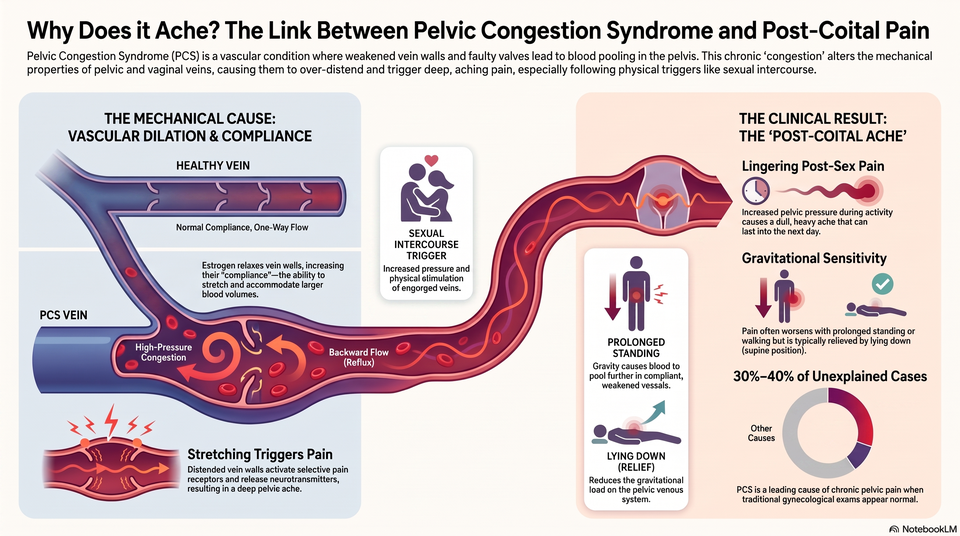
Can chronic pelvic congestion syndrome alter the vascular compliance of the vaginal walls and cause a dull, aching post-coital pain?
Deep dyspareunia may come from contact with tender pelvic structures, tethering, inflammation, vascular pressure, adhesions, endometriosis or infection.
Direct answer
Pelvic congestion syndrome may contribute to dull, aching post-coital pelvic pain through venous distension and pelvic pressure, but diagnosis requires careful exclusion of other causes. The safest approach is to define the anatomy, locate the pain, check for bleeding, infection or post-surgical red flags, and decide whether examination, imaging, supervised dilation discussion or specialist gynaecology review is needed. This avoids treating structural dyspareunia as anxiety, friction or a problem to force through.
A strong answer connects the mechanism to the pain pattern while keeping urgent symptoms and diagnostic uncertainty visible.
Educational only. Suitability and next steps should be confirmed after consultation. Results vary. Not a cure.

Deep pelvic pain
At a glance
These are the main points to understand before deciding whether painful sex is linked to entry obstruction, deep pelvic pathology, scarring, stenosis, mesh, pessary pressure or infection.
At a glance
Clinical summary
Main area
Deep pelvic cause
Pattern
Collision or aching pain
Watch for
Fever or severe pain
Next step
Pelvic assessment
Important safety note
Fever, severe pelvic pain, feeling unwell, new bleeding, discharge, suspected abscess or rapidly worsening deep pain needs prompt clinical advice.
Depth
Scarring
Bleeding
Review
Detailed answer
Detailed answer
The deeper answer starts by separating primary entry obstruction, deep collision pain, post-surgical scarring, stenosis, mesh or pessary friction, infection and endometriosis.
Direct answer
The reader wants to understand deep positional pain from pelvic disease, tethering, vascular pressure, inflammation or infection and when review should be urgent.
Mechanism
Imaging
Safety
Direct answer
Deep collision pain usually points to a different pathway than introital burning.
Deep contact mechanism
Endometriosis, adhesions or scar tissue can make deep contact painful.
Tethering or inflammation
Abscess or inflammatory pelvic disease should not be treated as routine sexual pain.
Differential diagnosis
Imaging, examination and clinical context are needed before naming the cause.
How the research shapes the answer
The clinical reality is that structural dyspareunia can involve congenital anatomy, deep pelvic disease, adhesions, post-surgical scarring, mesh, pessary pressure, stenosis or infection.
The benchmark shaped search intent and section order, while final wording avoids procedural instructions and keeps bleeding, infection, mesh and post-surgical red flags visible.
Patient safety
Why this matters
Structural painful sex is easy to mislabel as anxiety, friction or normal healing. The safer approach is to describe the mechanism and check what needs assessment.
It separates depth from entry
Deep collision pain usually points to a different pathway than introital burning.
It explains tethering
Endometriosis, adhesions or scar tissue can make deep contact painful.
It keeps infection visible
Abscess or inflammatory pelvic disease should not be treated as routine sexual pain.
It avoids symptom-only diagnosis
Imaging, examination and clinical context are needed before naming the cause.
Assessment prevents avoidable harm
Forcing penetration, ignoring bleeding or following generic dilation advice can worsen pain or delay the right diagnosis.
A better plan connects anatomy, symptoms, examination tolerance, imaging, prior surgery and follow-up.
Considerations
What to consider
Multidisciplinary Care: Optimal management requires a team approach involving a gynaecologist (to rule out primary pelvic organ diseases), an interventional radiologist (to perform advanced imaging and embolization), and often pain management or pelvic floor physical therapists. First-line Imaging: Providers typically begin with.
Consultation priorities
Useful details include entry versus deep pain, tearing, bleeding, fever, discharge, tampon history, period symptoms, previous surgery, mesh or pessary use, imaging and examination preferences.
Depth
Surgery
Safety
Cycle and position
Pain linked to cycle, deep thrusting or specific angles gives useful clues.
Associated symptoms
Bleeding, fever, discharge, bowel or urinary symptoms change the pathway.
Surgical history
Appendix rupture, caesarean section or pelvic surgery can affect adhesions and scarring.
Urgency
Severe pain, fever or feeling unwell needs prompt medical advice.
What not to assume
Do not assume structural dyspareunia is only anxiety, only friction, normal healing or something to push through.
Diagnostic Timeline: By definition, symptoms must be present for at least 6 months to be classified as chronic pelvic pain. Diagnosis is often delayed, averaging up to four years from initial presentation due to overlapping symptoms with other conditions. Procedure Duration: Pelvic.
Common concerns and myths
Common misconceptions
Structural dyspareunia advice can be too dismissive or too technical. These corrections keep the answer safer.
Myth: Deep pain is just position
Reality: deep pain can involve endometriosis, adhesions, infection, vascular pressure or scar tissue, and symptoms alone are not enough.
Myth: Adhesions or endometriosis can be diagnosed from symptoms alone
Reality: deep pain can involve endometriosis, adhesions, infection, vascular pressure or scar tissue, and symptoms alone are not enough.
Myth: Abscess-related pain behaves like routine dyspareunia
Reality: deep pain can involve endometriosis, adhesions, infection, vascular pressure or scar tissue, and symptoms alone are not enough.
Anatomy matters
The hymen, introitus, vestibule, vaginal canal, apex, cervix, uterus, mesh and pessary can create different pain patterns.
Instructions have limits
Surgery, dilation, pessary adjustment and mesh management need individual examination, consent and supervision.
Safety checklist
Safety checklist
Use these checks to decide whether symptoms can be discussed routinely or need prompt clinical advice.
Is there bleeding or discharge?
Bleeding during sex, discharge, odour or suspected mesh exposure should be assessed.
Is deep pain severe or new?
Severe deep pain, fever, feeling unwell or suspected abscess needs prompt advice.
Is there a structural barrier?
Repeated failed entry, tearing, tampon difficulty or obstructed periods can point to anatomy that needs review.
Is there post-surgical narrowing?
Narrowing after hysterectomy, prolapse repair, perineoplasty or cancer treatment should be managed with specialist guidance.
More reassuring signs
Symptoms are more reassuring when they are mild, improving, already assessed and not linked with bleeding, fever, discharge, a mass, mesh exposure, severe pain or post-surgical worsening.
Improving
Reviewed
Reasons to seek advice
Red Flags: Chronic pelvic pain requires a thorough workup to exclude serious pathologies. 'Red flag' symptoms that warrant urgent investigation for other causes (like malignancy) include postmenopausal onset of pain, rectal bleeding, postcoital or irregular vaginal bleeding, newly onset bowel symptoms in.
Fever
Severe pain
When to escalate
When to seek medical help
Some symptoms should not be managed as routine painful sex, friction or normal healing.
Use NHS 111 online
Bleeding, mass or mesh concern
Bleeding with sex, a new lump, partner scratchiness or suspected mesh exposure should be assessed.
Fever or severe pelvic pain
Fever, severe deep pain, discharge, feeling unwell or possible abscess needs prompt medical advice.
Failed entry or obstructed symptoms
Inability to tolerate entry, repeated tearing, tampon difficulty or obstructed periods should be reviewed.
Emergency symptoms
Call 999 for life-threatening symptoms such as collapse, chest pain, breathing difficulty or stroke-like symptoms.
Use NHS 111 for urgent advice or call 999 in a life-threatening emergency. This page is educational and does not replace individual medical assessment.
Additional clinical context
How to use this answer
This page is designed to separate congenital anatomy, primary entry obstruction, deep pelvic pathology, adhesions, post-surgical scarring, stenosis, mesh exposure, pessary pressure and infection-related pain.What to discuss at appointment
Useful details include entry versus deep pain, tearing, bleeding, fever, discharge, tampon history, period symptoms, prior surgery, prolapse or pessary use, mesh history, imaging, cancer-treatment history and examination preferences.Regulatory resources
Authoritative resources
These resources support advice on painful sex, endometriosis, pelvic inflammatory disease, adhesions, pelvic congestion and deep pelvic pain assessment.
Next step
Book a clinical consultation
A consultation can review pain depth, cycle pattern, position triggers, bowel or bladder symptoms, infection symptoms, surgical history, imaging and referral needs.
▶ View Research Sources (12 Sources)
These 12 source names are selected from 24 display-ready sources, with a raw audit trail of 83 imported records. Additional reviewed material included UK clinical guidance, professional society guidance, peer-reviewed clinical papers; duplicate, low-relevance and non-clinical records were removed before display.
Educational only. This information is for education only and is not a substitute for professional medical advice, diagnosis or treatment. Results vary. Not a cure.
