



🤯 Pudendal Neuralgia Clues: 5 Signs of Chronic Pelvic Nerve Pain

🤯 Pudendal Neuralgia Clues: 5 Signs of Chronic Pelvic Nerve Pain

How Obturator Internus Hypertonicity Drives Deep Pelvic Pain During Specific Sexual Angles
Nerve pathway
Shared decision
Side effects
Women’s Health Clinic FAQ
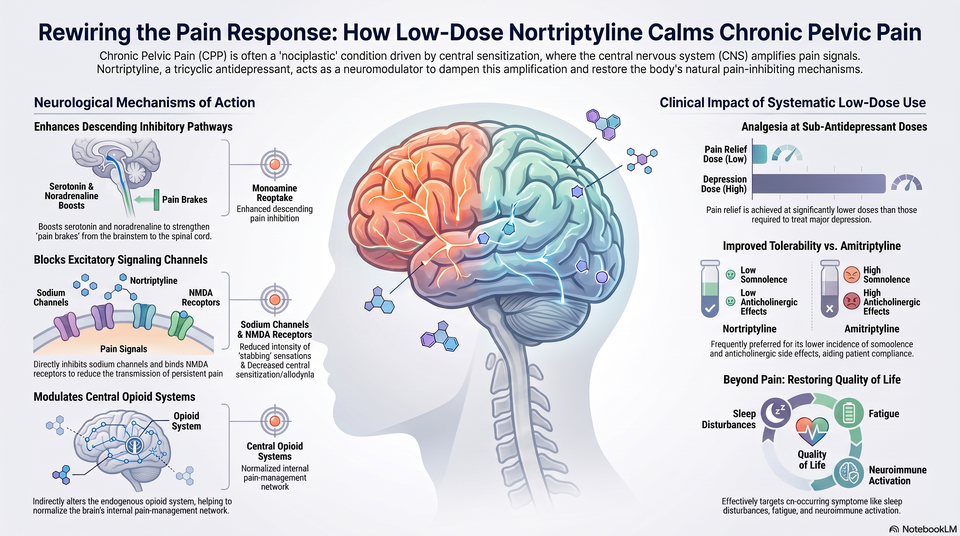
How does the systematic addition of low-dose oral nortriptyline alter the central nervous system processing of chronic, unyielding pelvic pain?
Oral neuromodulators may be discussed when dyspareunia behaves like persistent nerve pain, but they are not a simple cure for complex pelvic pain.
Direct answer
Low-dose nortriptyline may modulate central pain processing in selected chronic pelvic pain, but it needs prescribing review, side-effect monitoring and realistic goals. The safe clinical route is to confirm the pain pattern and diagnosis, check contraindications or red flags, explain realistic benefits and limits, and keep medicines, injections, surgery, devices and rehabilitation clinician-led. This gives patients useful understanding without turning specialist care into public protocol instructions.
A safe page explains central sensitisation in plain English, then keeps prescribing, interactions, sedation, mood effects and follow-up in view.
Educational only. Suitability and next steps should be confirmed after consultation. Results vary. Not a cure.

Neuropathic pain care
At a glance
These are the main points to understand before considering medicines, injections, surgery, laser, dilators, biofeedback or multidisciplinary review for painful sex.
At a glance
Clinical summary
Main area
Pain processing
Pattern
Persistent nerve pain
Watch for
Sedation or mood change
Next step
Medication review
Important safety note
Seek medical advice promptly for severe drowsiness, mood deterioration, suicidal thoughts, allergic symptoms, new neurological signs, pregnancy concern or unsafe medicine interactions.
Consent
Monitoring
Pelvic floor
Review
Detailed answer
Detailed answer
The deeper answer starts by separating mechanism from protocol. Patients need to know why an option may be considered, not the private clinical settings, formula, dose or procedural steps.
Direct answer
The key is to explain central pain processing, careful medicine selection, side-effect monitoring and why medication is only one part of refractory dyspareunia care.
Criteria
Limits
Safety
Direct answer
Persistent pelvic pain can involve amplified nervous-system processing, not weakness or imagination.
Central sensitisation and nerve modulation
Neuromodulators need risk, interaction and side-effect review.
When medicines may be considered
Medication rarely replaces pelvic-floor, tissue, skin or psychological support when those drivers coexist.
Shared decision-making
Benefit, sedation, mood and function should be monitored.
How the research shapes the answer
The clinical reality is that refractory dyspareunia can involve tissue sensitivity, nerve amplification, pelvic-floor guarding, medication tolerance, infection screening and consent boundaries.
The benchmark shaped search intent and section order, while final wording avoids formulas, doses, procedural details, technical settings and unsupervised progression plans.
Patient safety
Why this matters
Treatment-heavy dyspareunia pages can easily become too promotional or too technical. The safer route is to explain clinical reasoning and keep supervision visible.
It validates nerve pain
Persistent pelvic pain can involve amplified nervous-system processing, not weakness or imagination.
It keeps medicines cautious
Neuromodulators need risk, interaction and side-effect review.
It avoids single-solution thinking
Medication rarely replaces pelvic-floor, tissue, skin or psychological support when those drivers coexist.
It defines review points
Benefit, sedation, mood and function should be monitored.
Escalation should be structured
Persistent painful sex is rarely solved by adding one more treatment without checking the diagnosis, tissue state, pelvic floor and pain pathway.
A better plan connects the mechanism to suitability, consent, monitoring and realistic follow-up.
Considerations
What to consider
A consultation should clarify pain location, diagnosis, previous care, medicine history, contraindications, infection risk, pelvic-floor findings, consent questions and follow-up needs.
Consultation priorities
Useful details include pain location, onset, previous diagnoses, current medicines, allergies, infection history, bleeding, discharge, pelvic-floor symptoms, previous treatment response and what matters most to the patient.
Risks
Alternatives
Follow-up
Pain phenotype
Burning, shooting, widespread or persistent pain may suggest nerve involvement.
Current medicines
Interactions and sedation risk matter before prescribing.
Mental health
Mood and sleep can affect both suitability and monitoring.
Escalation
Limited response should prompt diagnosis review, not endless dose changes in isolation.
What not to assume
Do not assume more intensive treatment is better, or that refractory pain means the patient has failed conservative care.
Timelines vary because tissue healing, nerve sensitivity, medication review, pelvic-floor retraining and postoperative recovery each move at a different pace.
Common concerns and myths
Common misconceptions
Treatment content can sound confident in ways that are not clinically fair. These corrections keep the answer useful and responsible.
Myth: Neuromodulators cure refractory vestibulodynia
Reality: treatment may reduce symptoms in selected patients, but response varies and monitoring matters.
Myth: Side effects are irrelevant at low dose
Reality: treatment decisions need diagnosis, suitability, consent, monitoring and realistic expectations considered together.
Myth: Central sensitisation means the pain is imaginary
Reality: treatment decisions need diagnosis, suitability, consent, monitoring and realistic expectations considered together.
Mechanism is not instruction
It is appropriate to explain what a treatment is trying to change while keeping formulas, settings, doses and technique private.
Review protects progress
If pain worsens or response is poor, the next step is reassessment rather than force, escalation or self-adjustment.
Safety checklist
Safety checklist
Use these checks to decide whether treatment discussion can continue routinely or needs review before any next step.
Is the diagnosis secure?
Pain map, tissue findings, infection screen and pelvic-floor pattern should fit the proposed treatment.
Are there red flags?
Fever, bleeding, severe pelvic pain, pregnancy concern, infection signs or urinary retention should be reviewed first.
Are risks understood?
Medicines, injections, surgery, laser and rehabilitation each need consent, alternatives and monitoring.
Is progress being tracked?
Pain intensity, function, tolerance, flare-ups and side effects should guide follow-up.
More reassuring signs
A treatment pathway is more reassuring when diagnosis is clear, symptoms are stable, red flags are absent, consent is informed and follow-up is planned.
No red flags
Follow-up
Reasons to seek advice
Seek medical advice promptly for severe drowsiness, mood deterioration, suicidal thoughts, allergic symptoms, new neurological signs, pregnancy concern or unsafe medicine interactions.
Infection
Severe pain
When to escalate
When to seek medical help
Some symptoms should not be managed by continuing, intensifying or self-adjusting treatment.
Use NHS 111 online
Fever, infection signs or feeling unwell
Fever, offensive discharge, pelvic pain, worsening redness, swelling or feeling systemically unwell needs urgent advice.
Bleeding, pregnancy concern or severe pain
Bleeding with sex, possible pregnancy, severe pelvic pain or rapidly worsening vulval pain should be assessed promptly.
Neurological or urinary symptoms
New numbness, leg weakness, severe shooting pain or urinary retention needs medical advice.
Emergency symptoms
Call 999 for life-threatening symptoms such as collapse, chest pain, breathing difficulty or stroke-like symptoms.
Use NHS 111 for urgent advice or call 999 in a life-threatening emergency. This page is educational and does not replace individual medical assessment.
Additional clinical context
How to use this answer
This page is designed to separate treatment mechanism, suitability, consent, monitoring and escalation. It deliberately does not provide formulas, doses, procedural details, technical settings or unsupervised rehabilitation steps.What to discuss at appointment
Useful details include pain mapping, current medicines, allergies, infection history, bleeding, discharge, previous treatment response, pelvic-floor symptoms, mental health context, treatment goals and what level of risk feels acceptable.Regulatory resources
Authoritative resources
These resources support UK-facing explanation of painful sex, neuropathic pain medicines, prescribing review and chronic pelvic pain evidence.
Next step
Book a clinical consultation
A consultation can review pain pattern, current medicines, mood, sleep, safety risks, previous response and whether medication review or multidisciplinary care is more appropriate.
▶ View Research Sources (12 Sources)
These 12 source names are selected from 180 curated sources. Additional reviewed material included UK clinical guidance, professional society guidance, peer-reviewed clinical papers; duplicate and low-relevance records were removed before display.
Educational only. This information is for education only and is not a substitute for professional medical advice, diagnosis or treatment. Results vary. Not a cure.
