



When should a persistent, painful vestibular lesion be biopsied to rule out... | WHC Clinical FAQ

Does vulvar vestibulodynia hypersensitize nerves after dryness treatment | WHC Clinical FAQ

Does vulvar vestibulodynia hypersensitize nerves after dryness treatment
Pain mapping
Vestibule
Track change
Women’s Health Clinic FAQ
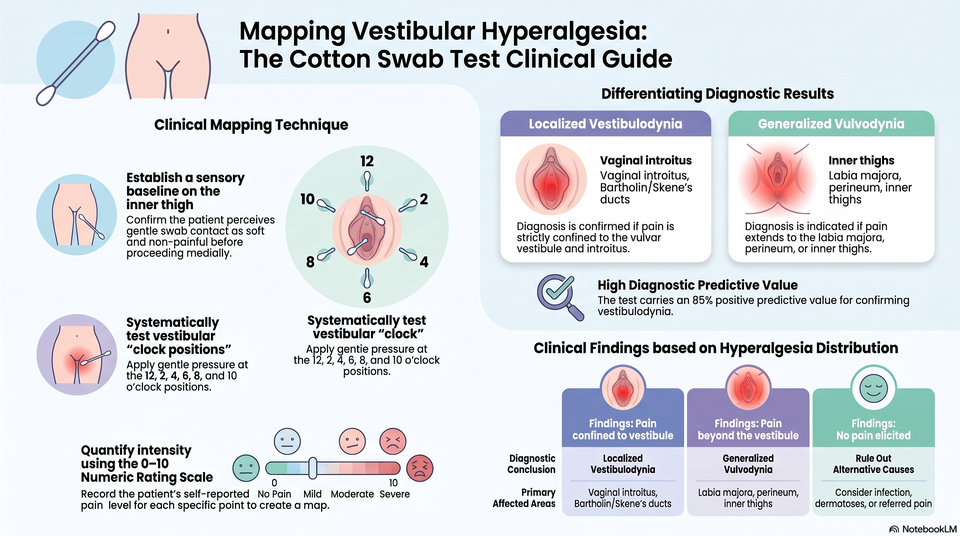
How do clinicians use the cotton swab test to precisely map localised versus generalised vestibular hyperalgesia?
Vestibular pain mapping helps clinicians understand whether pain is focal, provoked, localised, more generalised or changing over time.
Direct answer
The cotton swab test helps clinicians map whether vestibular pain is focal, localised, provoked or more generalised, but it is only one part of a full dyspareunia assessment. The safest approach is to identify the pain map, triggers, muscle response, bladder or nerve features and any red flags before deciding whether pelvic-health physiotherapy, gynaecology, pain-specialist or other review is appropriate. This avoids reducing dyspareunia to weakness, anxiety, posture or one isolated test result.
A strong answer explains what mapping can show, what it cannot prove, and why normal-looking tissue can still be painful.
Educational only. Suitability and next steps should be confirmed after consultation. Results vary. Not a cure.

Pain mapping
At a glance
These are the main points to understand before deciding whether painful sex is linked to nerve pain, pelvic-floor tone, vestibular sensitivity, bladder symptoms or biomechanics.
At a glance
Clinical summary
Main area
Vestibular sensitivity
Pattern
Mapped pain response
Watch for
Changing lesion
Next step
Cause-led assessment
Important safety note
Pain mapping should not replace assessment for skin disease, infection, lesions, pelvic-floor tone, hormonal tissue change or trauma-informed needs.
Nerves
Muscles
Bladder
Review
Detailed answer
Detailed answer
The deeper answer starts by separating nerve distribution, pelvic-floor tone, vestibular mapping, bladder symptoms, biomechanics, hip or spinal factors and gynaecological causes.
Direct answer
The reader wants to know how clinicians map vestibular sensitivity and track pain thresholds without treating a test result as the whole diagnosis.
Triggers
Assessment
Safety
Direct answer
Mapping helps show whether pain is focal, regional or more widespread.
Pain mapping
Repeat measures may help in specialist follow-up when interpreted cautiously.
Localised versus generalised findings
A normal-looking vulva can still have provoked vestibular pain.
Tracking over time
Pain scores need symptom history, examination and patient tolerance beside them.
How the research shapes the answer
The clinical reality is that dyspareunia can involve nerve distribution, pelvic-floor overactivity, vestibular pain, bladder symptoms, biomechanics, hip or spinal contributors and gynaecological causes.
The benchmark shaped search intent and section order, while final wording keeps assessment consent-led, avoids self-treatment protocols and preserves uncertainty where evidence is limited.
Patient safety
Why this matters
Painful sex can involve the nervous system, pelvic-floor muscles, bladder symptoms, pain memory and movement patterns. Naming the mechanism carefully helps avoid both dismissal and overdiagnosis.
It localises sensitivity
Mapping helps show whether pain is focal, regional or more widespread.
It tracks change
Repeat measures may help in specialist follow-up when interpreted cautiously.
It avoids visual dismissal
A normal-looking vulva can still have provoked vestibular pain.
It keeps context
Pain scores need symptom history, examination and patient tolerance beside them.
Precise assessment prevents wrong turns
The wrong label can lead to strengthening when relaxation is needed, reassurance when review is needed, or procedures before the pain map is understood.
A better plan connects symptoms, anatomy, examination tolerance, functional triggers and safety-netting.
Considerations
What to consider
vulval Skin Care: Patients should adopt gentle vulval care routines, including avoiding soaps, bubble baths, fragranced products, and tight clothing. Emollient soap substitutes and barrier creams (like petroleum jelly) are recommended to protect the skin. Topical Application: For dyspareunia, patients can apply.
Consultation priorities
Useful details include the exact pain map, sitting tolerance, touch sensitivity, sexual angles, urinary symptoms, surgery history, hip or back symptoms, neurological changes, trauma history and examination preferences.
Triggers
Tone
Consent
Test tolerance
Cotton-swab testing should be gentle, consent-led and stoppable.
Pain pattern
Clock-face location, pressure threshold and spread can guide interpretation.
Visible findings
Skin change, discharge, fissures or lesions still matter.
Longitudinal use
Tracking is most useful when it changes management or follow-up.
What not to assume
Do not assume dyspareunia is only weakness, only anxiety, only posture, only nerve entrapment or only a pelvic-floor problem.
Gradual Relief: Rapid resolution of vulvodynia is rare. Patients must be counseled that finding the right treatment combination can take months, and pain reduction may be incomplete. Medication Efficacy: Oral medications like tricyclic antidepressants (e.g., amitriptyline) or anticonvulsants (e.g., gabapentin) are usually.
Common concerns and myths
Common misconceptions
Pelvic pain advice can become too mechanical or too vague. These corrections keep the answer clinically safer.
Myth: A cotton swab test is the whole diagnosis
Reality: mapping tests add useful information, but they do not replace the whole clinical assessment.
Myth: Pain scores are perfectly objective
Reality: mapping tests add useful information, but they do not replace the whole clinical assessment.
Myth: A normal-looking vulva rules out vestibular pain
Reality: mapping tests add useful information, but they do not replace the whole clinical assessment.
Mechanism matters
Nerve pain, muscle guarding, vestibular pain, bladder urgency and biomechanical loading can overlap but need different questions.
Testing has limits
A test or palpation finding is useful only when it fits the patient story, examination and safety context.
Safety checklist
Safety checklist
Use these checks to decide whether symptoms can be discussed routinely or need prompt clinical advice.
Are there neurological symptoms?
New numbness, weakness, saddle symptoms, urinary retention or rapidly worsening nerve pain should be assessed.
Are bladder symptoms present?
Blood in urine, fever, flank pain, retention or recurrent infection symptoms need medical review.
Is examination consent-led?
Cotton-swab testing, internal palpation and pelvic-health treatment should be explained, optional and stoppable.
Has treatment stalled?
Persistent pain despite strengthening, relaxation, medicines or manual treatment should prompt reassessment of the diagnosis.
More reassuring signs
Symptoms are more reassuring when they are mild, improving, already assessed and not linked with neurological change, fever, bleeding, urinary retention, a new mass or severe pelvic pain.
Improving
Reviewed
Reasons to seek advice
Differential Diagnosis Red Flags: Before diagnosing vulvodynia, clinicians must rule out infectious causes (e.g., candidiasis, herpes), inflammatory conditions (e.g., lichen sclerosus, lichen planus), neoplastic diseases (e.g., squamous cell carcinoma, Paget's disease), and objective neurological damage (e.g., pudendal nerve entrapment). Topical Treatment Risks.
Retention
Severe pain
When to escalate
When to seek medical help
Some symptoms should not be managed as routine painful sex, muscle tension or posture-related discomfort.
Use NHS 111 online
New neurological symptoms
New numbness, weakness, saddle symptoms, loss of bladder or bowel control, or urinary retention needs urgent advice.
Severe pelvic or urinary symptoms
Severe pelvic pain, fever, flank pain, blood in urine or feeling very unwell should be assessed.
Bleeding, mass or post-surgical change
Unexplained bleeding, a new lump, rapidly worsening post-surgical pain or a non-healing area needs review.
Emergency symptoms
Call 999 for life-threatening symptoms such as collapse, chest pain, breathing difficulty or stroke-like symptoms.
Use NHS 111 for urgent advice or call 999 in a life-threatening emergency. This page is educational and does not replace individual medical assessment.
Additional clinical context
How to use this answer
This page is designed to separate nerve distribution, pelvic-floor muscle overactivity, vestibular pain mapping, bladder interaction, biomechanics, hip or spinal contributors and gynaecological causes.What to discuss at appointment
Useful details include the exact pain map, sitting tolerance, touch sensitivity, sexual positions, urinary symptoms, surgery history, hip or back symptoms, neurological changes, previous treatment response, trauma history and examination preferences.Regulatory resources
Authoritative resources
These resources support advice on painful sex, vulval symptoms, cotton-swab testing, vestibular pain and pressure-pain threshold tracking.
Next step
Book a clinical consultation
A consultation can review where pain is triggered, whether it is localised or wider, visible skin findings, discharge, pelvic-floor response and whether follow-up mapping is useful.
▶ View Research Sources (12 Sources)
These 12 source names are selected from 24 display-ready sources, with a raw audit trail of 77 imported records. Additional reviewed material included UK clinical guidance, professional society guidance, peer-reviewed clinical papers, clinical trial records; duplicate, low-relevance and non-clinical records were removed before display.
Educational only. This information is for education only and is not a substitute for professional medical advice, diagnosis or treatment. Results vary. Not a cure.
