

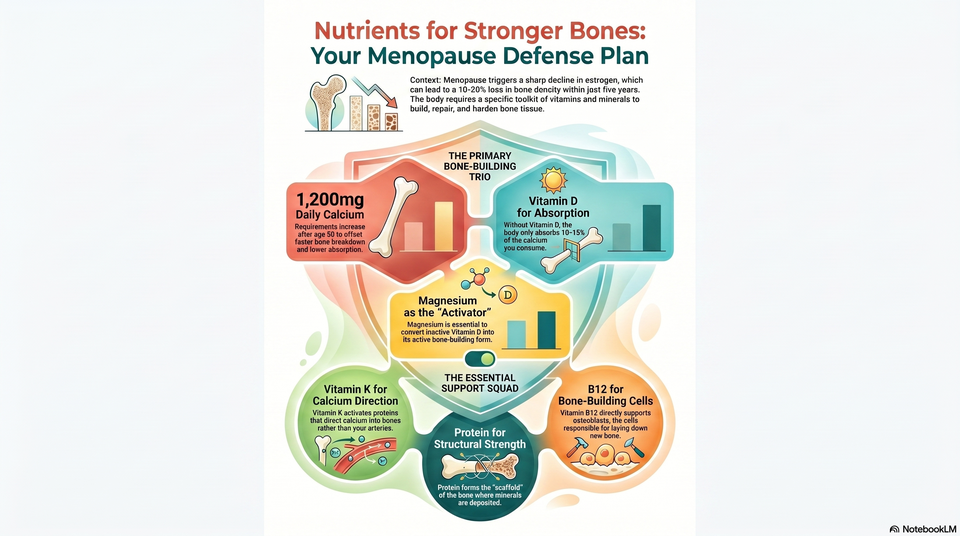


Which vitamins and minerals are absolute essentials for supporting bone hea... | WHC Clinical FAQ

What is the link between menopause and an increased risk of developing osteoporosis?

What is the link between menopause and an increased risk of developing oste... | WHC Clinical FAQ
Strength
Bone loading
Metabolic health
Women’s Health Clinic FAQ
Which vitamins and minerals are absolute essentials for supporting bone health during menopause?
Exercise advice in menopause is most useful when it explains strength, bone loading, balance and recovery rather than simply telling women to do more.
Direct answer
Bone health during menopause depends most on calcium, vitamin D, adequate protein, resistance or weight-bearing activity, and overall fracture-risk assessment. Magnesium, vitamin K and other nutrients may contribute, but they do not replace the core bone-health foundations. The safest plan depends on symptom pattern, medical history, current medicines, risk factors and whether red-flag symptoms are present. Lifestyle measures can be useful, but persistent, severe or unusual symptoms should be assessed.
A useful answer explains why loading, muscle, balance and recovery matter while keeping the plan realistic for current fitness and clinical risk.
Educational only. Suitability and next steps should be confirmed after consultation. Results vary. Not a cure.

Strength and bone
At a glance
These are the main points to understand before deciding whether symptoms are expected, need routine review or should be assessed promptly.
At a glance
Practical clinical summary
Main area
Muscle and bone
Pattern
Progressive loading
Watch for
Injury risk
Next step
Tailored plan
Important safety note
Exercise should be matched to current fitness, bone risk, pain, balance, medical history and safety, especially if osteoporosis or injury risk is present.
Symptoms
Mechanism
Review
Safety
Detailed answer
Detailed answer
The useful starting point is to separate what lifestyle support can realistically do, what the evidence can and cannot show, and when symptoms need clinical assessment.
Calcium
The reader wants a clear essentials list for bone health and supplement decisions.
Pattern
Assessment
Support
Calcium
Maintaining muscle supports strength, function, glucose handling and confidence during midlife change.
Vitamin D
Bones adapt to safe mechanical stress through remodelling, so resistance and weight-bearing work matter.
Protein
Strength, balance and mobility reduce falls risk, which is central to fracture prevention.
Magnesium and vitamin K
Protein, sleep and gradual progression help exercise support the body rather than overload it.
How the research shapes the answer
The research supports practical lifestyle advice, but it also shows why symptom pattern, medical history, medicines and safety checks matter.
The benchmark guides search intent and structure; final wording avoids quick resolves, cure claims, supplement hype and blame-based language.
Patient safety
Why this matters
Exercise advice in menopause is most useful when it explains strength, bone loading, balance and recovery rather than simply telling women to do more. A strong page should be useful without making the answer sound simpler than the evidence allows.
Muscle is metabolically active
Maintaining muscle supports strength, function, glucose handling and confidence during midlife change.
Bone responds to load
Bones adapt to safe mechanical stress through remodelling, so resistance and weight-bearing work matter.
Balance prevents harm
Strength, balance and mobility reduce falls risk, which is central to fracture prevention.
Recovery is part of training
Protein, sleep and gradual progression help exercise support the body rather than overload it.
Supportive, not simplistic
Diet, exercise, sleep, CBT, supplements, pelvic floor work and vaginal products can all be useful in the right context.
They should still be matched to the person, the symptom, the evidence and the safety boundary.
Considerations
What to consider
A useful plan starts with the symptom pattern, what has already been tried, current medicines, medical history, safety concerns and what feels realistic to maintain.
Practical priorities
Bring a symptom diary, supplement list, medicines list and any red-flag symptoms to a clinician if the answer is unclear or symptoms are affecting daily life.
Pattern
Options
Follow-up
Start from current ability
The safest programme is built around current strength, pain, balance, pelvic symptoms and medical history.
Progress gradually
Small increases in load, repetitions or impact are safer than sudden intense programmes.
Include balance work
Balance training matters for confidence, falls prevention and long-term independence.
Review pain or injury
Persistent joint pain, swelling, weakness or suspected fracture should be assessed.
What not to assume
Do not assume a lifestyle measure is ineffective because it is simple, or safe because it is natural.
Equally, do not assume symptoms should be managed alone if they are severe, persistent, unusual or linked with red flags.
Common concerns and myths
Common misconceptions
Online menopause advice can be either dismissive or overconfident. These corrections keep the answer balanced.
Myth: Calcium alone prevents osteoporosis
Reality: lifestyle changes can support health, but they should not be framed as a cure or a single answer.
Myth: More supplements always mean stronger bones
Reality: response varies, and suitability depends on symptoms, medical history, medicines, preferences and safety.
Myth: Bone loss always causes early symptoms
Reality: response varies, and suitability depends on symptoms, medical history, medicines, preferences and safety.
Evidence and lived experience both matter
Some people feel real benefit from lifestyle changes, but that does not make every claim or product reliable.
Safety keeps advice useful
The best advice is practical enough to try and careful enough to avoid delaying assessment when it is needed.
Safety checklist
Safety checklist
Use these checks to decide whether self-care is reasonable or whether clinical advice is needed.
What symptom are you targeting?
Flushes, sleep, weight, dryness, leaking, pain, breast tenderness and brain fog often need different strategies.
What are you already taking?
Medicines, supplements and herbal products can interact or make symptoms harder to interpret.
Is the plan sustainable?
A realistic plan protects nutrition, sleep, muscle, mood and safety rather than relying on extreme restriction.
Are there red flags?
Bleeding, breast changes, severe pain, infection signs, neurological symptoms or severe mood symptoms should be assessed.
More reassuring signs
Self-care is more reasonable when symptoms are mild, stable, clearly triggered, not worsening and not linked with red flags.
Improving
Reviewed
Reasons to seek advice
Exercise should be matched to current fitness, bone risk, pain, balance, medical history and safety, especially if osteoporosis or injury risk is present.
Interactions
Persistent symptoms
When to escalate
When to seek medical help
These symptoms or history details should not be managed with lifestyle advice alone.
Use NHS 111 online
Suspected fracture
Sudden severe back, hip or wrist pain after a fall or strain should be assessed.
Chest symptoms
Chest pain, severe breathlessness, collapse or a sustained racing heartbeat needs urgent help.
Neurological symptoms
New weakness, numbness, speech change or severe dizziness needs urgent assessment.
Inflamed joints
Hot, swollen, red or persistently painful joints should be reviewed.
Use NHS 111 for urgent advice or call 999 in a life-threatening emergency. This page is educational and does not replace individual medical assessment.
Additional clinical context
How to use this answer
Use this page to identify what is reasonable to try, what needs monitoring and what should be discussed with a clinician rather than managed alone.What to bring to a consultation
Helpful details include symptom timing, sleep pattern, exercise routine, diet changes, supplement list, medicines, bleeding history, urinary or vaginal symptoms, breast symptoms, mood changes and any medical history that affects safety.Regulatory resources
Authoritative resources
These resources support UK-facing information on bone health, resistance training, physical activity and menopause.
Next step
Book a clinical consultation
A consultation can review symptoms, bone risk, injury history, pelvic symptoms, fatigue and whether physiotherapy, fitness guidance or medical review is appropriate.
▶ View Research Sources (12 Sources)
These 12 source names are selected from 12 display-ready sources, with a raw audit trail of 52 imported records. Additional reviewed material included UK clinical guidance, professional society guidance, peer-reviewed clinical papers; duplicate, low-relevance and non-clinical records were removed before display.
Educational only. This information is for education only and is not a substitute for professional medical advice, diagnosis or treatment. Results vary. Not a cure.
