



What post-procedure symptoms after urethral bulking indicate acute urinary retention requiring...

What post-procedure symptoms after urethral bulking indicate acute urinary ... | WHC Clinical FAQ

What recovery restrictions apply immediately after undergoing an outpatient urethral bulking...
Assessment first
Evidence-aware
Safety focused
Women’s Health Clinic FAQ
What post-procedure symptoms after urethral bulking indicate acute urinary retention requiring intervention?
Procedural and emerging options for stress urinary incontinence can sound technically convincing, but suitability depends on the exact leakage mechanism, tissue health, urinary symptoms, previous treatments and safety checks.
Direct answer
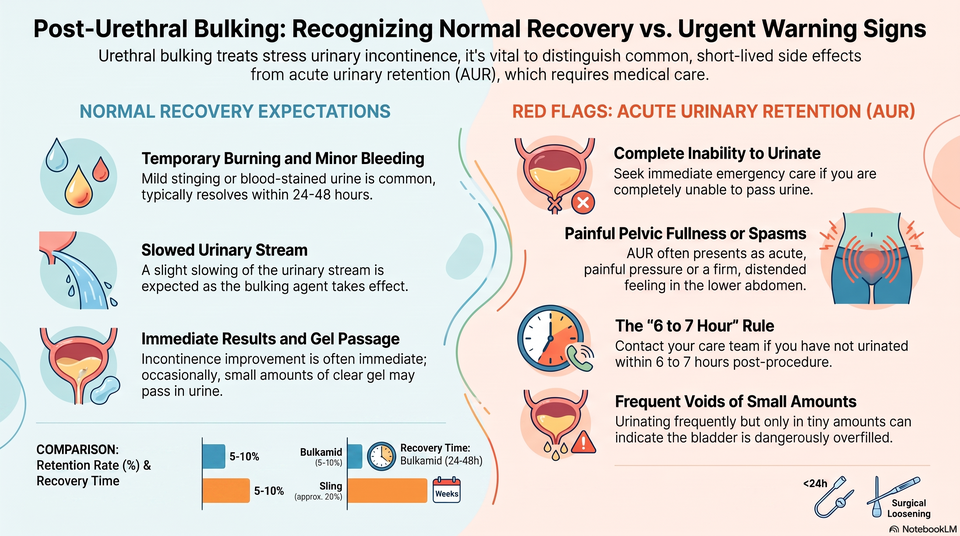
After urethral bulking, acute urinary retention may be suggested by inability to pass urine, painful bladder fullness, increasing lower abdominal discomfort, a very weak stream, repeated unsuccessful attempts to void, or feeling unwell with urinary symptoms. This needs prompt clinical advice, because retention after a urethral procedure should not be waited out at home.
The safest discussion separates what a treatment is designed to do, what evidence supports it, what remains uncertain and which symptoms should delay treatment or prompt urgent review.
Educational only. This page is educational and does not replace individual assessment. Results vary. Not a cure.

SUI assessment
At a glance
These are the key clinical points to understand before considering treatment.
At a glance
Clinical summary
Main check
Passing urine after urethral treatment matters.
Watch for
Retention, UTI symptoms, severe pain or heavy bleeding.
Activity
Restrictions should follow the treating clinician's written advice.
Urgency
Inability to pass urine needs prompt clinical contact.
Important safety note
Seek medical advice promptly for inability to pass urine, painful bladder fullness, fever, blood in urine, severe pelvic pain, recurrent infection symptoms, new neurological symptoms or postmenopausal bleeding.
Evidence
Suitability
Consent
Review
Detailed answer
Detailed answer
Aftercare should help patients distinguish expected mild symptoms from warning signs.
Clinical context
Urethral bulking can temporarily affect urination, so retention advice must be clear.
Tissue
Safety
Evidence
What it is meant to do
Aftercare should help patients distinguish expected mild symptoms from warning signs.
Why selection matters
Urethral bulking can temporarily affect urination, so retention advice must be clear.
Evidence limits
Activity and intimacy restrictions vary, so the page should avoid inventing resolved timelines.
Safety and review
Patients should know who to contact if they cannot pass urine or feel increasingly unwell.
What this means in practice
A responsible SUI page should explain the proposed mechanism without teaching procedural method or technical operating detail.
If symptoms suggest infection, retention, pain, bleeding or mixed incontinence, treatment should pause until the cause is assessed.
Patient safety
Why this distinction matters
Bulking, energy devices and regenerative options are not interchangeable, and each has different evidence, consent and safety issues.
It clarifies mechanism
Coaptation, tissue remodelling, sphincter weakness and support loss describe different clinical problems.
It protects consent
Patients need to know what is established, what is emerging and what cannot be promised.
It checks safety
Infection, retention, pain, bleeding and tissue fragility can change whether treatment should proceed.
It prevents overclaiming
Technical language should never imply promised dryness, proven regeneration or device superiority.
A clinician-led decision
The safest plan balances symptom burden, diagnosis, alternatives, likely benefit, evidence limits and aftercare.
This is especially important when treatment is invasive, energy-based or regenerative.
Considerations
What to consider
Before treatment, consider diagnosis, previous conservative care, bladder emptying, infection risk, tissue quality, pain, prolapse and realistic goals.
Consultation priorities
Before leaving, patients may be asked to pass urine or confirm they can empty comfortably.
Consent
Aftercare
Escalation
Before treatment
Before leaving, patients may be asked to pass urine or confirm they can empty comfortably.
Consent discussion
Written aftercare should explain symptoms, hygiene, activity, medication instructions if relevant and emergency contact routes.
Aftercare
The first days should focus on urinary comfort, infection symptoms and avoiding unnecessary irritation.
If symptoms persist
Follow-up should review leakage, emptying, discomfort and whether further treatment is needed.
Practical expectations
Response varies; treatment decisions should be reviewed against leakage triggers, comfort, emptying, infection symptoms and quality-of-life impact.
Costs, access and treatment details should be confirmed directly with the clinic before booking.
Common concerns and myths
Common misconceptions
These points help keep procedural and emerging SUI treatments realistic.
Myth: retention can always wait
Reality: inability to pass urine after a urethral procedure needs prompt advice.
Myth: resolved recovery rules apply to everyone
Reality: restrictions depend on the procedure and clinical context.
Myth: mild leakage after treatment is always failure
Reality: response and timing need review before conclusions are made.
Evidence and advertising
Clinical claims should not outrun the quality of evidence, especially for energy and regenerative treatments.
Alternatives
Supervised PFMT, pessary support, bulking, surgery or specialist referral may each fit different patients.
Safety checklist
Safety checklist
Use these checks before relying on procedural, energy-based or regenerative treatment claims for SUI.
Is the diagnosis clear?
Stress, urge, overflow, infection and retention symptoms should be separated before treatment.
Has suitability been assessed?
Mechanism, tissue health, previous treatment, red flags and expectations all affect suitability.
Are red flags absent?
Seek medical advice promptly for inability to pass urine, painful bladder fullness, fever, blood in urine, severe pelvic pain, recurrent infection symptoms, new neurological symptoms or postmenopausal bleeding.
Is follow-up planned?
Patients should know how response, side effects and next steps will be reviewed.
Reassuring signs
Proceeding is more reasonable when diagnosis is clear, infection and retention symptoms are absent, and expectations are realistic.
No red flags
Review plan
Reasons to pause
Seek medical advice promptly for inability to pass urine, painful bladder fullness, fever, blood in urine, severe pelvic pain, recurrent infection symptoms, new neurological symptoms or postmenopausal bleeding.
Infection
Bleeding
When to escalate
When to seek medical help
Some urinary symptoms need prompt review before or after SUI procedures.
Use NHS 111 online
Unable to pass urine
Inability to pass urine or painful bladder fullness after a procedure needs prompt clinical advice.
Infection symptoms
Fever, burning with systemic symptoms, worsening pelvic pain or feeling unwell should be assessed.
Bleeding or severe pain
Blood in urine, unexplained bleeding, severe pelvic pain or worsening discomfort should not be ignored.
Emergency symptoms
Call 999 in a life-threatening emergency, including collapse, chest pain or breathing difficulty.
Use NHS 111 for urgent advice or call 999 in a life-threatening emergency. This page is educational and does not replace individual medical assessment.
Regulatory resources
Authoritative resources
These resources support assessment-led, evidence-aware continence information.
NICE NG123 urinary incontinence recommendations
NICE supports careful counselling around SUI procedures, alternatives, repeat treatment and evidence limits.
NICE HTG86 intramural urethral bulking procedures
NICE summarises bulking indications, efficacy limits and adverse events including UTI and retention.
NHS urinary incontinence treatment
NHS gives the public baseline for conservative and procedural urinary incontinence care.
Next step
Book a continence consultation
A consultation can clarify the SUI mechanism, review safer established options, and decide whether a procedural or emerging treatment is appropriate.
▶ View Research Sources (12 Sources)
These 12 source names are selected from 102 curated sources. Additional reviewed material included UK clinical guidance, peer-reviewed clinical papers, clinical trial records; duplicate and low-relevance records were removed before display.
Educational only. This information is for education only and is not a substitute for professional medical advice, diagnosis or treatment. Results vary. Not a cure.
