


How do clinicians screen for active urinary tract infections before performing invasive urethral...

How do clinicians screen for active urinary tract infections before perform... | WHC Clinical FAQ

What recovery restrictions apply immediately after undergoing an outpatient urethral bulking...
Assessment first
Evidence-aware
Safety focused
Women’s Health Clinic FAQ
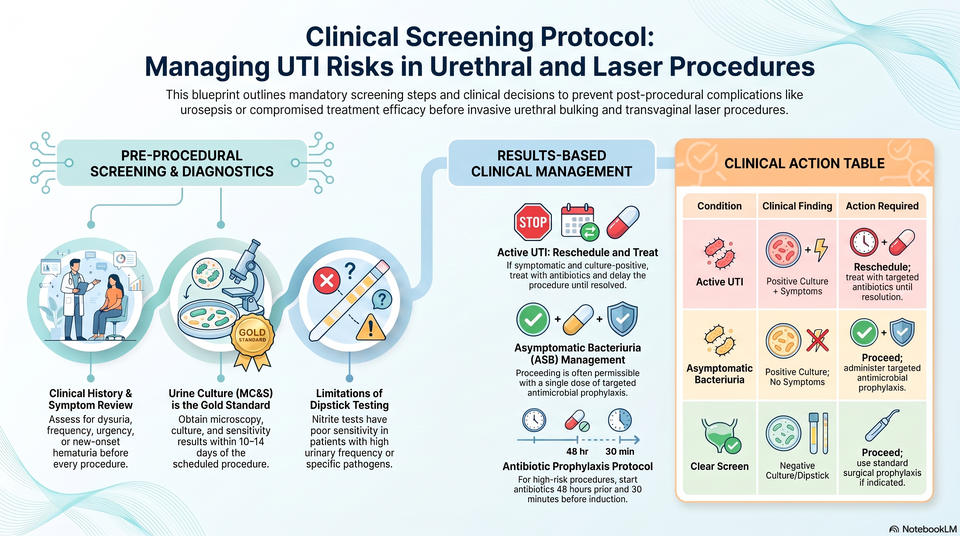
How do clinicians screen for active urinary tract infections before performing invasive urethral bulking or laser procedures?
Procedural and emerging options for stress urinary incontinence can sound technically convincing, but suitability depends on the exact leakage mechanism, tissue health, urinary symptoms, previous treatments and safety checks.
Direct answer
Before invasive urethral bulking or vaginal energy procedures, clinicians screen for urinary tract infection by asking about symptoms and using urine testing when appropriate. Burning, frequency, fever, pelvic pain, blood in urine or positive urine findings may delay treatment. The aim is to reduce infection risk and avoid treating through an active urinary problem.
The safest discussion separates what a treatment is designed to do, what evidence supports it, what remains uncertain and which symptoms should delay treatment or prompt urgent review.
Educational only. This page is educational and does not replace individual assessment. Results vary. Not a cure.

SUI assessment
At a glance
These are the key clinical points to understand before considering treatment.
At a glance
Clinical summary
Pre-check
Symptoms and urine testing may identify infection or delay criteria.
Delay reasons
Active infection, retention, unexplained bleeding or severe pain.
Consent
Benefits, limits, alternatives and safety uncertainties should be discussed.
Escalation
Fever, blood in urine or inability to pass urine needs review.
Important safety note
Seek medical advice promptly for inability to pass urine, painful bladder fullness, fever, blood in urine, severe pelvic pain, recurrent infection symptoms, new neurological symptoms or postmenopausal bleeding.
Evidence
Suitability
Consent
Review
Detailed answer
Detailed answer
Screening protects patients by identifying urinary or vaginal conditions that should be treated before an invasive procedure.
Clinical context
Contraindications are not only a tick-box list; they depend on symptoms, examination, medical history and treatment type.
Tissue
Safety
Evidence
What it is meant to do
Screening protects patients by identifying urinary or vaginal conditions that should be treated before an invasive procedure.
Why selection matters
Contraindications are not only a tick-box list; they depend on symptoms, examination, medical history and treatment type.
Evidence limits
Unresolved diagnosis matters because not every leak is stress-predominant SUI.
Safety and review
Clear delay criteria make the final page safer and more trustworthy.
What this means in practice
A responsible SUI page should explain the proposed mechanism without teaching procedural method or technical operating detail.
If symptoms suggest infection, retention, pain, bleeding or mixed incontinence, treatment should pause until the cause is assessed.
Patient safety
Why this distinction matters
Bulking, energy devices and regenerative options are not interchangeable, and each has different evidence, consent and safety issues.
It clarifies mechanism
Coaptation, tissue remodelling, sphincter weakness and support loss describe different clinical problems.
It protects consent
Patients need to know what is established, what is emerging and what cannot be promised.
It checks safety
Infection, retention, pain, bleeding and tissue fragility can change whether treatment should proceed.
It prevents overclaiming
Technical language should never imply promised dryness, proven regeneration or device superiority.
A clinician-led decision
The safest plan balances symptom burden, diagnosis, alternatives, likely benefit, evidence limits and aftercare.
This is especially important when treatment is invasive, energy-based or regenerative.
Considerations
What to consider
Before treatment, consider diagnosis, previous conservative care, bladder emptying, infection risk, tissue quality, pain, prolapse and realistic goals.
Consultation priorities
The clinician asks about urinary symptoms, infection history, bleeding, pain, emptying and pregnancy-related considerations.
Consent
Aftercare
Escalation
Before treatment
The clinician asks about urinary symptoms, infection history, bleeding, pain, emptying and pregnancy-related considerations.
Consent discussion
Urine testing or further examination may be needed if symptoms suggest infection or another cause.
Aftercare
Treatment is delayed when the risk profile is unclear or active symptoms need care first.
If symptoms persist
Once the issue is resolved, suitability can be reconsidered with realistic expectations.
Practical expectations
Response varies; treatment decisions should be reviewed against leakage triggers, comfort, emptying, infection symptoms and quality-of-life impact.
Costs, access and treatment details should be confirmed directly with the clinic before booking.
Common concerns and myths
Common misconceptions
These points help keep procedural and emerging SUI treatments realistic.
Myth: symptoms alone rule out infection
Reality: testing may be needed when risk or symptoms are present.
Myth: contraindications are the same for every procedure
Reality: bulking and energy treatments have different considerations.
Myth: delaying treatment is failure
Reality: delay can be the safest clinical decision.
Evidence and advertising
Clinical claims should not outrun the quality of evidence, especially for energy and regenerative treatments.
Alternatives
Supervised PFMT, pessary support, bulking, surgery or specialist referral may each fit different patients.
Safety checklist
Safety checklist
Use these checks before relying on procedural, energy-based or regenerative treatment claims for SUI.
Is the diagnosis clear?
Stress, urge, overflow, infection and retention symptoms should be separated before treatment.
Has suitability been assessed?
Mechanism, tissue health, previous treatment, red flags and expectations all affect suitability.
Are red flags absent?
Seek medical advice promptly for inability to pass urine, painful bladder fullness, fever, blood in urine, severe pelvic pain, recurrent infection symptoms, new neurological symptoms or postmenopausal bleeding.
Is follow-up planned?
Patients should know how response, side effects and next steps will be reviewed.
Reassuring signs
Proceeding is more reasonable when diagnosis is clear, infection and retention symptoms are absent, and expectations are realistic.
No red flags
Review plan
Reasons to pause
Seek medical advice promptly for inability to pass urine, painful bladder fullness, fever, blood in urine, severe pelvic pain, recurrent infection symptoms, new neurological symptoms or postmenopausal bleeding.
Infection
Bleeding
When to escalate
When to seek medical help
Some urinary symptoms need prompt review before or after SUI procedures.
Use NHS 111 online
Unable to pass urine
Inability to pass urine or painful bladder fullness after a procedure needs prompt clinical advice.
Infection symptoms
Fever, burning with systemic symptoms, worsening pelvic pain or feeling unwell should be assessed.
Bleeding or severe pain
Blood in urine, unexplained bleeding, severe pelvic pain or worsening discomfort should not be ignored.
Emergency symptoms
Call 999 in a life-threatening emergency, including collapse, chest pain or breathing difficulty.
Use NHS 111 for urgent advice or call 999 in a life-threatening emergency. This page is educational and does not replace individual medical assessment.
Regulatory resources
Authoritative resources
These resources support assessment-led, evidence-aware continence information.
NICE NG123 urinary incontinence recommendations
NICE supports assessment, urine testing, counselling and referral thresholds.
NHS urinary tract infections
NHS helps patients recognise UTI symptoms that may delay an invasive urinary procedure.
NICE HTG86 intramural urethral bulking procedures
NICE identifies adverse events and safety considerations for bulking procedures.
Next step
Book a continence consultation
A consultation can clarify the SUI mechanism, review safer established options, and decide whether a procedural or emerging treatment is appropriate.
▶ View Research Sources (12 Sources)
These 12 source names are selected from 216 curated sources. Additional reviewed material included UK clinical guidance, professional society guidance, peer-reviewed clinical papers, evidence reviews; duplicate and low-relevance records were removed before display.
Educational only. This information is for education only and is not a substitute for professional medical advice, diagnosis or treatment. Results vary. Not a cure.
