

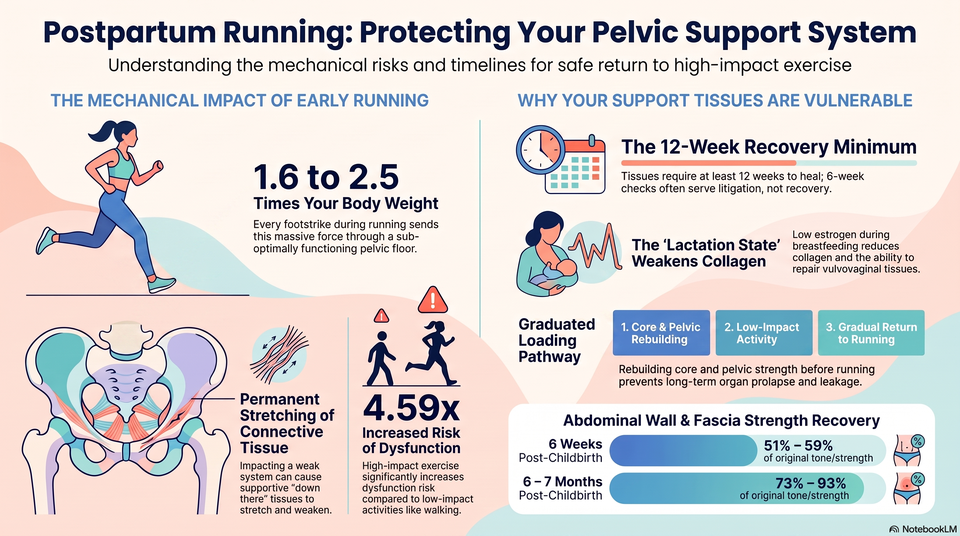


Can rapid postpartum return to running cause long-term mechanical breakdown... | WHC Clinical FAQ

Can delayed pelvic floor rehab worsen laxity after birth?

Can vaginal tissue recover naturally after 12 months postpartum?
Assessment first
Evidence-aware
Safety focused
Women’s Health Clinic FAQ
Can rapid postpartum return to running cause long-term mechanical breakdown of sub-urethral support tissues?
Leakage during exercise can feel frustrating and embarrassing, but it is usually a signal to assess pressure, tissue recovery and pelvic-floor coordination rather than a reason to give up movement.
Direct answer
Returning to running too quickly after birth may overload pelvic-floor and sub-urethral support tissues before strength, coordination and symptom control have recovered. That does not mean running causes inevitable long-term damage, but leaking, heaviness, pain or poor control are signs that the return should be slowed and assessed. A graded plan, pelvic-health review and attention to sleep, feeding, lifting and recovery load are more useful than a resolved calendar rule.
A useful consultation separates stress leakage from urgency, infection, retention, prolapse, pain and previous-surgery factors before recommending treatment or self-management.
Educational only. This page is educational and does not replace individual assessment. Results vary. Not a cure.

SUI guidance
At a glance
These points help place the question in a safer clinical context.
At a glance
Clinical summary
Recovery
Birth recovery is symptom-led as well as time-led.
Running
Impact should be rebuilt gradually.
Warning signs
Leaking, heaviness or pain need review.
Support
Pelvic-health physiotherapy can guide return to load.
Important safety note
Seek medical advice promptly for inability to pass urine, fever, blood in urine, recurrent urinary infection symptoms, severe pelvic pain, new neurological symptoms, postmenopausal bleeding or pregnancy concerns.
Pelvic floor
Training
Suitability
Review
Detailed answer
Detailed answer
Postpartum tissues may still be recovering even when general fitness feels ready.
Clinical context
Running combines impact, fatigue, breath control and repeated pressure rises.
Symptoms
Evidence
Alternatives
What is happening
Postpartum tissues may still be recovering even when general fitness feels ready.
Why it varies
Running combines impact, fatigue, breath control and repeated pressure rises.
What assessment checks
Symptoms such as leaking, heaviness, pain or poor control suggest the plan needs slowing or assessment.
What keeps it safe
A graded return respects tissue recovery without making women fearful of exercise.
What this means in practice
The page should explain the mechanism without reducing SUI to one cause or promising a single predictable result.
If symptoms are new, severe, mixed, painful, post-operative or pregnancy-related, the plan should pause for medical review.
Patient safety
Why this matters
The same outward leak can have different drivers, and the right next step depends on separating them.
It clarifies the mechanism
Pressure load, tissue quality, sphincter closure, pelvic-floor timing and bladder sensitivity are different issues.
It protects confidence
SUI can affect sport, sex, work, clothing, travel and public life, so it deserves a serious plan.
It prevents over-treatment
Conservative care, medication, surgery or referral suit different people and should not be rushed.
It keeps safety visible
Pain, infection, retention, bleeding, pregnancy concerns or previous pelvic surgery can change the pathway.
An individual plan
The safest approach considers symptom burden, cause, medical history, tissue context, goals and red flags.
This is especially important when medicines, pregnancy, elite sport, connective-tissue disorders or surgery are involved.
Considerations
What to consider
Before deciding what to do, consider the leakage trigger, bladder pattern, pelvic-floor function, bowel symptoms, cough, hormones, medication, pregnancy or surgery history and how symptoms affect daily life.
Consultation priorities
Assessment considers birth history, healing, pelvic-floor strength, prolapse symptoms, feeding, sleep and daily lifting load.
Triggers
Options
Follow-up
First assessment
Assessment considers birth history, healing, pelvic-floor strength, prolapse symptoms, feeding, sleep and daily lifting load.
Plan discussion
Return to running should build walking, strength, low impact and short intervals before sustained impact.
Monitoring response
Progression should respond to leakage, heaviness, pain and recovery between sessions.
When to reassess
Ongoing symptoms should be reviewed by a pelvic-health clinician.
Practical expectations
Improvement varies; review should look at leak triggers, quality of life, comfort, bladder emptying and any new symptoms.
Costs, access, prescription decisions, recovery instructions and treatment details should be confirmed directly with the clinic or prescribing clinician before booking.
Common concerns and myths
Common misconceptions
These myths are common because SUI is often discussed too simply.
Myth: a resolved week number makes running safe
Reality: symptoms and function matter as much as the calendar.
Myth: postpartum leaks must be tolerated
Reality: support is available and symptoms deserve assessment.
Myth: exercise is harmful after birth
Reality: graded movement is helpful when matched to recovery.
Evidence and context
A claim is only useful when it is matched to the woman's actual leakage mechanism and safety profile.
Alternatives
Options may include pelvic-floor physiotherapy, lifestyle support, containment, medicine review, local tissue treatment, surgery or specialist referral depending on the diagnosis.
Safety checklist
Safety checklist
Use these checks before relying on a single explanation or treatment plan for SUI.
Is the leakage pattern clear?
Stress leakage should be separated from urgency, infection, retention, prolapse, pain and mixed symptoms.
Have pressure factors been reviewed?
Cough, constipation, heavy lifting, training load, weight changes and smoking-related cough may all affect symptoms.
Are red flags absent?
Seek medical advice promptly for inability to pass urine, fever, blood in urine, recurrent urinary infection symptoms, severe pelvic pain, new neurological symptoms, postmenopausal bleeding or pregnancy concerns.
Is follow-up planned?
Know who reviews non-response, side effects, worsening leakage, pain, infection symptoms or difficulty passing urine.
Reassuring signs
Proceeding is more reasonable when the diagnosis is clear, expectations are realistic and follow-up is arranged.
No red flags
Review plan
Reasons to pause
Seek medical advice promptly for inability to pass urine, fever, blood in urine, recurrent urinary infection symptoms, severe pelvic pain, new neurological symptoms, postmenopausal bleeding or pregnancy concerns.
Infection
Severe pain
When to escalate
When to seek medical help
Some urinary or pelvic symptoms should be assessed promptly.
Use NHS 111 online
Unable to pass urine
Inability to pass urine, painful bladder fullness or repeated unsuccessful attempts to void need prompt clinical advice.
Infection symptoms
Fever, burning with feeling unwell, blood in urine, worsening pelvic pain or recurrent UTI symptoms should be assessed.
Pain, bleeding or pregnancy concern
Severe pelvic pain, postmenopausal bleeding, unusual discharge, pregnancy concerns or post-operative deterioration should not be ignored.
Emergency symptoms
Call 999 in a life-threatening emergency, including collapse, chest pain, breathing difficulty or sudden neurological symptoms.
Use NHS 111 for urgent advice or call 999 in a life-threatening emergency. This page is educational and does not replace individual medical assessment.
More clinical detail
Pressure management is not blame
Cough, constipation, lifting, weight-related pressure and early return to impact can all load the pelvic floor. Addressing them is a practical treatment support, not a judgement.When symptoms should slow the plan
Leaking with heaviness, pelvic pain, recurrent infections, poor bladder emptying or worsening symptoms should prompt reassessment before intensifying activity or treatment.Regulatory resources
Authoritative resources
These resources support assessment-led, evidence-aware SUI information.
NHS exercise in pregnancy
NHS gives public guidance on exercise, pelvic-floor strain and pregnancy safety.
NHS post-pregnancy body
NHS explains postnatal bladder leaks, pelvic-floor exercises and when to ask for help.
Postpartum return to running review
This clinical sports-medicine source supports symptom-led return-to-running advice after birth.
Next step
Book a continence consultation
A consultation can clarify the SUI mechanism, review conservative and specialist options, and decide what is safe and realistic for your situation.
▶ View Research Sources (12 Sources)
These 12 source names are selected from 369 curated sources. Additional reviewed material included professional society guidance, peer-reviewed clinical papers; duplicate and low-relevance records were removed before display.
Educational only. This information is for education only and is not a substitute for professional medical advice, diagnosis or treatment. Results vary. Not a cure.
