

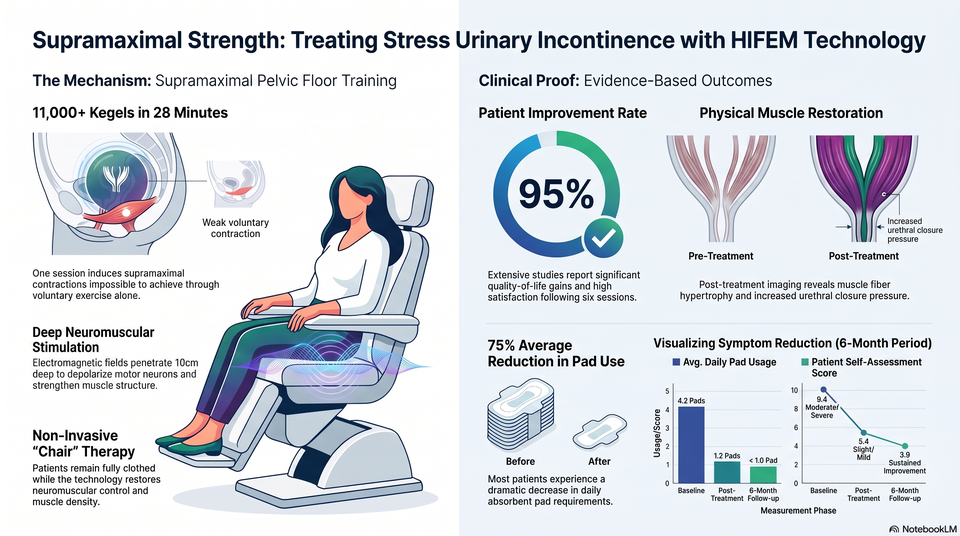


Can high-intensity focused electromagnetic (HIFEM) chair technology treat stress urinary...

Can high-intensity focused electromagnetic (HIFEM) chair technology treat s... | WHC Clinical FAQ

How do specialised incontinence tampons or OTC urethral support devices work during physical...
Conservative care
Assessment-led
Safety focused
Women’s Health Clinic FAQ
Can high-intensity focused electromagnetic (HIFEM) chair technology treat stress urinary incontinence effectively?
Conservative stress urinary incontinence care can involve pelvic-floor training, support devices, lifestyle changes, exercise modification or selected technologies, but the safest plan starts by understanding the mechanism of the leakage.
Direct answer
HIFEM chair technology is a non-invasive pelvic-floor stimulation option being used for selected stress urinary incontinence patients, but it should be presented cautiously. It may support pelvic-floor activation, yet it does not replace diagnosis, supervised PFMT, bladder assessment or review of prolapse and retention symptoms. Evidence, suitability and realistic goals should be discussed before treatment.
The right option depends on leakage triggers, urgency symptoms, bladder emptying, pelvic-floor coordination, prolapse, tissue comfort and how much the symptoms affect daily life.
Educational only. This page is educational and does not replace individual assessment. Results vary. Not a cure.

Continence care
At a glance
These are the main clinical points to understand before deciding what is suitable.
At a glance
Clinical summary
Position
A non-invasive stimulation option with developing evidence.
Not a shortcut
It should not replace diagnosis or supervised PFMT when those are needed.
Selection
Best discussed after symptoms, prolapse, retention and red flags are reviewed.
Expectation
Results vary and claims should stay evidence-aware.
Important safety note
Seek medical advice promptly for blood in urine, recurrent infection symptoms, urinary retention, severe pelvic pain, new neurological symptoms, a pelvic mass or postmenopausal bleeding.
Technique
Fit
Evidence
Review
Detailed answer
Detailed answer
HIFEM aims to stimulate pelvic-floor contractions without an internal probe, but the clinical question is whether it suits the patient's leakage pattern.
Clinical context
Device treatment should not be marketed as a predictable answer for all stress urinary incontinence.
Support
Timing
Safety
What it means
HIFEM aims to stimulate pelvic-floor contractions without an internal probe, but the clinical question is whether it suits the patient's leakage pattern.
Why it matters
Device treatment should not be marketed as a predictable answer for all stress urinary incontinence.
Where it helps
Supervised PFMT remains the key comparison because it teaches awareness, timing, endurance and pressure control.
What to avoid
Assessment is still needed to identify urgency, prolapse, retention, pain or tissue concerns before treatment.
What this means in practice
A useful continence plan explains the mechanism, the patient selection and the review point rather than presenting a device or exercise as universal.
If leakage is mixed, painful, new or associated with poor emptying, assessment should come before self-directed treatment.
Patient safety
Why assessment matters
Stress leakage can be affected by support, pressure, timing, tissue health and bladder behaviour, so conservative care works best when it is targeted.
It identifies the trigger
Coughing, sneezing, lifting, running and jumping create different pressure demands.
It checks suitability
Some patients need pelvic-floor rehabilitation, some need device support and some need medical review first.
It protects safety
Pain, bleeding, infection symptoms or retention should not be hidden by pads, plugs or exercise advice.
It sets a review point
Progress should be measured so the plan can continue, change or escalate at the right time.
A targeted conservative pathway
The best plan is practical without being casual about red flags or overclaiming results.
This helps patients stay active and informed while avoiding unsafe self-management.
Considerations
What to consider
Before choosing a device, exercise strategy or technology, consider the leakage pattern, comfort, pelvic-floor coordination, bladder emptying and any symptoms that need review.
Consultation priorities
The consultation should confirm the type of leakage and whether conservative rehabilitation has been tried.
Comfort
Emptying
Follow-up
Assessment
The consultation should confirm the type of leakage and whether conservative rehabilitation has been tried.
Practical use
The clinician should explain what the technology is expected to do and what remains uncertain.
Safety advice
Progress should be measured by symptom change, triggers, pad use, bladder diary or quality-of-life impact.
Reassessment
Non-response should prompt reassessment rather than automatic repeated courses.
Practical expectations
Conservative care may reduce leakage and improve confidence, but response varies and depends on the underlying mechanism.
Costs, access and treatment details should be confirmed directly with the clinic before booking.
Common concerns and myths
Common misconceptions
These points help keep conservative continence care realistic and safe.
Myth: a chair device replaces PFMT
Reality: technology may support pelvic-floor activation but does not teach every skill.
Myth: non-invasive means no assessment is needed
Reality: diagnosis, suitability and red flags still matter.
Myth: early studies prove predictable results
Reality: evidence may be promising but individual outcomes vary.
Evidence and marketing
Patient information should separate plausible mechanisms from predictable outcome claims.
Individual fit
The same device, exercise or protocol can work differently depending on symptoms, anatomy and technique.
Safety checklist
Safety checklist
Use these checks before relying on self-directed devices, exercises or technology for stress leakage.
Is the leakage pattern clear?
Stress leakage is usually linked to pressure triggers such as cough, sneeze, lift, run or jump.
Is bladder emptying normal?
Weak stream, incomplete emptying, increasing discomfort or constant dribbling should be reviewed.
Are red flags absent?
Seek medical advice promptly for blood in urine, recurrent infection symptoms, urinary retention, severe pelvic pain, new neurological symptoms, a pelvic mass or postmenopausal bleeding.
Is there a review plan?
PFMT, devices and technologies should have a clear review point so poor response is not ignored.
Reassuring signs
Symptoms are easier to manage conservatively when triggers are consistent, there is no pain or bleeding, and bladder emptying feels normal.
Comfortable
Reviewed
Reasons to pause
Seek medical advice promptly for blood in urine, recurrent infection symptoms, urinary retention, severe pelvic pain, new neurological symptoms, a pelvic mass or postmenopausal bleeding.
Retention
Pain
When to escalate
When to seek medical help
Some urinary symptoms should be checked before they are treated as routine stress leakage.
Use NHS 111 online
Blood in urine
Visible blood or unexplained blood on urine testing needs medical assessment.
Retention or emptying problems
Difficulty passing urine, weak stream, bladder pain or constant dribbling should be reviewed.
Pain or infection symptoms
Fever, burning with systemic symptoms, severe pelvic pain, discharge or feeling unwell needs prompt advice.
Emergency symptoms
Call 999 in a life-threatening emergency, including collapse, chest pain or breathing difficulty.
Use NHS 111 for urgent advice or call 999 in a life-threatening emergency. This page is educational and does not replace individual medical assessment.
Regulatory resources
Authoritative resources
These resources support assessment-led, evidence-aware continence information.
NICE NG123 recommendations
NICE anchors first-line PFMT, assessment and escalation before procedural treatment.
NICE NG210 pelvic floor dysfunction
NICE supports supervised pelvic-floor rehabilitation and review-based care.
NHS non-surgical urinary incontinence treatment
NHS explains conservative options and sets patient expectations before procedures.
Next step
Book a continence consultation
A consultation can clarify the likely cause of leakage, whether conservative care is suitable and when specialist investigation or escalation may be needed.
▶ View Research Sources (12 Sources)
These 12 source names are selected from 82 curated sources. Additional reviewed material included UK clinical guidance, peer-reviewed clinical papers, evidence reviews, clinical trial records; duplicate and low-relevance records were removed before display.
Educational only. This information is for education only and is not a substitute for professional medical advice, diagnosis or treatment. Results vary. Not a cure.
