

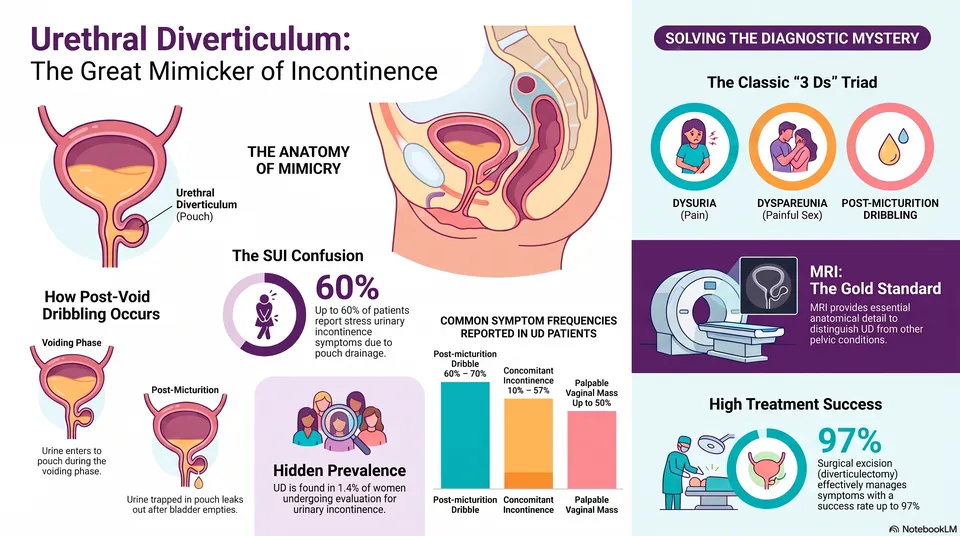


Can a urethral diverticulum mimic symptoms of stress urinary incontinence or post-void dribbling?

Can a urethral diverticulum mimic symptoms of stress urinary incontinence o... | WHC Clinical FAQ

Can chronic pelvic organ prolapse mask underlying severe stress urinary incontinence?
Urinary assessment
Mechanism-led
Safety first
Women’s Health Clinic FAQ
Can a urethral diverticulum mimic symptoms of stress urinary incontinence or post-void dribbling?
Stress urinary incontinence can feel straightforward, but the clinical cause may involve urethral support, sphincter closure, bladder behaviour, prolapse, tissue quality or a mimic that needs a different pathway.
Direct answer
Yes. A urethral diverticulum can mimic stress leakage or post-void dribbling because urine may collect in a small outpouching beside the urethra and leak later. Recurrent urinary symptoms, pain, a tender lump, discharge, post-void dribbling or symptoms that do not fit a simple stress pattern should prompt examination and appropriate referral.
The safest answer comes from matching the symptom pattern with examination and appropriate tests, rather than assuming that every leak has the same cause or needs the same treatment.
Educational only. This page is educational and does not replace individual assessment. Results vary. Not a cure.

Assessment-led continence care
At a glance
These are the main clinical points behind this question.
At a glance
Clinical summary
Main issue
Not all urine leakage with activity is pure SUI.
Mimics
Overflow, diverticulum, infection, inflammation and urgency may overlap.
Assessment
History, urinalysis, residual urine and examination help separate causes.
Safety point
Pain, blood, retention or recurrent infection symptoms need review.
Important safety note
Seek medical advice promptly for blood in urine, burning with fever, recurrent infections, urinary retention, severe pain, new neurological symptoms or unexplained bleeding.
Examination
Testing
Mechanism
Review
Detailed answer
Detailed answer
SUI has a typical pressure-trigger pattern, but several urinary conditions can look similar to the patient.
Clinical context
Overflow leakage is linked to incomplete emptying, while diverticulum or inflammation may cause dribbling, pain or irritation.
Bladder
Pelvic floor
Prolapse
What it means
SUI has a typical pressure-trigger pattern, but several urinary conditions can look similar to the patient.
Why it happens
Overflow leakage is linked to incomplete emptying, while diverticulum or inflammation may cause dribbling, pain or irritation.
Where testing helps
The safest diagnosis comes from matching symptoms with examination and simple investigations before deciding on treatment.
What it cannot prove
When symptoms are atypical, persistent or painful, referral is more appropriate than assuming severe SUI.
What this means in practice
A continence plan should be based on the likely mechanism, symptom burden and safety checks, not on a single label.
If symptoms are mixed, new, painful or difficult to explain, a more detailed assessment is usually safer than rushing into treatment.
Patient safety
Why this distinction matters
Different causes of urinary leakage need different priorities, and the wrong assumption can lead to poor expectations or the wrong care pathway.
It clarifies the cause
Stress, urge, overflow, prolapse-related and urethral causes can overlap but are managed differently.
It protects safety
Blood in urine, retention, recurrent infection symptoms, severe pain or neurological symptoms should not be treated as routine SUI.
It shapes treatment
Pelvic-floor therapy, bladder treatment, pessary support, medication review or specialist referral may be considered depending on findings.
It sets expectations
A clear diagnosis helps explain what improvement is realistic and when reassessment is needed.
A mechanism-led approach
Good continence care separates the trigger, the anatomy, the bladder response and the patient's quality-of-life burden.
This makes the final discussion more useful than a simple yes-or-no answer.
Considerations
What to consider
The right next step depends on symptoms, examination, bladder emptying, prolapse findings, tissue health and how much the leakage affects daily life.
Consultation priorities
The clinician asks about triggers, urgency, stream, emptying, pain, infections, blood and post-void dribbling.
Emptying
Prolapse
Goals
History
The clinician asks about triggers, urgency, stream, emptying, pain, infections, blood and post-void dribbling.
Examination or tests
Urinalysis and residual urine checks may help rule out infection, blood or retention.
Interpretation
Examination or imaging may be needed if diverticulum, prolapse or another structural issue is suspected.
Next steps
Treatment is chosen only after the likely cause is clear enough to counsel safely.
Practical expectations
Some women need only conservative assessment and pelvic-floor support; others need bladder, prolapse, urology or urogynaecology review.
Costs, access and treatment details should be confirmed directly with the clinic before booking.
Common concerns and myths
Common misconceptions
These points help prevent over-simple explanations of stress urinary incontinence.
Myth: post-void dribbling is always SUI
Reality: diverticulum, incomplete emptying or urethral issues can mimic leakage.
Myth: overflow feels just like stress leakage
Reality: retention symptoms and residual urine can point elsewhere.
Myth: severe symptoms always mean severe SUI
Reality: symptom burden and diagnosis are different questions.
Evidence and uncertainty
Clinical findings can be useful without being perfect; the safest wording is clear about limits.
Personalised planning
The most suitable pathway depends on mechanism, symptom burden, health history and the patient's priorities.
Safety checklist
Safety checklist
Use these questions to decide whether continence symptoms need routine review, more detailed assessment or urgent advice.
Is the trigger clear?
Stress leakage is usually linked to cough, laugh, lifting, running or sudden pressure.
Is emptying normal?
Weak stream, incomplete emptying or constant dribbling may suggest retention or overflow rather than simple SUI.
Are red flags absent?
Seek medical advice promptly for blood in urine, burning with fever, recurrent infections, urinary retention, severe pain, new neurological symptoms or unexplained bleeding.
Is the plan reviewed?
If symptoms change, persist or do not fit the expected pattern, reassessment is more useful than repeating the same approach.
Reassuring signs
Symptoms are easier to interpret when triggers are consistent, urine testing is clear, emptying feels normal and there are no new red flags.
No red flags
Review plan
Reasons to pause
Seek medical advice promptly for blood in urine, burning with fever, recurrent infections, urinary retention, severe pain, new neurological symptoms or unexplained bleeding.
Retention
Pain
When to escalate
When to seek medical help
Some urinary symptoms should be checked before they are labelled as stress incontinence.
Use NHS 111 online
Blood in urine
Visible blood or unexplained blood on urine testing needs medical assessment.
Retention or overflow signs
A weak stream, inability to empty, increasing bladder discomfort or constant dribbling should be reviewed.
Infection or severe pain
Fever, flank pain, burning with systemic symptoms, severe pelvic pain or feeling unwell needs prompt advice.
Emergency symptoms
Call 999 in a life-threatening emergency, including collapse, chest pain or breathing difficulty.
Use NHS 111 for urgent advice or call 999 in a life-threatening emergency. This page is educational and does not replace individual medical assessment.
Regulatory resources
Authoritative resources
These resources support assessment-led, evidence-aware continence information.
NICE NG123: urinary incontinence and pelvic organ prolapse
NICE anchors UK standards for urinary incontinence assessment and management.
NHS: urinary incontinence
NHS patient information supports clear descriptions of stress, urge and overflow leakage.
BAUS: stress urinary incontinence
BAUS gives urology context for SUI assessment and treatment discussions.
Next step
Book a continence consultation
A consultation may help clarify the likely cause of leakage, whether tests are needed and which treatment or referral pathway is most appropriate.
▶ View Research Sources (12 Sources)
These 12 source names are selected from 70 curated sources. Additional reviewed material included professional society guidance, peer-reviewed clinical papers, evidence reviews; duplicate and low-relevance records were removed before display.
Educational only. This information is for education only and is not a substitute for professional medical advice, diagnosis or treatment. Results vary. Not a cure.
